AI-assisted translation
This version was translated from Portuguese by Complexe Systémique with the help of artificial intelligence. In case of doubt, the original version prevails.
Revista Brasileira de Terapia Familiar · Couples
Mapping the Influences of the Family of Origin on the Construction of Conjugality: Questions for Couples Therapy
Joana and Mário argue constantly, and their families of origin are part of every quarrel: he defends his with loyalty, she fights hers, and each attacks the other’s family. Drawing on this case, seen at the applied psychology service of a university in Rio de Janeiro, the authors use Bowen, Minuchin, Carter and McGoldrick, and Boszormenyi-Nagy to reread what differentiation, boundaries and loyalties do to the construction of conjugality. The genogram serves as a map for sorting out what belongs to each family, to each partner and to the couple.
Unofficial English translation. This article is a translation of Mapeando as Influências da Família de Origem na Construção da Conjugalidade: Questões para a Terapia de Casal, by Lilia Maria Bittencourt, Marcelino Flores Saldaña, Mariza Moreno and Monica de Vasconcellos Dias, published in the Revista Brasileira de Terapia Familiar (ABRATEF), vol. 6, no. 1 (2016), doi: 10.60114/rbtf.v6i1.103, under a CC BY 4.0 licence. Translated by Complexe Systémique in November 2026 with the help of artificial intelligence: the original Brazilian Portuguese text has been translated into English and reformatted, which constitutes a modification of the work under the terms of the licence. The text was established from the journal’s PDF, whose text layer is unusable; paragraphs and headings are those of the journal; the biographical notes of the four authors, printed as footnotes on the first page, are included in the presentation; a few typographical errors (the spelling of Mário, the names of Boszormenyi-Nagy and Venturini) have been corrected silently. The abstract is the authors’ own English version. This translation was made neither by the authors nor by the journal, who are not responsible for its content or for any errors. The original version prevails.
Being a couple does not mean breaking with the family of origin, but adjusting one’s loyalties and references in building new ways of relating.
Lilia Maria Bittencourt, Marcelino Flores Saldaña, Mariza Moreno, Monica de Vasconcellos Dias
Abstract
This paper discusses the connection between the difficulties couples experience when building their marital relationships and the standards that each of the partners brings from his/her upbringing in their families of origin. To do this, it analyses how these two aspects appear on the demands that arise in couple therapy. The study will be conducted by a theoretical reflection on the demands for marriage counseling, on the process of constructing conjugality, and on the process of spouses differentiation from their families of origin. The discussion will be linked to the presentation of a clinical case.
Keywords: family of origin; conjugality; differentiation; boundaries; loyalty
Introduction
In clinical work with couples, the complaints that partners bring to psychotherapy often involve the families of origin, of one or both of them, whether through the couple’s relationship with those families or through the expectations that each partner brings to the relationship from that earlier experience. The difficulty each member of the couple has in differentiating from their family of origin can affect the marital dynamic, insofar as it interferes with the construction of a shared identity and has repercussions on the setting of boundaries between the couple and their families of origin, creating dilemmas of loyalty and belonging that affect the marital relationship.
To work on these aspects in couples therapy, it is important to start from a discussion of the complaint brought to the therapeutic process, seeking to understand how it relates to the marital dynamic and how the difficulties the couple presents may be linked both to their experiences in the family of origin and their attachment to those patterns of interaction, and to a fragility in the construction of the joint references that sustain the conjugal identity.
In this sense, the therapeutic process with the couple can strengthen the construction of conjugality and help each member of the couple to differentiate from their family of origin. As roles, bonds and values are redefined, the couple can maintain an affective connection with their families of origin while differentiating from legacies that interfere with the construction of their conjugality and hinder the structuring of references better suited to sustaining their shared world.
We understand that mapping the path, which involves understanding the couple’s request for therapy, discussing their everyday relational difficulties and linking these to making explicit the models and patterns that each partner brings from their family of origin, is achieved through the use of therapeutic resources such as the genogram and dialogical reflection itself, which takes place in the conversation of the therapeutic context. To discuss this process, we will start from the analysis of a clinical case of couples psychotherapy.
You, me, us and them: a clinical case
Joana and Mário came to the Applied Psychology Service (SPA) of a university in Rio de Janeiro seeking couples psychotherapy. Joana’s complaint was the couple’s constant fighting. Mário is 35 and Joana 31. They have been together for 12 years, married for five, and have a four-year-old son. They were neighbors and still live in the same neighborhood, close to their families of origin. For the couple, the most important initial complaints for the therapeutic process were: Joana’s domestic disorganization; Mário’s low participation in household routines; disagreements about their son’s upbringing; and an affective and sexual wearing down, perceived between the lines, in addition to many personal criticisms and criticisms of each other’s families.
Joana had no difficulty recognizing the problems of her family of origin. She was strongly critical of her father and described difficult relationships with her sister and her mother. She said that her parents had opposed her marriage and had reservations about Mário because of his humble origins. According to Joana, her parents had different plans for her professional and personal life, which was not the case for her younger sister, who lives up to the parental ideal of building a social status they themselves never reached.
Joana’s professional life takes place in the domestic space (home office), which has made it difficult to build boundaries between her domestic and professional lives. Mário, for example, believes that because she is at home during the day, she can always be available to the family. Neither Joana’s nor Mário’s mother ever worked outside the home, but unlike Mário’s mother, who always devoted herself to caring for the house and the children, Joana’s mother never accepted domestic work.
Joana saw Mário’s family as very intrusive, and his mother as very protective and partial toward her sons. He agreed with some of the criticisms but hastened to justify them. Mário was the only son who managed to leave home: the eldest is single and still lives with their parents, and the youngest moved back to the parental home after a separation. Mário works with his father in a family-owned business and, according to Joana, he is always being called upon to “put out fires” in his family of origin.
Throughout the sessions, the families of origin were always present in the couple’s fights. While Mário defended his family against Joana’s criticisms, she listened to Mário’s criticisms of her family without objecting, and sometimes even agreeing and adding details to her husband’s accounts. Joana and Mário have different relationships with their families, and this difference is a source of many misunderstandings. In the couple’s frequent disputes, the families of origin served as an instrument for disqualifying the other. The problems were not limited to the facts. They were always magnified, and past events were brought up to justify present attitudes. Both families were constantly held responsible by the couple for their disagreements, and a constant disbelief in possible agreements served as justification for the clashes.
Each frequently demanded that the other take a position regarding their families of origin, as if this mattered for feeling valued by their partner. So the facts got lost and solutions did not come. Joana and Mário could not separate what belonged to the families of origin from what belonged to the family they had formed; or perhaps they had not even built a family nucleus of their own.
Although she demanded that her husband take a firmer stance toward his family’s demands, Joana showed affection for them in what she said, especially for her father-in-law, someone she likes and admires. In one session, she referred to the conjugality of Mário’s parents, remarking that, despite their many years together, they are very affectionate with each other as well as being companions. Mário, for his part, although he felt the target of mistrust and prejudice from Joana’s family, had a good relationship with his wife’s family.
Both families share the same foreign origin, but Mário’s, which is very large, has mostly remained in its country of origin, and only one of his maternal grandparents’ eight children has separated from his wife. In Mário’s family, there is a clear hierarchy by age, and respect for elders is closely observed. This is not the case in Joana’s family: her parents have even separated, but are now living together as a couple, and clashes are common and frequent, especially between Joana and her father, which greatly displeases Mário, who sees disrespect in his wife’s attitude toward her father, his father-in-law. During the sessions, it was observed that Mário avoided opposing family members, both his own and Joana’s, repeating a characteristic of his family of origin.
Understanding the couple’s therapeutic request
The couple’s constant fights were the trigger for seeking psychotherapy. Although the distress was shared by the couple, the perception of each partner’s contribution to their difficulties was still, at that point, very much focused on individual behavior: each partner attributed the problem to the other or to the other’s family of origin. The couple’s difficulty in accepting the differences between the families of origin, without attaching a value judgment to those differences, was clear. As seen in the previous section, Mário’s and Joana’s families, out of their histories, had built different patterns of functioning, but shared, as a similarity, the lack of differentiation among their members. Mário and Joana reacted differently to this lack of differentiation: while Mário maintained an extreme loyalty to his family of origin’s principles, values and patterns, Joana reacted to her family from a critical stance marked by constant clashes, mainly with her father and her sister. If Mário was bound to his family of origin’s patterns by repeating them, Joana remained bound through a reactive stance. Thus, the beginning of the couple’s therapy involved an understanding of the complaint brought, broadened by a theoretical frame that would make it possible to understand how this couple had constituted their conjugality and to what extent the patterns brought from the family of origin had affected that process (Bowen, 1985; Minuchin, 1982; Dias, 2000).
The perception that analyzing the influences of the families of origin on the couple’s problems would be relevant began to take shape from a recurrent discourse that linked personal criticisms to each partner’s family of origin. The initial complaints in the therapeutic process were frequently tied to experiences in each partner’s family of origin, brought into the discussion through the other partner’s critical lens, which caused intense strain in the relationship. It therefore became necessary to separate, for the couple, what belonged to the family of origin from what belonged to each of them and to the couple.
Carter and McGoldrick (2001) also help us understand this process, insofar as they state that marriage marks, in the life cycle, a new stage for the family, in which it becomes essential for the spouses to manage to differentiate from their families of origin in order to form their own family nucleus. This is not always an easy task for couples, especially for those who have a strong bond with their family of origin. Thus, marriage concerns not only the interpersonal bonds between two people but also the whole ecosystem with which these people will interact from then on. Each person, on joining another, carries a whole individual history which, in turn, is made up of family and transgenerational roots that are perpetuated over time.
“Family specialists say that the birth of a couple is one of the most difficult tasks of the life cycle” (Cerveny & Berthoud, 1997, p. 56). According to these authors, the new story that begins has as its text the life stories of each partner: individual patterns, beliefs, perceptions of the world, desires and expectations; and as its challenge, the difficult task of combining one’s individual history with the construction of a new shared story. The dynamics of marital relationships are thus influenced by cultural, social and economic factors, and it is in the web of relationships built under the influence of these three fields that the meanings each spouse will carry in their baggage, to be shared, will be woven.
According to Venturini (2011), various theorists consider marital conflicts, especially those that occur early in marriage, as stemming from difficulties experienced in the process of separation-individuation from their families of origin, on the part of one or both spouses. In this sense, loyalty conflicts with the original family nucleus prevent the person from loosening family ties in order to bond with the partner and form the basis of a new family (Costa, 2000; Groisman, 2000; McGoldrick, 2007).
Marriage, according to Carter and McGoldrick (2001), symbolizes a change in the status of all family members and generations, which presupposes the need to negotiate with the new relationships. As a pair, the couple will have to negotiate with other subsystems: parents, grandparents, siblings, nieces and nephews, and friends. Each spouse will deal with their family of origin in their own way. Some couples see marriage as the only way to separate from their families; they tend toward a pattern of enmeshment that persists after the wedding. Others cut off emotionally from their families even before the wedding takes place, and a third pattern maintains ongoing contact with permanent conflicts with parents and siblings.
Some couples bring issues from their relationships with their families into the marriage, transferring to the spouse the struggles they wage with their parents. They choose partners to manage their families for them, as if they had handed their battles over to their spouses, placing themselves as mere spectators of them. For Carter and McGoldrick (2001), most marital problems derive from unresolved problems with the extended family and not, as the spouses may think, from their own conflicts. For Loriedo and Strom (2002), the construction of the emotional process between the spouses intensifies the greater the partners’ emotional cutoff from their families of origin. However, Wagner and Falcke (2014) believe that, although people may wish to build ways of being different from those of their families of origin, they run into a difficulty: since parents (or the people who fill that role) are the models for their children, there is a tendency to repeat their patterns/ways of functioning.
In this sense, Severino (1996), cited by Falcke, Wagner and Mosmann (2014), argues that the transgenerational aspects learned and lived in the family of origin are also perpetuated through what people observe of their parents’ marriage. The parents’ relationship is regarded by the children as the model of the conjugal bond and will be seen as the basis for building their own love relationships. Even when they express the wish to find new models, they seek similar unions. In fact, the search will be related to their family experiences: if these were mainly positive, they will seek a similar relationship; if mainly negative, they will seek very different relationships. However, the author points out that in many cases the attempt to go against the family model can lead partners to face a different version of the same situation, resulting in suffering similar to that deriving from the pattern experienced in the family of origin.
With the aim, then, of better understanding the family patterns and their interference in Joana and Mário’s conjugality, we used the construction of the genogram of the families of origin as a resource, which allowed us to clarify the request that had been taking shape. This resource allowed us to identify: diffuse boundaries between the families of origin and the couple, with much interference, generating a large part of the marital conflicts; difficulties in building the process of differentiation from the families of origin, affecting the relational dynamic; as well as dilemmas of loyalty and belonging.
We then understood that Joana and Mário, as a couple, carried in their clashes the reflections of this differentiation process, projecting onto marital problems aspects that originated in issues involving their relationships with their families of origin more than issues related, strictly speaking, to the structure of their current family. It thus became necessary to work with the couple on strengthening their conjugality. The main axis of the work was making explicit the pattern each partner had brought from their family of origin, and the need to build boundaries that differentiated the couple from their original nuclei, thus allowing the construction of conjugality to emerge.
In this sense, the therapeutic work developed from the construction of boundaries between the couple and the families of origin, so that the spouses could establish clear limits between the marital space and their families, while maintaining their bonds with the families of origin and preserving their family roots. The commitments of loyalty that interfered with the differentiation process and hindered the construction of a pattern of conjugality of their own, beyond reactivity or the repetition of the families’ patterns, were explored with the couple.
Conjugality under construction
The construction of conjugality is a gradual process involving two individuals and a relationship, which is constituted by the participation of both spouses but has characteristics that go beyond their individualities. The marital relationship thus constituted, as a third element, has its own dynamic, with specific demands and needs, and to be viable it requires a project built jointly by the partners. This process involves a redefinition of individual identities and projects and a construction of shared references and projects, which also requires differentiating from the patterns brought from the families of origin. Thus, the construction of conjugality becomes a complex process, insofar as it links the individuality built in the relationship with the family of origin with its redefinition, which is necessary for the couple to be established (Féres-Carneiro, 1998; Dias, 2000).
In family discussions, if Joana or Mário did not take a stand against their family of origin and in favor of the other, the other felt devalued by their partner. Siding with the spouse and against the family of origin was, for them, a sign of conjugal identity. At such moments, however, individual characteristics also came into play, since Joana is more confrontational in this process than Mário. It therefore became important to help the couple perceive their individual differences and build tolerance for the way each of them could build boundaries, differentiating from their family of origin, without that confrontation necessarily having to take the same form.
Marriage requires negotiating individual demands which, in turn, are steeped in habits, customs and values inherited from the families of origin. In this process, each spouse will bring their familiar repertoire, trying to stake out in this negotiation the position most comfortable for maintaining those patterns. However, building a shared world requires precisely that these patterns be made more flexible in favor of establishing new references. The clashes between Joana and Mário made this situation evident whenever one of them demanded that the other perform gender roles in the marital and parental relationship according to a particular view. Joana demanded that Mário take more of a stand regarding his work with his father in the family business, while Mário expected Joana to organize the domestic world better. Here each partner’s conceptions of gender roles came into play, articulated in the representations of provider and caregiver. The couple immediately linked this to their family-of-origin references, disqualifying the other’s references. Thus, Joana is disorganized because her mother raised her badly, and Mário does not take a stand, and that is why his family exploits him. It was therefore necessary to help the couple loosen the image of the spouse somewhat from the image of the spouse’s family. Will a child always be a reflection of their parents? Where is each person’s individuality? For this couple, the dilemma of building conjugality was even more complicated because, before understanding that the couple is made up of two individuals and a relationship, they needed to understand that individuality is constituted beyond family references and identities.
Building a shared world that encompasses personal needs and demands is fundamental for the conjugal identity to grow stronger. Many aspects come together in this process, relating both to the individuals and to the bond they establish. Thus, whatever the purpose or meaning the bond between partners may have, it is always a creation of the couple. Although the representation of the couple may precede meeting the partner, its constitution is only possible through living the relationship, and it takes shape as a process of mutual construction (Féres-Carneiro, 1998; Dias, 2000).
The therapeutic challenge for Joana and Mário as a couple was therefore to strengthen the process of mutual construction of the marital relationship while differentiating from the references of their families of origin. Being a couple does not mean breaking with the family of origin, but adjusting one’s loyalties and references in building new ways of relating (Bowen, 1985; Boszormenyi-Nagy & Spark, 1973).
The new couple and the families of origin
Bowen (1978), cited by Papero (1998), argues that the process of individuation, growth and belonging is made possible by the passage from the family of origin to the acquired family. By establishing clear limits between the marital space and the families of origin, the couple will build their intimacy. It must be remembered, however, that maintaining the bond with the families of origin preserves family roots in the construction of conjugal identity, which leads to the conclusion that marital health presupposes a coexistence of limits and bonds where the families of origin are concerned.
According to Nichols and Schwartz (2007), adaptation and the setting of boundaries are structural requirements of the new couple and constitutive of this new relationship. In this process, each spouse tries to organize the relationship according to their experiences in the family of origin and their expectations of the marital relationship. Each partner pressures the other so that the dynamic established is the one familiar to them. Adaptation between the members of a couple presupposes a negotiation about the nature of the boundary to be built between them and of the boundaries that will separate them from the outside world. Thus, they will need to establish whether each will have their own friends and independent outside activities or whether leisure time will always be spent together; whether they will have separate or joint accounts, and so on; in other words, what kind of boundary there will be between the individual and the conjugal, and between the conjugal and the outside world. This adaptation is necessary insofar as spouses come from families with different degrees of agglutination or dispersion and tend to feel more comfortable keeping their own family pattern.
For Minuchin (1982), reconciling these different expectations is an important and difficult task, but one the new couple will have to carry out. Still according to this author, couples also need to establish boundaries that separate them from their families of origin, so as to define the new union and protect the intimacy of the marital system. After marriage, the families of origin need to take second place, because the newlyweds’ fundamental commitments now lie in structuring this new family nucleus. This is a difficult adjustment both for the newlyweds and for their parents and, depending on the dynamic of the family of origin, that family will cope better or worse with the situation and create more or fewer problems for the new couple.
The family, according to Bowen (1985), is a multigenerational network of relationships, responsible for building an interplay between individuality and closeness. The multigenerational past and the family’s own life experiences determine each person’s capacity to keep their emotional and intellectual systems separate. The family remains within us, since we carry the unresolved emotional reactivity with our parents. And, for this reason, we become vulnerable to repeating the same old patterns in every new and intense relationship we enter. We perceived that reactivity is a family pattern of Joana’s that repeats itself in her relationship with Mário. She even admits that this is a characteristic of her father’s temperament, and she recognizes in Mário the capacity to be the rational part of the couple.
The greater a person’s differentiation from their family of origin, the greater their capacity to cope with internal or external emotional pressures. Undifferentiated people, having scarcer emotional resources, tend to project all their needs onto the other, which can produce situations such as: reactive emotional distance; physical or emotional dysfunction in one of the partners; marital conflict; projection of the problem onto one or more children. Not all adults who marry and leave their parents’ home manage to have the maturity and independence from their family needed to build their own family nucleus.
Loriedo and Strom (2002) believe that a lack of differentiation from the family of origin may lead the person to present chronic anxiety, emotional reactivity and immaturity. Emotional fusion will cause difficulty in differentiating one’s own desire from the desire of others, which will probably bring suffering to the individual who, having been unable to become independent before marrying, may transfer their dependence on their family to their spouse. Faced with a dependent partner, the spouse may feel incomplete, immature and unable to make decisions. This reactivity is an aspect that often appears in Joana and Mário’s relational dynamic.
According to Angelo (1995), the choice of partner is influenced by historical aspects of the personal lives of those involved. This happens in the form of values and functions transmitted by the family of origin’s myth and history. Family myths assign functions to their members: a daughter may have the function of making up for her mother’s shortcomings, for example the aspirations to social prestige that her mother could not fulfill in her own marriage. Joana’s parents expected their daughters to reach the social status they had not managed to reach, whether professionally or through their choice of partner, which, in Joana’s case, did not happen. Joana disappointed her parents by choosing Mário and abandoning the profession she had trained for, seeking fulfillment in work that her parents consider less important.
Joana and Mário, as a couple, faced dilemmas of loyalty toward their families of origin, which affected the marital relationship insofar as they hindered greater closeness between them whenever there was a gap between their everyday reality and family legacies. This feeling was seen most strongly in Mário, in his protective attitudes toward his brothers and his parents, but above all toward his mother. Mário fulfills the family expectations of unity and preservation of the family model – a traditional, patriarchal family – which is preserved even though its members live on different continents. This can be better understood in the light of what Boszormenyi-Nagy (1994), cited by Branco (2008), regards as family loyalty. For this author, it is bound to biological and hereditary kinship, and each family member is subject to its expectations, even when not fulfilling them. Failure to meet these family expectations leads the family member to feel guilt, which constitutes a secondary force regulating the family system. Once internalized, loyalty ceases to be merely a characteristic of the group and also becomes an individual attitude. Thus loyalty goes beyond identification with the group, and the individual’s behavior comes to match the demands of the family group.
Final considerations
This study sought to present the influence of families of origin on the construction and maintenance of conjugality, based on the account of a clinical case. Over the course of the sessions, it was observed that the low level of differentiation from the family of origin interfered significantly with the marital dynamic. In this sense, we consider it important to broaden the understanding of differentiation through the concept of loyalty, which functions as a force that imposes on the spouses the commitment to maintain family rules and to obey the mandates delegated to them. The difficulties experienced in the process of separation and individuation, and the persistence of unresolved problems with the extended family, were the main sources of conflict for the young couple.
The construction of conjugality is a gradual process that requires establishing boundaries between the couple and the families of origin, so as to make it possible to build a joint project between the partners. Thus, Joana and Mário, as a couple, needed to build boundaries between themselves so as to allow individuality to coexist with conjugality. This process is mediated by the model each spouse brings from their family of origin. Thus, the process of building conjugality is influenced both by the delimitation of boundaries between individuality and conjugality and by the relationship established through the redefinition of the identity tied to the relationship with the family of origin.
Building boundaries between the members of the couple, and between them and their families of origin, is also important because a differentiated couple, with defined boundaries in the relationship, will have a greater capacity to perceive the differences between self and other. At the same time, it will be able to accept differences and deal with them, being better equipped to build its conjugality without losing individualities. Expectations regarding the dynamics of life as a couple differ from one spouse to the other, depending on the different degrees of dispersion or agglutination that each family of origin may present. For Minuchin (1982), reconciling these different expectations is an important and difficult task that the new couple will have to carry out.
The therapeutic work with Joana and Mário necessarily involved creating boundaries between them and their families of origin, so that they could maintain a bond with their relatives without endangering the intimacy of the new couple. At the same time, the recognition and acceptance of the differences between the models and dynamics present in their families of origin were worked on with the couple, distinguishing between those families and the family they are building. It thus became possible for both of them to accept the different rules of living together that they bring from their families of origin, without having to pass value judgments or disqualify the other’s model. In this way, the couple was able to build their joint references, accepting that their conjugal reality was not a reproduction of their experiences in the families of origin and that this did not represent disloyalty, but simply a process constitutive of the conjugality they were bringing about. The flexibility to see differences not as obstacles but as challenges accompanied this couple throughout the therapeutic process, fostering a redefinition of individualities and making possible the construction of a stronger conjugality.
Complexe Systémique: key points
Joana and Mário’s case shows two opposite ways of staying tied to one’s family of origin: his through repetition and loyalty, hers through reaction and confrontation. The article’s merit is to read them as two faces of the same lack of differentiation, in Bowen’s sense, rather than setting a “reasonable” partner against a “critical” one. The clinical guideline that follows is simple and valuable: to separate, with the couple, what belongs to each family, to each partner and to the couple, and to loosen the image of the partner from that of their family. It is a pity that the therapeutic work is so sparsely described: we learn neither how many sessions took place nor how the genogram was built and shared. Gender roles, provider and caregiver, are named without being discussed, although Joana’s work from home clearly weighs on the conflict. Several cited works are also missing from the bibliography. In sessions, one question remains useful: what is each partner staying loyal to when defending or attacking their family? Read alongside the article on invisible loyalties, and the study on self-differentiation in couple adjustment.
References
Angelo. C (1995). A escolha do parceiro. In M. Andolfi, C. Angelo, & C. Saccu, O casal em crise (pp.47-57). São Paulo: Summus Editorial.
Boszormenyi-Nagy, I. & Spark, G.M. (1973) Invisible loyalties: Reciprocity in intergenerational family therapy. Oxford: Harper & Row
Bowen, M. (1985). Family therapy in clinical practice. New York: Jason Aronson
Branco, I. (2008) Estudo de caso: Sacrifício de um sistema conjugal diante da busca de equilíbrio com a depressão e a traição. Monografia de especialização não publicada. Especialização em Psicologia Clínica. Universidade Tuiuti do Paraná, Curitiba.
Cerveny, C. M. O., & Berthoud, M.E. (Orgs). (1997). Família e ciclo vital: Nossa realidade em pesquisa. São Paulo: Casa do Psicólogo
Dias, M. (2000). A construção do casal contemporâneo. Rio de Janeiro: Papel Virtual
Falcke, D., & Wagner, A. (2014). A dinâmica familiar e o fenômeno da transgeracionalidade: Definição de conceitos. In A. Wagner (Org.) Como se perpetua a família? A transmissão dos modelos familiares (pp. 25-46). Porto Alegre: EDIPUCRS.
Falcke, D., Wagner, A. & Mossman, C. (2014). Passando a história a limpo: o impacto das experiências da família de origem na conjugalidade. In A. Wagner (Org.) Como se perpetua a família? A transmissão dos modelos familiares (pp. 67-80). Porto Alegre: EDIPUCRS.
Feres-Carneiro, T. (1998). Casamento contemporâneo: O difícil convívio da individualidade com a conjugalidade. Psicologia: Reflexões Criticas, 11(2), 379-394. Retirado em 15/11/2015 do SciELO (Scientific Eletronic Library On-line) <http://www.scielo.br/scielo.php?script=sci_arttext&pid=S0102-79721998000200014&lng=pt&nrm=iso>
Loriedo, C. & Strom, P. (2002). Os processos de transmissão transgeracional nos casais e o tratamento das problemáticas ligadas às famílias de origem. In M. Andolfi (Org.), A crise do casal: Uma perspectiva sistêmico-relacional (pp. 123-138). Porto Alegre: Artmed.
McGoldrick, M. & Carter, B. (2001). As mudanças no ciclo de vida familiar: Uma estrutura para a terapia familiar (2ªed.). Porto Alegre. Artmed.
Minuchin, S. (1982). Família: Funcionamento & tratamento. Porto Alegre: Artes Médicas.
Nichols, M. P. & Schwartz, R. C. (2007). Terapia familiar: Conceitos e métodos. Porto Alegre: Artmed.
Papero, D. V. (1998). A teoria sobre os sistemas familiares de Bowen. In M. Elkaim, Panorama das terapias familiares (Vol. 1) (pp.71-100). São Paulo: Summus Editorial.
Venturini, N. J. (2011). Conjugalidade nos anos iniciais do casamento: Experiências na família de origem. Dissertação de mestrado não publicado. Mestrado em Psicologia Clínica. Universidade do Vale do Rio dos Sinos, São Leopoldo, RS.
Unofficial English translation of Mapeando as Influências da Família de Origem na Construção da Conjugalidade: Questões para a Terapia de Casal, by Lilia Maria Bittencourt, Marcelino Flores Saldaña, Mariza Moreno and Monica de Vasconcellos Dias, Revista Brasileira de Terapia Familiar, vol. 6, no. 1 (2016), doi: 10.60114/rbtf.v6i1.103, under a CC BY 4.0 licence. Translation (with the help of artificial intelligence) and layout: Complexe Systémique, November 2026 — the work has been modified under the terms of the licence. Neither the authors nor the journal are responsible for this translation; the original version prevails.
Unofficial English translation of “Mapeando as Influências da Família de Origem na Construção da Conjugalidade: Questões para a Terapia de Casal”, published in Revista Brasileira de Terapia Familiar (2016) under a CC BY 4.0 licence. Made by Complexe Systémique with the help of artificial intelligence, it does not come from the authors or the journal, who are not responsible for its content; the original version prevails.
Read the original articleHow to cite this article
Bittencourt, L. M., Saldaña, M. F., Moreno, M., et Dias, M. de V. (2016). Mapping the Influences of the Family of Origin on the Construction of Conjugality: Questions for Couples Therapy (Complexe Systémique, Trans.). Complexe Systémique. https://app.complexe-systemique.com/en_GB/articles/mapping-the-influences-of-the-family-of-origin-on-the-construction-of-conjugality (Original work published in 2016 in Revista Brasileira de Terapia Familiar, v. 6, n. 1 (2016); republished in 2016 by Revista Brasileira de Terapia Familiar, https://revbrasterapiafamiliar.abratef.org.br/revista/article/view/103)
To go further
- Self‐Differentiation and Mentalization in Couple Adjustment: An Actor–Partner Mediation ModelSelf-differentiation in the couple.
- What are invisible loyalties?The invisible thread of family loyalties.
- What you need to know about the genogram, a systemic toolThe genogram, a map of legacies.
Related training courses
 Short course
Extramarital affairs in couple therapy: from crisis to forgiveness
One-day online training with Julien Besse: reading the crisis triggered by an extramarital affair, positioning oneself as a couple therapist, rebuilding trust and working on forgiveness up to the repair ritual. Delivered in French.
 Symposium
État des Lieux: a psychological approach to spaces
Replay of the “État des Lieux” conference (Paris, 16 October 2026): Ivy Daure, Maurizio Frisina, Viola Sallay and Gilbert Pregno on places as a clinical resource. In French.
 Certifying course
Training in Systemic Therapy and Interventions – Cycle 1
Certifying training cycle in systemic therapy and interventions – year 1. Courses, supervision and practice, aligned with EFTA/SFTF. In French.
 Certifying course
Training in Systemic Therapy and Interventions – Cycle 2
Certifying training cycle in systemic therapy and interventions – year 2. Clinical complexity, supervision and practice. EFTA/SFTF aligned. In French.
Related articles
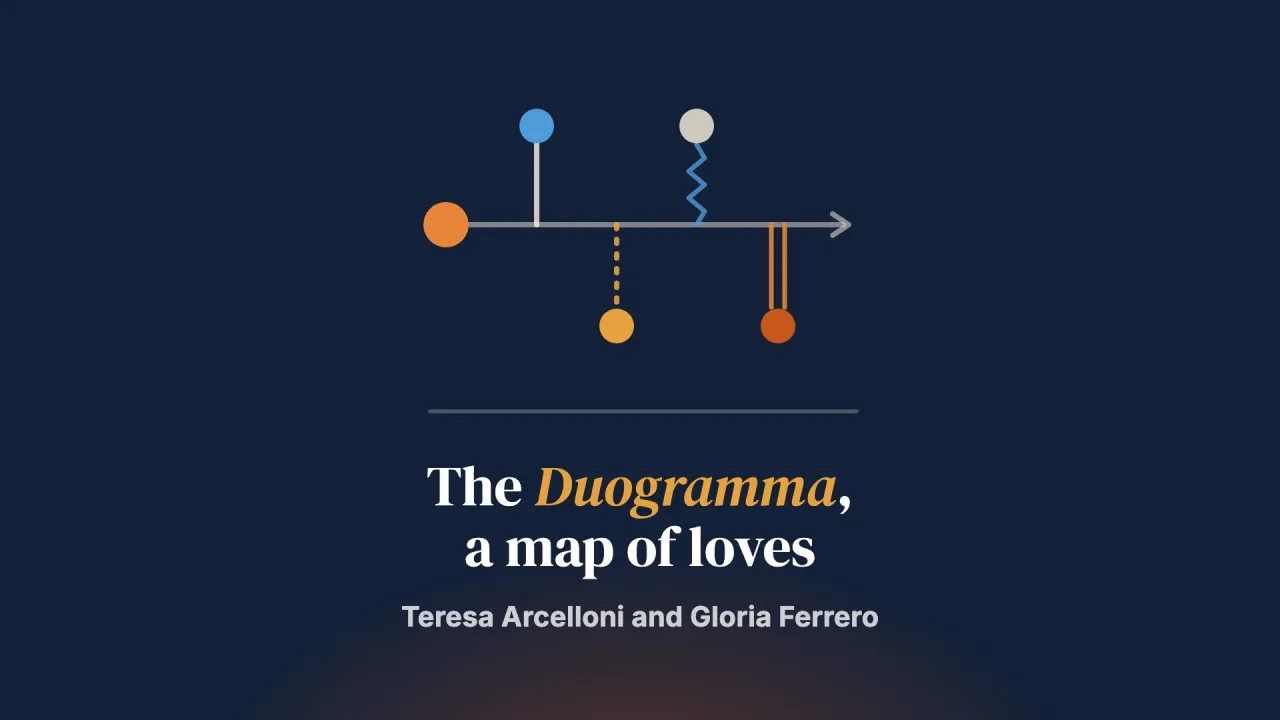 Scientific
The Duogramma®: An innovative methodology for psychotherapy
A map of the couple relationships lived, desired or rejected since childhood: the Duogramma®, its graphic rules and its use in individual therapy.
 Blog
Challenging in therapy: What a patient taught me
A couples therapy session led me to reflect on confrontation, authenticity and resonance: how to address difficult behaviour without invalidating the person.
 Scientific
Digital Co-Regulation and Dysregulation in Romantic Relationships: A Systemic Model of Technology-Mediated Emotional Processes
Checking, chasing, blocking: 31 interviews show how the phone regulates or dysregulates a couple’s anxiety, with a systemic model of the loop.
 Scientific
“One Can Have All Sorts of Good Intentions but Sometimes in Everyday Life, It Turns Out Differently”: Change Agreements in Couples' Everyday Lives
Six Danish couples followed after an online couple program: their change agreements become guilt-inducing contracts, shared understanding or revealers of inequality.
Comments 0
Log in to join the discussion. Log in