Journal of Solution-Focused Brief Therapy · Interview
Not all who wander are lost: Wandering and wondering in the Solution-Focused world. An interview with Frank N. Thomas
Michael Durrant, founder of the Brief Therapy Institute of Sydney and first Editor of the journal, interviews his friend of twenty-five years Frank N. Thomas, Professor at Texas Christian University and official Archivist of the Solution-Focused Brief Therapy Association. From South Dakota in 1967 to the preservation of the Brief Family Therapy Center tapes, by way of a disastrous first encounter with Steve de Shazer, this is the path of a man who says he built his academic career by wandering and wondering — and who asks, at the end, how a tradition can be kept alive without being frozen.
This is the original article Not all who wander are lost: Wandering and wondering in the Solution-Focused world. An interview with Frank N. Thomas, by Frank Thomas and Michael Durrant, published in Journal of Solution-Focused Brief Therapy, vol. 1, no. 2 (2014), doi: 10.59874/001c.75105, under a CC BY 4.0 licence. Republished by Complexe Systémique: the authors’ text is unchanged, except that the four-line epigraph from Tolkien is not reproduced (see the note below); the layout has been adapted and section headings added for reading online.
Who is Frank Thomas — introduced by Michael Durrant
Dr. Frank Thomas is Professor of Counseling and Counselor Education at Texas Christian University in Fort Worth (Texas, US). He is also official Archivist for the Solution-Focused Brief Therapy Association. Frank and I have been friends and colleagues for nearly 25 years, co-presented at international conferences and written book chapters and professional articles together. I endorsed his latest book, Solution-Focused Supervision: A resource-oriented approach to developing clinical expertise (2013, Springer), describing it as “THE most significant Solution-Focused book of the past 10 years.” Frank is also an Associate Editor of JSFBT.
Complexe Systémique — on the epigraph
In the journal, the interview opens with four lines by J. R. R. Tolkien from The Fellowship of the Ring (1954), from which the title is taken: lines about what is valuable without glittering, and about wandering that is not being lost. Still in copyright, they are not reproduced here.
I have built my career as a member of the academy by wandering and wondering.
Frank N. Thomas
Looking after people, before knowing why
You have a long history in pastoral care, youth work and various versions of “looking after people.” What were the driving forces in your early work with people?
You’re the first person to ever ask me this question, Michael — ever! — so gathering my memories will bring some new insights, I believe. Some expected influences come to mind including family, Scouting, church and service projects in my community. My parents were quiet about their benevolence toward others, which fit their humble Scandinavian heritage. But one impactful incident that informed my “looking after people” comes to mind, a story worth telling:
In 1967, the “Jones” family — an African American man from the eastern USA, his white wife and their infant daughter — moved to my home town of Sioux Falls, South Dakota. He had been hired at my junior high school to teach “shop” (woodworking, metalworking, electronics and so on). They moved into a house one street over from us and somehow my mother learned of their plight: several childcare businesses had refused to take care of their daughter, so the mother could not seek employment. My mother also learned that this family had been petitioned out of two neighbourhoods prior to purchasing their home because of their cross-racial marriage and “mixed” child. With her fifth child finally in school, my mother had her days free for the first time in 16 years … but she (with my father’s agreement, I’m sure) decided to approach this couple and offer to care for their infant. She only asked one favor; that Mr Jones take me to school each morning.
This was the same year of the famous US Supreme Court case Loving v. Virginia (2015), which (finally) ended all state laws that prohibited or restricted race-based marriages. Witnessing my mother’s act of bravery and kindness still influences my passion to serve nearly 50 years later. Although the Jones’ left South Dakota at the end of the school year, I got a first-hand education in race (from Mr Jones) and justice (from my mother) that still fuels me.
What was the route from these Sioux Falls high school lessons to growing up to become a therapist?
My dedication to justice and becoming a psychotherapist continued during high school and into college. Counsellor (and lifeguard) positions at summer camps the last two summers prior to college plus the summer following my first year at the University of South Dakota solidified my dedication to helping others by affirming my gifts. My commitment to becoming a mental health professional grew and I had mentors — faith-based and academic — who encouraged me toward the helping professions of social work and pastoral counselling.
So, you began your career as a pastor but ended up a therapist?
I chose a pastoral ministry path after receiving my undergraduate degree in sociology and social work. But I didn’t feel as though I was fulfilling my potential working as a pastor in local churches after graduation with my master’s degree. I felt I could be more influential in the university as a professor and supervisor but what surprised me was that my interests had formed around family therapy rather than counselling or social work. One thing led to another and the final outcome was a marvellous educational and clinical learning experience at Texas Tech University leading to a doctoral degree. Doors opened and I’ve been teaching psychotherapy in various institutions and contexts for nearly 30 years.
“One of the strangest people I’d ever encountered”
When were you first exposed to the Solution-Focused (SF) approach?
I met Steve de Shazer at an AAMFT1 conference being held in New York City in the mid-1980s and I thought he was one of the strangest people I’d ever encountered. He was trying so hard to introduce himself to people at a gathering that he honestly appeared to be selling a product no one wanted! When he walked away from me, I tossed his business card aside. Later in the week I told my professor, Bradford Keeney, about this strange fellow I’d met. After describing him, Brad said, “That’s got to be Steve de Shazer. I wrote one of the introductions to his first book; John Weakland wrote the other one. When you get back to Texas, you need to read it.” So, I did (because when a professor directs you to read something, you do!) — I ordered Patterns of Brief Family Therapy (de Shazer, 1982) and read it a few days after it arrived. And was I impressed!
This initial exposure grew into a commitment to the SF approach that now spans four different decades. I had the privilege of being asked by Steve to be a Founder of the SFBTA Academy, an initial gathering of SF professionals in North America he believed should be tasked with continuing the SF tradition. Founders included Peter De Jong, Yvonne Dolan, Heather Fiske, Dan Gallagher, Josee Lamarre, Teri Pichot, Joel Simon, Lance Taylor, Terry Trepper and others who made significant contributions to SF in North America. So you can see that my initial impressions of Steve, and SF, changed drastically from my first encounter with him in New York.
How did the approach fit with what was already important to you?
Steve’s systems/interactional approach was very close to my own at that point in time. Having studied with Brad Keeney, cybernetics was my primary theoretical lens. Steve had a remarkable ability to distil very complicated systemic/interactional ideas into clinically relevant and applicable forms. I was already quite adept at applying the MRI/interactional model under the tutelage of Brad, Monte Bobele and others at Texas Tech University. Steve had studied at MRI, and his mentor was John Weakland, who introduced Insoo and Steve (Cade, 2007). In fact, the origins of the Berg/de Shazer approach were interactional, not Solution-Focused: “We just wanted to be in the forefront of thinking in the family therapy field. We wanted to be the MRI of the Midwest and provide the very best training possible for the next generation of family therapists … Looked at in one way, (we) could say this all happened by accident” (Nunnally, de Shazer, Lipchik, & Berg, 1986; c.f. Cade, 2007). So it was an easy step from MRI/interactional to early SF, as they were sister approaches.
How did the approach make a difference to you?
Change toward a more SF approach took a few years to coalesce. Although I liked Steve’s directions from interactional to SF, there was little support in my doctoral program for SFBT. My clinical work at Texas Tech continued to be structural-strategic and MRI/interactional because of the teams with whom I worked — no one else was practicing SF. After graduating from Tech I directed an outpatient therapy clinic associated with a psychiatric hospital in 1988-89. There I found some like-minded professionals who wanted to learn SF together. So for more than a year this wonderful SF group thrived in Arlington, Texas. People I still admire as SF professionals — Tom Lee, Tracy Todd, Tom Chancellor, and others — dedicated time to work as a team with a one-way mirror to learn the SF approach. We spent hundreds of hours seeing clients and discussing cases, refining our skills and supporting one another’s learning. My dedication to the SF approach began with this skill-building experience and I continue to learn through teaching and training others as well as psychotherapy practice and supervision.
What the approach changed: the practice, then the academy
How has SFBT made a difference to how your practice as a therapist has developed?
The most significant difference SF had on my practice development came from its emphasis on exceptions and resources. In my clinical work in the 1970s and 1980s, I applied first-order systems models. These were the tools of the times for family therapy and all are practiced today. But I yearned for something less expert-centred, less instrumental, and I found it in the SF approach. Following in your tradition, Michael, I say I practice “Frank Therapy” — I cannot duplicate another’s style because I believe we bring biases and knowledge to our work that reflect who we are and what we value. But my core philosophical stance toward psychotherapy is based on systems thinking and SF assumptions: the ripple effect is possible (change leads to more change), interaction creates reality, relationships are generative, observing is more important than interpreting and curiosity drives inquiry.
What have been the particular challenges that your commitment to SFBT have raised in your practice as a therapist?
I’m sure my challenges parallel those of most SF practitioners, only I don’t make a living doing psychotherapy, so they don’t impact me in the same way. The most common experience we run into is the need for constant referrals! My median number of sessions over the past 25 years is about six, which is fewer than half of most of my non-SF colleagues, so my referral stream is constantly in need of tributaries. Most people come to me via one of two sources: professional colleagues and client word-of-mouth. Referrals from the latter category are particularly interesting to me because many clients make their way to my office after horrible experiences with other therapists and therapy approaches. “My last therapist told me I was XYZ (diagnosis) and needed medication (even though the therapist had no medical credentials)” and “S/he told me to (get divorced, leave my family, join AA)” are the most common things I hear from clients who have had negative therapy experiences. I know about clients’ negative experiences in therapy because I ask (Norcross & Wampold, 2011)! And I continue to be amazed by the pseudo-expertise floating around the therapy community. Professionals give advice and dictate what clients must believe, change, or do in order to bring resolution to their difficulties but pay little attention to client feedback and resourcefulness. So many challenges within my practice are tied to the barriers previous therapy has erected for clients by the very professionals who tried to help them.
Another interesting challenge comes from the influence of the media. I constantly have clients who bring Oprah or Dr Phil into the room: “The other day on (television show, podcast, website) I heard/read about this disease/diagnosis and I think I might have it.” Even clients who are experiencing more and more instances of their preferred future and moving up their personal scales of positive change can be side-lined by pop cultural references or experts selling books on syndromes and disorders — advertising works. I even have clients who seek out Skype or email consultations between sessions: “I didn’t want to bother you so I contacted this website and learned …” So, exchanges like these can be trying and even derail progress the clients report. However, the good news is that SF as an approach is remarkably resilient! Even when clients encounter debilitating information that gets them off-track, I respectfully request that we return to our agreed-upon collaborative directions to see if we can continue to make headway in spite of barriers that appear on their road to change. Almost all of the time, clients prefer positive change over oppressive information suggested by other sources and I believe this preference is reinforced by positive and responsive therapeutic relationships.
How has SFBT made a difference in how your practice as an academic has developed?
I have built my career as a member of the academy by wandering and wondering. Unlike many successful colleagues who have laser-like focus in their scholarly activities, my path has taken many, many interesting trails. I have published and presented on a wide variety of topics outside the SF realm including cybernetics, family therapy with substance abuse, marital therapy, weight control, therapist self-care, ethics, pedagogy, pastoral care, ethnography/qualitative research, humour, spirituality, justice and counselling interventions. I’ve been most fortunate to be able to follow my curiosity, write on what interests me and collaborate with colleagues I admire from many walks of life.
However, the majority of my presentations and publications have been focused on SF approaches. My scholarly activities have concentrated on SF and other postmodern approaches for about 25 years including books that I believe have been significant contributions to the field (Malinen, Cooper, & Thomas, 2011; Nelson & Thomas, 2007; Thomas, 2013; Thomas & Cockburn, 1997) and having the privilege of presenting more than 230 workshops across five continents. My teaching has been guided by SF principles as well as I attempt to build relationships with students centring on competence and collaboration. I will be forever indebted to the SF community for creating opportunities within which I have learned and contributed. From my initial professional presentations on SF supervision (Thomas, 1990) and my first SF publications (Thomas, 1994a, 1994b) to today, I have found the SF community of professionals to be supportive of innovation and open to alternative voices.
What have been the particular challenges that your commitment to SFBT have raised in your practice as an academic?
I’ve found the academy to be an open, inquisitive body. University colleagues and administrators have always been supportive of my scholarly activities and research including my forays into the SF world. Research support for SF practices has grown exponentially the past several years (Franklin, Trepper, Gingerich & McCollum, 2012) but novelty has always been welcomed at the institutions within which I’ve instructed and served. Texas Tech University was fertile soil for innovative thinking and practice in the world of family and interactional therapy. I was privileged to teach and learn with some of the finest family therapists in the country while at Texas Woman’s University and it was during this 12-year period I began to collaborate with SF thinkers including you, Thorana Nelson, Jack Cockburn, John Wheeler, Dvorah Simon and others to whom I am indebted. Finally, the primary approach we teach in our counselling program at Texas Christian University (TCU) is SFBT, with a heavy emphasis on systems thinking and resourcefulness. Becky Taylor created the program and approached me a decade ago to join what has turned out to be a top-flight investment in the lives of professionals at the master’s and doctoral level. My TCU deans have supported the work of the SFBTA Archive (see below) by assigning assistants to this project year after year, all at TCU’s expense. So … as you can see, the challenges have been few but the rewards, many.
Here in Australia, SFBT is widely used by practitioners but is not widely embraced within academia, it is viewed with scepticism within most university departments — thus, most Solution-focused therapists do not learn the approach within university study. It sounds like your experience is very different from this.
Yes, you’re right. SFBT has influence inside and outside the academy. It has roots within educational institutions here in the US and has also thrived through training centres. People like Peter De Jong (Calvin College), Cynthia Franklin (University of Texas/Austin), Mo Yee Lee (The Ohio State University), Eric McCollum (Virginia Tech University), Johnny Kim (University of Denver) and others are known for their commitment to SFBT practice and research, building their careers around the approach within the US academic world. I have been granted tenure at two prestigious universities and taught at an accredited theological seminary over the past 25 years while committing a great deal of my scholarly activity and teaching to the SF approach, so my own professional trajectory has been tied to the prominence of SF as a legitimate academic pursuit.
I believe Solution-Focus’ research base has established itself to the point that it is questioned on philosophical grounds of bias more than on grounds of academic rigour or validity as a treatment “model.” The work of Gingerich (Gingerich & Eisengart, 2000), Franklin and her colleagues (Franklin et al., 2012) and front-line researchers like Lee (Lee, Sebold, & Uken, 2003) have elevated SF in many clinical academic programs. Also, my experience is that most academic programs teach SFBT as a legitimate option for mental health professionals. It is not just trainers on the workshop and professional development circuit who promote the approach; professors, lecturers and supervisors support budding clinicians as they develop clinical skills and apply the SF approach in various psychotherapy graduate education settings and training contexts.
“The coaxing of expertise”: supervision
When I think of your work, the particular contribution that most comes to mind is your work over many years developing ideas about Solution-Focused Supervision. How did this become such a large area of interest?
I’ve searched and re-searched my personal (memory) and digital (computer) recollections and have come to this conclusion: the majority of my applications of SFBT have been therapy-plus-supervision. From the behind-the-mirror team learning experiences at Willow Creek Adolescent Center in the late 1980s to my current work at TCU, I don’t separate counselling practice from supervision. I had not read Joe Wetchler’s (1990) article on SF supervision — the first SF supervision publication — until after I had already created a presentation on the topic and begun teaching this (what I thought of as a) unique approach to mental health counselling supervision (Thomas, 2013, 2012, 1996, 1994b, 1992, 1990). Since my first presentations, I have scrutinized our profession’s literature for conceptual and research publications related to SF supervision. This remains a commitment of mine, to track SF supervision developments because … well, if I don’t, who will? “Acquire, preserve and catalogue” is the archivist’s mantra and this attitude has spilled over from the SFBTA Archive to a few of my own professional interests and research/writing pursuits.
The appeal of and my commitment to SF supervision is tied to the field of supervision in general. Most attributing value to supervision for mental health professionals do so with little research support of their conclusions. Our commitment to this long-standing learning practice is more philosophical than anything, as there is meagre support for (any type of) supervision having value for clients (Freitas, 2002). Training in SFBT leading to effective practice without ongoing supervision has some research support (Ferraz & Wellman, 2009) and is probably the most common learning scenario for SFBT practitioners throughout the world. I’m hoping colleagues will continue to examine the supervisor-therapist-client connection, even though the research methodologies are usually complex (see Freitas, 2002) and if someone is interested in teaming up for a study … contact me!
Your 1996 chapter on supervision was titled “Solution-Focused supervision: The coaxing of expertise”. The four words after the colon have always struck me as rich with meaning. Could you unpack them a little?
Choosing a phrase that would suit how I was thinking about SF supervision back then was agonizing! This title was the best I could come up with for my first presentation in 1990 and it still fits today. My supervisory collaborations with therapists are not “mining” (trying to locate or discover things inside the therapist or her history); instead, my stance is one of curiosity. Creating space for therapists to speak forth their thoughts leads to safe conversations. And even though some supervision moments must [be] very directive and/or didactic (pointing out what the law requires of the therapist, for instance), most of these SF supervision conversations draw forth moments of and reflections on successes and competence.
It’s important for me to coax forth experiences of expertise. For me, to coax is not to persuade; my use of the word “coax” parallels terms like encourage, bring forth, prompt or even provoke. In a follow-up interview I conducted years ago (Thomas, 1994a), a client once told me this: “You believed in me before I believed in me.” That is what I want to communicate to therapists: I trust you have deliberate ways of thinking and acting that support client change and I want to hear about in-session experiences that corroborate your developing expertise.
One of the ways I love to supervise is sitting with the therapist and client(s) — not behind a one-way mirror or watching via video/audio link, but right in the room (see Lane & Thomas, 2013 for a description of how this can be organized). In the last few minutes of this supervisory consultation time I often interview the client regarding what the therapist did well (staying within the SF tradition). This feedback process is almost always well-received by clients and therapists alike. With the therapist in the room, witnessing our conversation, clients inform me about how their therapists have been effective and how clients make sense of these moments of success. I ask:
- What did your therapist do today that you found helpful?
- What do you think this says about your therapist?
- What do you think this says about your relationship with your therapist?
When reflecting with therapists after the clients have responded to these questions and left the room, practitioners almost always report a positive impact — they are excited to hear how they have cooperated with and encouraged client change and ready to discuss how they might nurture these practices in the future. Although some in our field believe therapists’ contributions to client change should be de-emphasized (“the client is the expert” taken to an extreme, limited therapist self-disclosure, de-valuing the importance of the therapist-client relationship, and so on), clients share credit (Furman & Ahola, 1992) with little prompting — they experience change as the result of the SF collaboration and highly value the person and expertise of the SF practitioners they see. This practice of including the client in the supervision process is yet another way I coax expertise.
The SFBTA Archive: preserving Milwaukee
You have been appointed as “official Archivist” by the Solution-Focused Brief Therapy Association. What does your role as SFBTA Archivist involve?
The SFBTA Archive (preserving the Brief Family Therapy Center of Milwaukee) was created by the Solution-Focused Brief Therapy Association of North America. Insoo Kim Berg and Steve de Shazer left all of their professional items and heritage to SFBTA and Insoo’s daughter, Sarah Berg, has been highly supportive of our endeavour. My role as Archivist is to solicit, collect, archive, and safeguard materials directly connected to BFTC. I work with the SFBTA Archive Committee and Board to meet these Archive objectives and they have been wonderfully innovative and supportive.
What is included in the Archive?
So far, my assistants and I have archived hundreds of items including video and audio recordings (and some transcriptions), photographs, publications, unpublished manuscripts, training and presentation handouts, promotional materials and correspondence. We hope to solicit even more items by continually reminding SF professionals that once something is thrown away, it can’t be retrieved. (Readers: please check out your own filing cabinets and hard drives for items you’d like to contribute to the Archive!)
Somewhere, I have a scribbled note that says, “Received from Michael Durrant, teaching fee of $200 plus one beer, [signed] S de S”. Is that the kind of thing you would want?
Absolutely! Scan it (300 dpi minimum) and send me the PDF or JPEG! Preserving the BFTC is so much more than documents and videos — it is an effort to capture as much of the ethos as we can. Steve and Insoo corresponded with hundreds of people around the world and I am certain many letters, faxes and emails are hidden in office file drawers, boxes or electronic storage devices. People have photographs of Insoo, Steve and other original BFTC team members that could be scanned, preserved, and shared. One of my projects is to acquire stories — people’s favourite recollections of SF founders as well as current perspectives on the impact the SF originators had on them. If in doubt, preserve what you have and contact me! (Thanks for allowing the Archive plug!)
How (or how do you hope) the Archive will benefit the SF community?
With the 10th anniversary of Steve’s death approaching in September 2015, the Archive Committee and I are working toward a website launch to honour him, Insoo and the BFTC. We hope to make the Archive accessible while protecting the confidentiality and maintaining dignity for all. What we plan to roll out initially are videos of SFBTA Founders and colleagues who were close to Insoo and Steve, videos of Steve and Insoo that have not been made available to the professional public, unpublished manuscripts, photographs, and other items of interest to those who are attracted to the history of SFBT. I’m also committed to progressive rollout of Archive materials — rather than put everything on the Internet at once, I hope we can lure people back to the website time and time again by periodically posting items, stories, videos, and photos. This Archive is a preservation but it is also a process, offering elements from our past and encouraging future contributions. History is continuous re-collection!
I know that you have analysed Insoo’s supervision style using some of this archival material. Will any of the archive material be available to people conducting research in SFBT?
The SFBTA Board and Archive Committee are committed to protecting client confidentiality, so most Archive videos will never be available to the public or the profession. Research with any materials involving therapy clients will be very restricted (if it is allowed at all) and some of this spills over into video recorded supervision and team conversations. A major Archive project I am conducting now, with the able assistance of my TCU teaching assistants, is to identify all video recording segments that have no identifiable information or images of clients. These segments will then be reviewed by the Archive Committee to assure client confidentiality and the dignity of all involved. My hope is that many segments will then be made available for viewing within the SF community for learning and research. In addition, I will post my personal supervision presentation handouts, some transcripts and unpublished manuscripts related to Insoo’s supervision and consultation style via the website.
Neither frozen nor diluted: the future of the approach
At the Australian & New Zealand Solution-Focused Conference in 2013, your keynote address was called “Something old, something new, something borrowed … something true” and you looked at the path trodden by SFBT (where we had come from) and possible future paths for the approach. How do you see the future of Solution-Focused work?
My colleague Cynthia Hansen and I spoke about this in Milwaukee at the 2014 AAMFT Conference, within which an entire day was dedicated to SF and the contributions SF has made to the field of family therapy (Thomas & Hansen, 2014). Many of my heroes were in the audience that day for our plenary, including Eve Lipchik, Wally Gingerich, Gale Miller and others who blazed the SF trail … our future is dear to my heart.
Mark McKergow (2014) has written a wonderful little piece on what he calls “key new developments” (p. 36) in SF practices. These developments-as-shifts — from exceptions to the problem to instances of client preferred futures, from therapist-centred tasks and suggestions to client resources and from questions toward additional conversation tools — describe a SF approach that is much, much different from the SF approach as it was originally created in Milwaukee. This is in step with the tradition Gale Miller and Steve de Shazer encouraged in their article on “SFT as a rumor” (1998; c.f. Miller, 2013) in which they encourage creativity among writers and practitioners while requesting commitment to the central ideas that have long informed SF. Gale and Steve say there is no metanarrative about SF — it is formed, in-formed, and re-formed in each conversation, constantly changing with each SF interaction. Their only recommendation is, “that Solution-Focused therapists and others who hear different versions of the Solution-Focused rumor ask two questions … How is Solution-Focused therapy defined within the stories; what is it that the stories are about? And, do the stories offer adequate descriptions of how Solution-Focused therapy is done?” (p. 377). To quote an often-cited SF tenet, change is inevitable … for clients, for practitioners and for the SF approach.
SF today isn’t the SF of the founders, as deifying would lead to its demise; at the same time, we who have had the privilege of practicing SF approaches and living within the highly dedicated global SF community have the responsibility to sustain the traditions, ideas and memories that make SF practices so exceptional.
A final word of thanks to you, Michael, for all your efforts to support SF and promote it throughout the world … you (along with Michelle Weiner-Davis) were also plenary speakers at AAMFT in Milwaukee. We are all in your debt.
Finally, you say that trying to maintain the SFBT of Steve and Insoo (the risk of deification, you say) would be fatal. Can you make some comments about the reverse of that? As you gaze over a wealth of SF material, do you think there is a risk that some will begin to dilute or obscure the things that really are fundamental to this approach?
Your question is prescient and very important for all in the SF community to consider and discuss. If SF is a postmodern approach (of which I am convinced) and postmodernism as a philosophy avoids essentialism (e.g., necessary practices and/or ideas), how are we to continue the SF tradition without restraining its obvious evolution? Attempts to promote and preserve the SF approach continue through global and regional professional associations, conferences, training centres and manuals, research protocols and professional publications (including JSFBT). But I don’t believe it’s possible to identify or claim what is and is not Solution-Focused without locating it within a context and time. Few well-read SF professionals would identify their current ideas and practices with de Shazer’s early writings. I doubt many of us design and assign between-session tasks according to client response tendencies; even fewer of us practice SF as a forced-choice decision tree; and I doubt the majority of those who practice SF take literal breaks before closing a session. Few leaders in the SF profession label clients as customers, complainants, or visitors anymore and several respected SF trainers and authors have even rejected “the questions” — miracle, exception, and others — as essential to SF practice. So, if we don’t enshrine a frozen-in-time set of notions and customs as “this is SF” but still want the tradition to endure, what are our options?
My views are influenced by founders, sages, manuscripts, experiences and critical thinking. As our principal founders, Steve and Insoo, remain my primary informants. I’m able to privilege them and their work because I have so much to draw from compared to nearly everyone in the SF field — the Archive is a treasure chest! But other sources inform me and how I envision SF’s future. Sages like Eve Lipchik, Gale Miller, Brian Cade, Andrew Turnell, Mark McKergow, you, and others remind me to appreciate and anticipate — appreciate our common bond and anticipate change. Gale Miller’s (2013) article on his imagined SF futures is a wonderful example of critical thought regarding the inevitability of change in SF practices. SF has never been and can never become static — entropy is the only possible outcome for approaches entrenched in the past. But “anything goes” cannot apply either. I like the idea expressed by Bertrand Russell (2014): “Liberty is the right to do what I like; license, the right to do what you like.” The current forms of SF should be informed by collaboration among professionals who honour our heritage and seek to create with “license” — we should work toward agreement rather than going solo. What works should be preserved; if it doesn’t work, we should stop doing it and do something different(ly). We (together) ought to be dedicated to what I believe are central SF ideas and actions as SF evolves, such as working from observation rather than from hypotheses, building solutions clients desire rather than goals imposed by helpers, maintaining a future focus, creating solutions in concert with client resources and honouring client expertise and seeking to avoid pathologising and pejorative practices. Risk is unavoidable … but so is reward! My friend, the late Heinz von Foerster, once stated what he called The Therapeutic Imperative: “If you want to be yourself, change!” (von Foerster, 1990). If we want a vibrant, viable SF that is true to our traditions … we must change!
Note from the original
1. American Association for Marriage and Family Therapy.
References
Cade, B. (2007). Springs, streams and tributaries: A history of the brief, solution-focused approach. In T. S. Nelson & F. N. Thomas (Eds.), Handbook of solution-focused brief therapy: Clinical applications (pp. 25–63). Binghamton, NY: Haworth.
De Shazer, S. (1982). Patterns of brief family therapy: An ecosystemic approach. New York: Guilford.
Ferraz, H. & Wellman, N. (2009). Fostering a culture of engagement: An evaluation of a 2-day training in Solution-Focused Brief Therapy for mental health workers. Journal of Psychiatric and Mental Health Nursing, 16, 326–334.
Franklin, C., Trepper, T. S., Gingerich, W. J. & McCollum, E. E. (Eds.) (2012). Solution-Focused Brief Therapy: A handbook of evidence-based practice. New York: Oxford University Press.
Freitas, G. J. (2002). The impact of psychotherapy supervision on client outcome: A critical examination of 2 decades of research. Psychotherapy: Theory/Research/Practice/Training, 39(4), 354–367.
Furman, B. & Ahola, T. (1992). Solution talk: Hosting therapeutic conversations. New York: W. W. Norton.
Gingerich, W. J. & Eisengart, S. (2000). Solution-Focused Brief Therapy: A review of the outcome research. Family Process, 39, 477–498.
Lane, D. H. & Thomas, F. N. (2013). Live supervision-of-supervision: Lessons learned the hard way. In F. N. Thomas, Solution-focused supervision: A resource-oriented approach to developing clinical expertise (pp. 204–215). New York: Springer Science + Business Media.
Lee, M. Y., Sebold, J. & Uken, A. (2003). Solution-focused treatment of domestic violence offenders: Accountability for change. New York: Oxford University Press.
Loving v. Virginia: The case over interracial marriage. Retrieved March 9, 2015 from https://www.aclu.org/racial-justice/loving-v-virginia-case-over-interracial-marriage
Malinen, T., Cooper, S. J. & Thomas, F. N. (Eds.) (2011). Masters of collaborative and narrative therapy: The voices of Tom Andersen, Harlene Anderson, and Michael White. New York: Routledge.
McKergow, M. (2014, Nov/Dec). Going further with Solution-Focused work: Flexible tools, new paradigms, refined practice. Family Therapy News, 35–37.
Miller, G. (2013). Readers matter: Reading practices and the future of Solution-Focused thought and practice. International Journal of Solution-Focused Practices, 1(1), 3–9.
Miller, G. & de Shazer, S. (1998). Have you heard the latest rumor about …? Solution-Focused therapy as a rumor. Family Process, 37, 363–377.
Nelson, T. S. (2005). Introduction: The birth of the Solution-Focused Brief Therapy Association. Journal of Family Psychotherapy, 16(1/2), 1–2.
Nelson, T. S. & Thomas, F. N. (Eds.) (2007). Handbook of Solution-Focused Brief Therapy: Clinical applications. Binghamton, NY: The Haworth Press.
Norcross, J. C. & Wampold, B. E. (2011). What works for whom: Tailoring psychotherapy to the person. Journal of Clinical Psychology: In Session, 67(2), 127–132.
Nunnally, E., de Shazer, S., Lipchik, E. & Berg, I. (1986). A study of change: Therapeutic theory in process. In D. E. Efron (Ed.), Journeys: Expansion of the strategic-systemic therapies (pp. 77–96). New York: Brunner/Mazel.
Russell, B. (2014). Retrieved March 25, 2015 from http://izquotes.com/quote/160366
Thomas, F. N. (2013). Solution-Focused supervision: A resource-oriented approach to developing clinical expertise. New York: Springer Science + Business Media.
Thomas, F. N. (2012). Solution-Focused supervision: Lessons from Insoo Kim Berg. In P. De Jong & I. K. Berg, Interviewing for solutions (4th ed.) (pp. 345–354). Belmont, CA: Thomson Brooks/Cole.
Thomas, F. N. (1996). Solution-Focused supervision: The coaxing of expertise in training. In S. D. Miller, M. A. Hubble & B. L. Duncan (Eds.), Handbook of Solution-Focused Brief Therapy: Foundations, applications, and research (pp. 128–151). San Francisco: Jossey-Bass.
Thomas, F. N. (1994a). The experience of solution-oriented therapy: Post-therapy client interviewing. Case Studies in Brief and Family Therapy, 8(1), 47–58.
Thomas, F. N. (1994b). Solution-oriented supervision: The coaxing of expertise. The Family Journal: Counseling and Therapy for Couples and Families, 2(1), 11–18.
Thomas, F. N. (1992, October 17). Solution-oriented supervision. Annual Conference of the American Association for Marriage and Family Therapy, Miami, FL.
Thomas, F. N. (1990, October 4). The coaxing of expertise: Solution-Focused supervision. Annual conference of the American Association for Marriage and Family Therapy (AAMFT), Washington, DC.
Thomas, F. N. & Cockburn, J. (1998). Competency-based counseling: Building on client strengths. Minneapolis: Fortress Press.
Thomas, F. N. & Hansen, C. (2014, October 17). Solution-focused brief therapy and behavioral health (keynote plenary). American Association for Marriage and Family Therapy (AAMFT), Milwaukee, WI.
Tolkien, J. R. R. (1954, 1987). The fellowship of the ring (The lord of the rings, part 1). Boston: Houghton Mifflin.
von Foerster, H. (1990). Ethics and second-order cybernetics. ESF (ed.), Systèmes, éthique, perspectives en thérapie familiale. Textes issus des travaux du Congrès Système et thérapie familiale, Paris, 4–6 octobre. (English version here: http://ada.evergreen.edu/~arunc/texts/cybernetics/heinz/ethics.pdf)
Wetchler, J. L. (1990). Solution-Focused supervision. Family Therapy, 17, 129–138.
About the authors
Frank Thomas is Professor of Counseling and Counselor Education in the College of Education at Texas Christian University in Fort Worth, Texas. Previously, he was a professor and clinical graduate faculty in the Family Therapy Program at Texas Woman’s University in Denton, Texas (1989-2001) and an adjunct faculty member and clinical supervisor at TCU’s Brite Divinity School in the Pastoral Counseling and Theology Program (1995-2007). A licensed marital and family therapist, Frank also maintains a private practice in Fort Worth.
Email: f.thomas@tcu.edu
Michael Durrant is Honorary Associate in the Faculty of Education and Social Work at the University of Sydney, Director of the Brief Therapy Institute of Sydney and Editor of this journal.
Email: michael@briefsolutions.com.au
Original article Not all who wander are lost: Wandering and wondering in the Solution-Focused world. An interview with Frank N. Thomas, by Frank Thomas and Michael Durrant, published in Journal of Solution-Focused Brief Therapy, vol. 1, no. 2 (2014), doi: 10.59874/001c.75105, under a CC BY 4.0 licence. Republished by Complexe Systémique, September 2026, with the changes set out at the head of this page.
This is the original article “Not all who wander are lost: Wandering and wondering in the Solution-Focused world. An interview with Frank N. Thomas”, published in Journal of Solution-Focused Brief Therapy (2014) under a CC BY 4.0 licence. Republished by Complexe Systémique: the author’s text is unchanged; only the presentation has been adapted for reading online, as set out at the head of this page.
Read the original articleHow to cite this article
Thomas, F. N., & Durrant, M. (2014). Not all who wander are lost: Wandering and wondering in the Solution-Focused world. An interview with Frank N. Thomas. Complexe Systémique. https://app.complexe-systemique.com/en_GB/articles/not-all-who-wander-are-lost-an-interview-with-frank-thomas (Original work published in 2014 in Journal of Solution-Focused Brief Therapy, vol. 1, n° 2; republished in 2023 by Journal of Solution Focused Practices, https://journalsfp.org/article/75105)
To go further
- Confessions of an Unashamed Solution-Focused Purist: What Is (and Isn’t) Solution-Focused?The answer that the interviewer, Michael Durrant, would give two years later to the question Frank Thomas leaves open.
- From School Psychology to Disaster Recovery: A Journey of Encountering Resilience and Continually Being Surprised by Peoples’ Own Solutions. An Interview With Cynthia K. HansenThe colleague with whom he gave the 2014 Milwaukee plenary, also interviewed by Michael Durrant.
- Horses, Histories and Futures: Some Thoughts on the Evolution of Solution-Focused Brief TherapyGale Miller’s piece on the futures of the approach, which Thomas holds up as a model of critical thought.
Related training courses
 Certifying course
Training in Systemic Therapy and Interventions – Cycle 1
Certifying training cycle in systemic therapy and interventions – year 1. Courses, supervision and practice, aligned with EFTA/SFTF. In French.
 Certifying course
Training in Systemic Therapy and Interventions – Cycle 2
Certifying training cycle in systemic therapy and interventions – year 2. Clinical complexity, supervision and practice. EFTA/SFTF aligned. In French.
 Certifying course
Training in Systemic Therapy and Interventions – Cycle 3
Certifying training cycle in systemic therapy and interventions – year 3. In-depth intervention, supervision and practice. EFTA/SFTF aligned. In French.
 Certifying course
Training in Systemic Therapy and Interventions – Cycle 4
Certifying training cycle in systemic therapy and interventions – year 4. Clinical integration, supervision and certification. EFTA/SFTF. In French.
Related articles
 Article
 What if the shortest path to change ran through a joyful detour?
Humour in therapy is not a gimmick but a clinical skill: it loosens the loops, reframes without wounding and reopens the field of possibilities. With its ethical safeguards and a concrete toolbox.
 Article
 The therapy wars: who really has the right to treat?
Protected titles versus practitioners trained outside the university: a systemic reading of the “therapy wars”, and the real question of what minimum guarantees to demand.
 Article
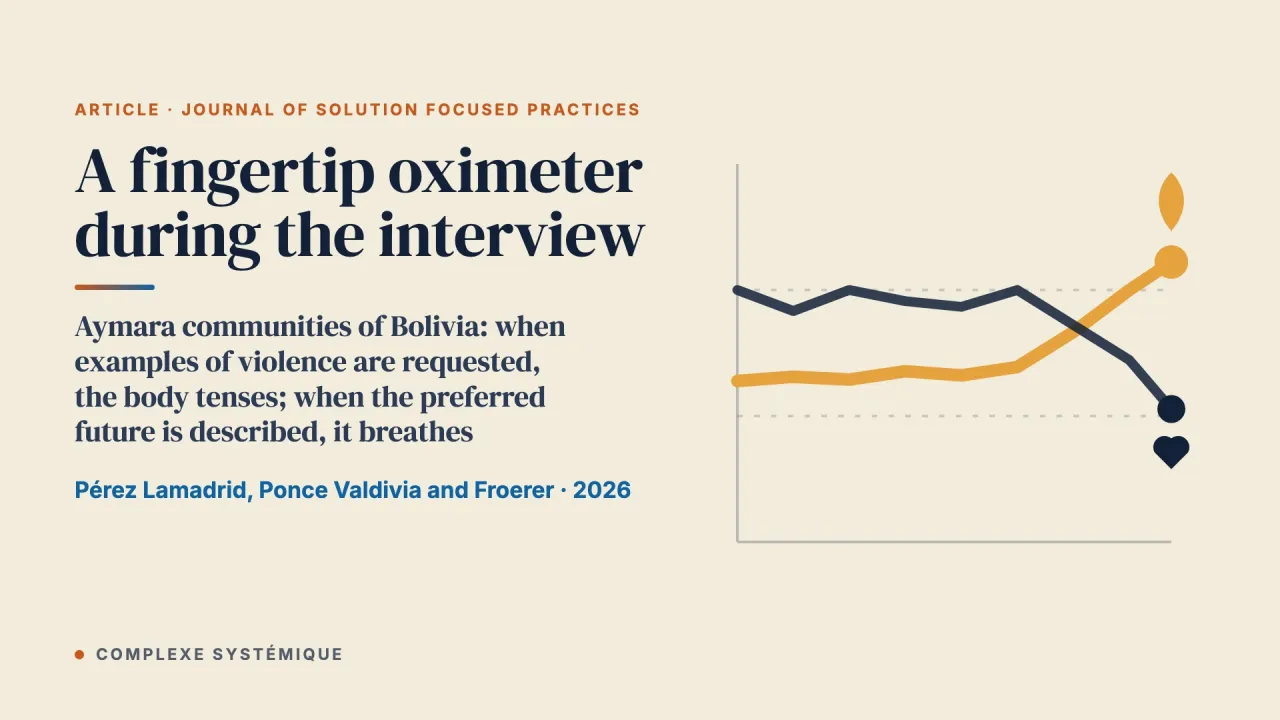
 Oxygenation and Heart Rate in Solution-Focused and Problem-Focused Interviews With Rural and Indigenous Aymara Communities (Viacha and Laja) Regarding Intersectional Violence
A fingertip oximeter on 19 Aymara people of the Altiplano: the problem-focused interview tenses when examples of violence are requested; the solution-focused one oxygenates and slows the heart.
 Article
 Putting the Hope Back In: Making the Case for Solution Focused Practice in AMHP Interventions
Sixteen English professionals in charge of compulsory admissions trained in Solution Focused Practice: time alone with the person, best hopes, more human reports. A qualitative study.
Comments 0
Log in to join the discussion. Log in