Clinical Psychology & Psychotherapy · Family
The psychosocial stressors of siblings of people with experiences of psychosis (SOPEP): A systematic narrative review across cultures
When psychosis enters a family, siblings often remain outside the scope of care. Bringing together 22 qualitative studies from five continents, Emma Izon’s team describes what siblings carry: shame, jealousy, financial strain, cultural expectations of care, but also compassion and attachment. From this it derives six areas to explore with each sibling and a list of resources for services.
This is a reformatted republication of The psychosocial stressors of siblings of people with experiences of psychosis (SOPEP): A systematic narrative review across cultures, by Emma Izon, Jerica Radez and Matthew T. D. Knight, published in Clinical Psychology & Psychotherapy (Wiley) (2024), doi: 10.1002/cpp.2921, under a CC BY 4.0 licence. Prepared by Complexe Systémique in September 2026: the authors’ text is unchanged; the layout has been adapted for reading online, which constitutes a modification of the work under the terms of the licence. Tables are presented as lists. This edition was made neither by the authors nor by the publisher, who are not responsible for its content or for any errors. The original version prevails.
The sibling bond is often the longest familial relationship in one’s life.
Emma Izon, Jerica Radez and Matthew T. D. Knight
Abstract
Objectives. This study aimed to synthesise the psychosocial stressors of siblings of people with experiences of psychosis (SOPEP). Understanding the specific needs of siblings across diverse cultures would help mental health services to provide culturally specific psychosocial family and sibling-centred support. This may result in improved relationships between families, better psychosocial well-being for siblings and better outcomes for patients.
Methods. Following PRISMA guidelines, a systematic review was conducted to explore the psychosocial stressors of SOPEP. Six databases were utilised to identify literature using qualitative methodology.
Results. Twenty-two studies were included that investigated the Psychosocial Stressors of SOPEP. SOPEP's experiences were influenced by various stages: individual factors, social factors, physical and macro-level environments. Six key components contributed to SOPEP's psychosocial stressors and facilitated or hindered their intentions, behaviours and experiences of caregiving. These were the SOPEP's beliefs about psychosis, caregiving beliefs, family and cultural values, personality traits, pragmatic challenges and access to resources.
Conclusions. Globally, SOPEP and families may benefit from their involvement in family interventions and individual support that facilitates caregiving and acknowledges their responsibilities, resources, psychosocial needs and emotional experiences.
Key Practitioner Message
- Siblings of people with experiences of psychosis (SOPEP) may need support and psychoeducation from mental health services around topics including symptom management, aetiology, social welfare and legal and financial support.
- Some SOPEP experience a wide range of complex, layered emotions. Mental health services could support them to feel less stressed, isolated and confused about the psychosocial demands as a SOPEP and feel more positive and knowledgeable in how to support themselves and their sibling.
- Services may look to incorporate cultural adaptations to SOPEP's needs, depending on their personal and social identity and the patient's stage of psychosis, for example, using simplified language and acknowledging SOPEP's beliefs and cultural expectations to explore ways to facilitate caregiving.
- Services may look to build connections with the community members (e.g., religious leaders, shamans, monks and traditional healers) to facilitate SOPEP's expectations of the caregiving role through religious support or spiritual sustenance, as well as reduce stigma, burden and promote mental health literacy.
1 INTRODUCTION
Sibling relationships - outlast marriages, survive the death of parents, resurface after quarrels that would sink any friendship. They flourish in a thousand incarnations of closeness and distance, warmth, loyalty and distrust. Erica E. Goode
This paper begins by describing the term ‘caregiving’, acknowledging those who undertake a caring role. Subsequently, the term ‘psychosis’ and experiences along the psychosis spectrum will be introduced. The authors consider cultural differences both within populations and between countries when reviewing the literature on psychosis. A summary of the key findings within psychosis literature will provide context for studying siblings of people with experiences of psychosis (SOPEP). Limitations from an earlier review will be explored, followed by the research aims of the current study.
1.1 Caregiving
A carer is someone who provides support to an individual, which includes family members living with or providing support from a distance (NHS, 2017). Caring for someone experiencing mental health difficulties may involve practical help, personal care and/or emotional support (McCann et al., 2011). Providing support may impact carers' emotionally, physically, socially and/or financially, both positively and negatively (Shiraishi & Reilly, 2019). The level of multifaceted strain perceived by caregivers over time is known as caregiver burden (Liu et al., 2020). In this paper, siblings have been referred to as carers and providing caregiving, yet it is recognised some may not consider themselves a carer (BPS, 2021).
1.2 Psychosis
Psychosis conditions affect more than 20 million people worldwide (James et al., 2018), emerging typically in adolescence and early adulthood (McClellan, 2018). The DSM-5 classification for primary psychotic disorders emphasises that these conditions occur along a spectrum, with schizoid (personality) disorder and schizophrenia defining its mild and severe ends, respectively (Arciniegas, 2015). More recently, there has been a focus in the literature on prevention and early intervention, moving from chronic conditions (e.g., schizophrenia; Severe Mental Illness) to early psychosis experiences (e.g., First Episode Psychosis, FEP; the At-Risk Mental State, ARMS). The term ‘ARMS’ describes a state that confers a high but not inevitable risk of developing a psychotic condition (McGorry & Singh, 1995).
In the process of deinstitutionalisation, the focus of rehabilitation and treatment has shifted to the community, relying on families to care for their ill family member (Kritzinger et al., 2011). A high proportion of people with experiences of psychosis live at home and are supported by their families (Izon et al., 2019). The literature recommends family interventions for people experiencing symptoms of psychosis (Claxton et al., 2017; Varghese et al., 2020). Benefits may include reduced relapse and re-hospitalisation rates and reduced levels of criticism, hostility and/or emotional over-involvement in family members (Camacho-Gomez & Castellvi, 2020; Claxton et al., 2017). Families themselves gain a sense of empowerment and enhanced stigma coping skills and can facilitate patient engagement (Ben-David et al., 2019; Izon et al., 2020).
1.3 Cultural differences
The literature exploring family members' experiences originate predominantly from western cultures, with few studies including Black and Minority Ethnic populations, who are overrepresented in rates of psychosis in many regions (Edge et al., 2016). Cultural differences may exist and influence family members' perceptions and management of psychosis, and caregiving behaviours. Considering diverse cultural traditions and values is essential to understanding families' experiences and providing acceptable and effective culturally adapted interventions (Rathod et al., 2018).
Culture decides which behaviours are acceptable and open to criticism, with variations in levels of affection and concern. Explanatory models of psychosis may include supernatural beliefs about the aetiology of the illness, seeing mental illness through a spiritual–social model, rather than biomedical. In certain cultures, people with symptoms of psychosis and their families may experience social exclusion from employment (economic exclusion), denied legal rights to vote, marry or own land (political exclusion), and be ostracised (United Nations General Assembly, 2017).
The authors recognise caregiving may be more acceptable from certain relationship types in certain cultures; therefore, these findings may vary between interpersonal relationships as well as cultures. Dilworth-Anderson's 20-year narrative review (Dilworth-Anderson et al., 2002) highlights White caregivers often cared for a spouse, whereas African American caregivers often cared for siblings, friends or extended family members. Research suggests gender differences exist, with more females taking on the caregiving role (Caqueo-Urízar et al., 2014). However, in some cultures, women provide personal care and emotional support, whilst men provide equal caregiving but focussing on financial support and transportation (Delgado & Tennstedt, 1997). In some cultures, sociological explanations emphasise the societal and cultural expectations of women to adopt the role of a caregiver. For example, Confucianism places value on women in some cultures assuming caregiver roles, regardless of other responsibilities such as having their own families (Hsiao et al., 2006).
1.4 Siblings of people with experiences of psychosis (SOPEP)
The experiences of people with psychosis may impact the whole family through experiences of emotional and economic stress and caregiver burden (Wang et al., 2017); however, research and treatment typically involve spouses and parents (Onwumere et al., 2020). The sibling relationship often provides reciprocal friendship and emotional and practical support (Bank & Kahn, 2003). Some SOPEP may have more knowledge of their sibling's difficulties than their parents (Dyregrov & Dyregrov, 2005) and take on caregiving support (BPS, 2021). In some cultures, SOPEP may be obligated to provide care for an ‘ill’ sibling and socialised to the caretaking role, as well as act as sources of support to their parents (Amaresha et al., 2014; Bowman et al., 2017). Quantitative research and the literature exploring the experiences of SOPEP and their relationship are limited (Bowman et al., 2014; Plessis et al., 2020). Psychosis-related symptoms and behaviours observed by SOPEP have been associated with psychological distress for SOPEP and conflict in family relationships (Lively et al., 2004; Plessis et al., 2020). A history of exhibiting physical violence, aggression and suicidal behaviours in individuals with FEP resulted in higher caregiver burden and lower quality of life for siblings (Bowman et al., 2014, 2017). Siblings may make sacrifices within their personal lifestyle (e.g., time with their spouse and children) to facilitate providing long-term care (Bowman et al., 2017). SOPEP providing care may encounter a wide range of complex, layered emotions, experiences of stigma, increased distress and burden (Bowman et al., 2014, 2017). However, they may experience positive emotions from providing support and companionship (Bowman et al., 2017).
Several theories conceptualise the impact of mental distress on siblings. Family systems theory asserts that family members are part of a symbiotic, dynamic family system, whereby the behaviour of each member has the capability to impact others (Minuchin, 1988). This is particularly relevant, as diagnosis of psychosis is often in late adolescence and early adulthood. Disruption to relationships for siblings during this stage of life may have significant implications, specifically to personality development, identity formation and social support (Bowman et al., 2014). For example, a lack of attention and affection perceived by siblings may result in greater empathy or withdrawal behaviours (Fleary & Heffer, 2013). SOPEP who experience difficulties in psychosocial functioning may be at high risk of developing psychosis themselves (Yung et al., 2005) and vulnerable to developing mental health problems (Bowman et al., 2014).
To understand the psychosocial needs of SOPEP and guide further practice and research, Amaresha et al. (2014) conducted a systematic descriptive review. Their review included seven studies (four qualitative; two quantitative and one mixed method study) and found that SOPEP have specific needs. The authors highlight SOPEP's desire for support from professionals for both their own psychosocial needs, as well as information of their sibling's difficulties, illness management and rehabilitation. A more up-to-date review incorporating studies across diverse cultures and across the psychosis umbrella (i.e., including ARMS and FEP) would help to inform services how best to support SOPEP's stressors and psychosocial needs across cultures.
1.5 Current study
This study focusses on qualitative studies, due to the richness and number of qualitative research papers across cultures that are identified in a relatively novel area. This narrative systematic review enabled a consolidation of descriptive themes to determine the extent to which services provide support to siblings and guide further practice and quality research with this population. With this background, we systematically reviewed studies which explored the psychosocial stressors of SOPEP. Psychosocial stressors were defined as perceived personal and social resources, including appraisals of care demands, coping styles and social support (Ownsworth & Karlsson, 2022).
1.6 Aims
- Identify studies focusing on the psychosocial stressors of SOPEP as derived from qualitative studies.
- Provide a narrative synthesis of the psychosocial stressors of SOPEP to date and assess the quality of the literature.
- Explore culturally specific psychosocial family and sibling-centred support.
2 METHODS
2.1 Search strategy
This review was conducted in line with PRISMA guidelines for reporting systematic reviews (Moher et al., 2009). The published review protocol can be found on PROSPERO https://www.crd.york.ac.uk/prospero/display_record.php?RecordID=297598.
An electronic advanced search was carried out on six databases PsycINFO, EMBASE, CINAHAL, MEDLINE, PubMed and Web of Science using search below. To reduce duplication from Amaresha et al. (2014) review and explore novel research, these searches were limited from October 2013 to February 2023, human and English language. The references in each included paper were reviewed through forwards and backwards searching, for extra relevant publications not identified in the initial electronic search.
The authors used the following search terms to be open and inclusive to any qualitative research involving a population of siblings of someone with experiences of psychosis. The authors were aware that this may result in a greater number of initial articles that required full-text searches, however, felt that this was important due to the breadth of the area. The search terms were psychosis OR psychot* OR schizo* OR early intervention in psychosis OR FEP OR first-episode psychosis OR first episode psychosis OR first episode of psychosis OR severe mental illness OR severe mental disorder AND Sibling* OR brother* OR sister* AND qualitative OR ethnograph* OR phenomen* OR ethnograph* OR grounded theory OR qualitative valid* OR purposive sampl* OR observational method* OR content analys* OR thematic analys* OR constant comparative OR field stud* OR theoretical sampl* OR discourse analys* OR focus group* OR lived experience* OR life experience* OR narrative analysis OR interview*.
2.2 Inclusion criteria
Eligible studies were original research papers, published in October 2013, in peer-reviewed journals in English. Qualitative empirical research studies and mixed-methodological studies that included a qualitative element were included. Studies involving people with ‘severe mental illness’ were required to state the diagnoses of participants and that over 50% of the sample had a psychosis cluster diagnosis. Eligible studies focused on stressors of SOPEP, which could be from the perspectives of either the sibling, another family member, healthcare professionals or the patient. Siblings of all ages and those cohabiting or not cohabiting with their siblings were eligible for inclusion.
2.3 Exclusion criteria
Studies exploring genetics and pathophysiological risk were beyond the scope of the review. All other study designs were excluded (e.g., quantitative studies and grey literature).
2.4 Study selection and data extraction
The article selection process is illustrated in Figure 1. The initial search retrieved 2438 citations. Duplicate results were removed using Endnote before titles, and abstracts were screened for inclusion. Full-text articles were obtained for all potentially eligible studies, which were then reviewed according to eligibility criteria. The first author (insert initials) assessed study eligibility with queries resolved through discussion and consensus with additional review team member (insert initials). A second rater (insert initials) assessed the reliability of the selection process by reviewing 30% of abstracts and 25% of full-text papers. Estimates of inter-rater reliability showed a high level of agreement at screening (κ = 0.84, p < 0.001) and full-text stages (κ = 1.00, p < 0.001; Landis & Koch, 1977). Insert initials screened 41 full texts of the remaining articles; 19 were excluded due to the publication year prior to October 2013 (n = 3), the study design (n = 8), not focussing on a population of people with psychosis cluster diagnoses (n = 5) or the focus not looking at the psychosocial needs of siblings (n = 3).
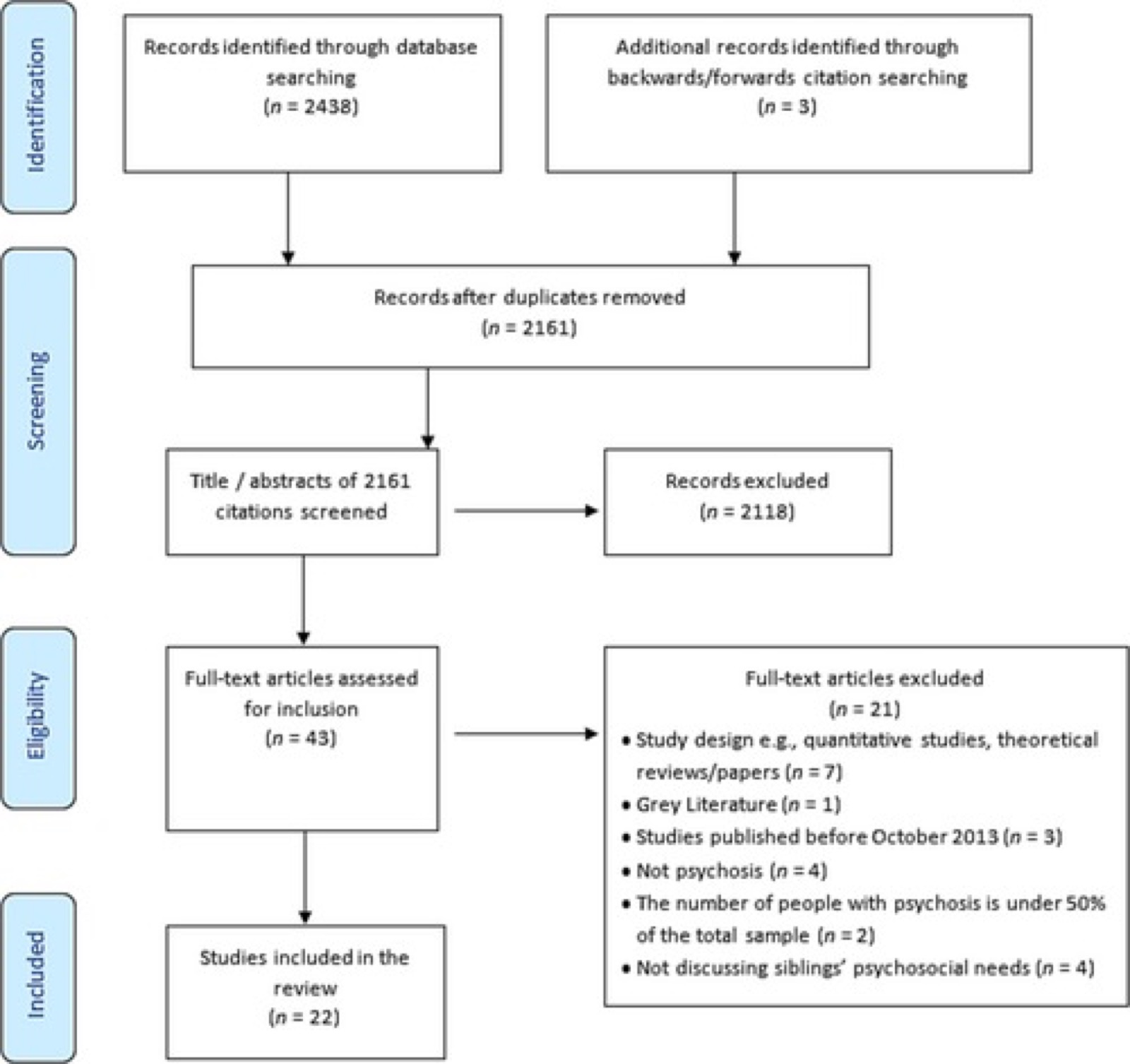
The first author contacted authors from the papers identified to gain additional information. Three additional paper was identified from reviewing citations. Twenty-two papers met full inclusion criteria, and a data extraction tool was developed (see Table 1) to record: (1) Study characteristics; (2) Design; (3) Sample demographics for study participants; (4) Sample demographics for SOPEP; (5) Sample demographics for patients; (6) Study aims, key findings and implications. Of the extracted papers, 30% were reviewed by both the first author and second rater to assess inter-rater reliability, with 90% agreement, and any discrepancies resolved through discussion.
Table 1 — Summary of included studies.
- 1. Al-Sawafi et al., 2021, Oman. Study aim: Explore the experience and needs of Omani relatives of hospitalised patients diagnosed with SZ. Design: Descriptive qualitative design. In-person, semi-structured interviews in Arabic with family members of hospitalised patients with SZ. Purposely sampling of parents, spouses and siblings. Data analysis: Framework analysis. Study participants: Relatives n = 20 (parents n = 10; siblings n = 5; partners n = 5); Females n = 12 (60%); Age range 25–60 years. Siblings: Siblings n = 5 (25%); Female n = 4; Age range 25–39 years. Patients: Inpatients with diagnosis of SZ n = 20; No other details reported. Key findings: (1) Caregiving can impact emotions, finances, work, etc. (2) SOPS experienced sadness, worry, feeling powerless, frustration, stigma, guilt, shame and responsibility. Siblings tried to ignore negative comments. (3) SOPS experienced compassion and love, which enhanced close sibling bonds and personal development. (4) Siblings encouraged patient's involvement in activities to support their independence. Clinical implications: Culturally adapted FI to effectively assist relatives in providing care and adjusting to the caregiving role are needed to reduce burden and stigma.
- 2. Al Sawafi et al., 2022, Oman. Study aim: Explore relatives' and mental health professionals' views to inform development of FI for inpatient with SZ diagnosis. Design: Semi-structured interviews with caregivers (see above). Three focus groups with staff members in English. Data analysis: Framework analysis. Study participants: Caregivers n = 20 (see above study for details); Staff focus groups: Psychiatrists (n = 7); Psychiatric nurse (n = 5); Both professions (n = 6); Experience range 4–32 years. Siblings and patients: See above study for details. Key findings: Psychosocial needs include: (1) Knowledge: prognosis, symptoms, aetiology, treatment, etc. (2) Problem-solving skills, e.g., managing when symptoms conflicted cultural practices. (3) Emotional support. Clinical implications: Culturally adapted FI would be acceptable to caregivers, when tailored to the families' needs.
- 3. Amaresha et al., 2015, India. Study aim: Explore the needs of the SOPS, who attend a tertiary care mental health hospital in Southern India. Design: Qualitative exploratory study using semi-structured in-person interviews in Kannada, Tamil, Telugu, or English. Purposive sampling. Data analysis: General Inductive Approach. Sample (participants/siblings): Siblings n = 15; Male n = 11; Mean age = 33 years; Identified as primary caregiver n = 10; Living with the patients n = 9; Urban background n = 9. Patients: Diagnosis of SZ n = 15 (paranoid SZ n = 9); Mean age = 30.40 years. Key findings: (1) Siblings wanted help managing the negative symptoms, access to information, and discuss concerns, e.g., hereditary. (2) Negative impacts on socio-occupational functioning, unemployment and family burden. Clinical implications: Specific psychosocial interventions in India are needed to support SOPS understanding and facilitate caregiving.
- 4. Amaresha et al., 2019, India. Study aim: Explore SOPS' experiences, attitudes and perspectives from the onset of illness. Design and sample: See above study for details. Key findings: (1) SOPS expressed negative attitudes towards their sibling when they believed they could control the illness. (2) SOPS experienced subjective and objective burden. (3) SOPS proactively engaged in their sibling's care, e.g., treatment adherence and support their livelihood. (4) SOPS used adaptive and maladaptive strategies, e.g., distraction and internalising feelings. Clinical implications: Information and open discussions around avoidance, burden, grief, stigma and isolation would benefit SOPS. Families may attribute that the symptoms can be controlled by the patient, which clinicians must address in interventions.
- 5. Bishop & Greeff, 2015, South Africa. Study aim: Identify resilience qualities in families of individuals diagnosed with SZ. Design: Cross-sectional mixed-method research design. Qualitative open-ended question on a questionnaire. Data analysis: Thematic analysis. Study participants: 42 families, represented by 33 parents (27 mothers) and 9 siblings of the diagnosed family member. Siblings: Siblings n = 9 (21%); All aged 18 years +. Patients: Diagnosis of SZ n = 42; Males n = 33 (79% sample); Mean age = 31 years. Key findings: (1) Resources that helped families adapt were social support, characteristics within the family (e.g., family time) and communication and attitudes towards the patient. (2) Siblings engaged in the caregiving and involved them in social activities. Clinical implications: Siblings may benefit from specific support and interventions that focus on their needs and resilience.
- 6. Day & Petalas, 2020, UK. Study aim: Address the perceptions of sibling relationships from the perspective of patients with mental health difficulties. Design: Qualitative semi-structured interviews. Data analysis: IPA. Sample: Primary diagnosis of a psychotic disorder n = 9; PTSD and EUPD n = 1; Male n = 10; Ages range 18–55 years; Inpatients at a rehabilitation hospital n = 10; Sibling included biological, adopted and stepsiblings, ranging from 1 to 8 siblings (mean n = 3.4). Key findings: (1) Patients felt guilty being cared for by their siblings and noticed change in sibling dynamics, particularly following diagnosis, and hospitalisations. (2) Siblings provide an alternative support to parents and support patient's mental health and recovery. They were often protective factors and be positive/negative influences. Clinical implications: Services should offer private spaces within and outside hospital settings to allow siblings to meet and interact. Involving siblings could help patient's well-being and QOL and be resources of historical data and helpful for future planning.
- 7. Dodge & Smith, 2019, Canada. Study aim: Examine transitions, constraints and experiences as a caregiver following their sibling's diagnosis. Design: Qualitative semi-structured interviews in person. Purposive sampling. Data analysis: Grounded theory. Sample (participants/siblings): Siblings n = 10; Male n = 5; Age range 21–56 years (mean = 32.2 years); Sibling number range 1–4; Older sibling of patient n = 4; Living with patient n = 1. Patients: Diagnosis of SZ n = 10; Male n = 8; Age range 26–46 years (mean = 32.5 years). Key findings: (1) Siblings play a key role in supporting their ill sibling in the community. (2) Initially struggled with sibling's dependency but over time appreciated small successes. (3) Siblings were ambivalent towards responsibilities as future primary carers. Clinical implications: Siblings need to be integrated in care decisions and supported with problem-solving skills and techniques, which will help them long-term.
- 8. Graves et al., 2020, USA. Study aim: How siblings of individuals with SZ experience family crises and the influences on their own development. Design: Exploratory qualitative study, 1–1 interviews conducted via Skype, with one interview conducted in person. Purposive and snowball sampling. Data analysis: Grounded theory techniques. Sample (participants/siblings): Siblings n = 23; Male n = 10; Aged between 18–30 years; Caucasian n = 21; Latino n = 1; Native American ancestry n = 1. Patients: Diagnosis schizoaffective disorder or SZ n = 23 (two had died before the interview); Male n = 19; Age range 20–37 years; Caucasian n = 21; Latino n = 1; Native American ancestry n = 1. Key findings: (1) Parents varied in how they responded to sibling's emotional needs, i.e., support, attention and involvement. (2) Parents more attuned to the emotional needs of siblings reduced their anxiety and were deemed more mastered at managing challenges within the family. Clinical implications: Fostering a cohesive family unit or FI should include siblings, e.g., family communication, crisis managing and discussions of siblings as potential future caregivers.
- 9. Graves et al., 2021, USA. Study aim: Examine how emerging adult siblings experience their developing awareness of their siblings' SZ. Design and sample: See above study for details. Key findings: (1) Open communication between parents and sibling positively influenced their perception of family unity and family relationships. (2) The sibling's own emotional availability and sense of self were important in how they viewed their role in the family. Clinical implications: Increased mental health support would benefit siblings, who experience developmental, identity changes and family crisis/conflict.
- 10. Izon et al., 2021, UK. Study aim: Understand siblings of individuals with an ARMS. Design: Qualitative semi-structured interviews using a critical realist approach. Convenience sampling. Data analysis: Thematic analysis Study participants: Caregivers n = 14; Mothers n = 9; partners n = 4; sibling n = 1. All the mothers (aged 41–56 years) lived with the patient: Five had additional younger children living in the family home, one lived alone with the patient, and three had older children who no longer lived with the family. Siblings: One sibling—aged 31 years, female White British. Patients: At risk of psychosis aged 17–34 years (mean age 21.15), male n = 9. Key findings: (1) Mothers' behaviour impacted on other siblings, e.g., less attention and time together. (2) Disruptions and stress for siblings at home included involvement of social services. (3) Siblings lack information or understanding of the patient's difficulties. They may show similar emotional reactions to their parents, which can impact the sibling bond. Clinical implications: Siblings may benefit from support in managing the changes in the family, e.g., relationships and involvement in FI could create family cohesion, e.g., open communication, how they feel about situations and spending time listening to one another.
- 11. Kovacs et al., 2019, Israel. Study aim: Understand the adult sibling bond, when one experiences mental health problems and the other may not be the primary caregiver. Design: Qualitative semi-structured in-person interviews in Hebrew. Purposive sampling. Data analysis: IPA. Sample (participants/siblings): Siblings n = 14; Age 20–55 years; Male n = 7; Ethnicity: Israeli n = 13; Arab Israeli n = 1; Oldest sibling n = 5. Patients: Diagnosis: SZ n = 9; bipolar n = 2; eating disorder n = 4; OCD n = 1; Male n = 8 aged 25–49 years. Key findings: (1) Siblings spoke about dilemmas, e.g., wanting to be close/involved but desiring distance. They found balancing involvement tough. (2) Communication between siblings could be confrontational, demanding and closed. (3) Siblings who took on parental burden spoke about a lost sibling friendship/boundary ambiguity. Clinical implications: Services should encourage the involvement of siblings in FI and provide psycho-education groups and dyadic sibling therapy to help siblings and provide opportunities to process internal and interpersonal relationship challenges.
- 12. Liegghio, 2017, Canada. Study aim: How young siblings experience their sibling's mental health and the impact on their family and sense of self. Design: Semi-structured interview. Purposive sampling. Data analysis: Thematic content analysis based on grounded theory using an inductive process. Sample (participants/siblings): Siblings n = 7; Male n = 3; Age range 13–21 years; Younger sibling n = 4. Patients: Diagnosis: FEP n = 4; ADHD n = 1; bipolar n = 1; depression n = 1; Male n = 6; Age range 12–22 (mean = 16 years). Key findings: (1) Siblings describe negative experiences of worry, stress, burden and family conflict. They hesitate from talking openly to avoid stigmatising encounters and protect their sibling. (2) Some behaviours were seen as patient's character, e.g., purposeful or attention-seeking. (3) They felt parental openness and peer support would be helpful. Clinical implications: Young siblings may benefit from opportunities to talk about the illness through sibling-sibling peer support. This may also help reduce isolation, stigma and normalise their experiences.
- 13. Liu & Zhang, 2019, China. Study aim: Explore the experiences of caregivers of people with SZ. Design: Descriptive phenomenological approach using semi-structured 1–1 interviews in Putonghua. Purposive sampling. Data analysis: Inductive content analysis. Study participants: Caregivers n = 16 (parents n = 11; spouses n = 3; sibling n = 1; child n = 1); Age range 25–58 years (mean = 44.75 years). Siblings: One sister. Patients: Diagnosis of SZ n = 16; Male n = 9; Mean age = 27 years; Inpatient n = 16. Key findings: (1) Caring can disrupt the family relationships. (2) Siblings felt unconditional love and sense of responsibility for supporting the patient and their family. Clinical implications: The involvement of all family members in FI—culturally valued in China. Also, clinicians may benefit from further training.
- 14. Napa et al., 2017, Thailand. Study aim: Explore the family interactions and behaviours of Thai families. Design: Semi-structured, in-depth interviews and observations of family's communication and behaviours towards each other and the patient. Purposive and theoretical sampling. Data analysis: Grounded theory methodologies. Study participants: 31 participants from 18 families including parents, siblings, aunts and grandparents; Age range 25–46 (n = 16) and >45 (n = 15); Rural n = 16. Siblings: One sibling from one family. Patients: Diagnosis FEP n = 18; Aged 18–25 years. Key findings: (1) Siblings' shared caregiving responsibilities with family members, e.g., companionship and essential care (i.e., washing clothes). (2) Siblings' rules for growing up were sometimes different from patients, on account of their mental health. Clinical implications: Extended family and key persons in the community (e.g., shamans, monks and neighbours) should be considered as a support resource. Plus, better sharing of information to rural areas.
- 15. Park & Lee, 2017, Korea. Study aim: Korean sibling caregivers' experiences caring for a sibling diagnosed with SZ. Design: Qualitative in-depth semi-structured face-to-face interviews in Korean. Purposive and snowball sampling. Data analysis: Descriptive phenomenological investigation. Sample (participants/siblings): Siblings n = 8; Female n = 5; Age range 20–40, the majority in their 20s (n = 4). Patients: Diagnosis SZ n = 8; Inpatient n = 8. Key findings: (1) Siblings experienced a mix of emotions: positive (love, positive regard) and negative (frustration, fear, helpless, burden). (2) Siblings had lack of understanding but were committed to learning about the illness. (3) Siblings felt responsible and obligated to caring for the patient. Clinical implications: Programs for siblings (e.g., normalising complex emotions, education) would aid siblings and consequently improve the well-being of patients.
- 16. Paul & Nadkarni, 2017, India. Study aim: Understand patients' and families' illness-related experiences, with specific attention to acceptance, stigma and discrimination. Design: In-depth interviews with people with SZ and five focused group discussions with their caregivers, in Hindi or English. Purposive sampling. Data analysis: Ground theory. Study participants: Caregivers n = 14 (parents n = 8; spouse n = 3; sibling n = 1); Male n = 7. Siblings: One brother who started caregiving after 15 years of the onset of his brother's illness. Patients: Diagnosis SZ or related disorder n = 20; Male n = 10; Age range 27–59. Key findings: (1) Siblings perceived negative impacts of caring (e.g., marriage prospect and career development) and increased burden. (2) Siblings who were more established in their profession and married were more receptive to caregiving roles. (3) Siblings who perceived stigma from society were more likely to avoid their ill sibling. Clinical implications: Educating families about SZ (i.e., knowledge and practical skills) to enhance family cohesion and acceptance. Support groups would help challenge family attitudes. Wider education would help reduce societal stigma and discrimination.
- 17. Purba, 2017, Indonesia. Study aim: Explore caregivers' needs when caring for someone with SZ. Design: In-depth interviews—phenomenology design. Data analysis: Colaizzi's method of analysis. Study participants: Family members n = 8. Siblings: Unknown details. Patients: Diagnosis SZ n = 10. Key findings: (1) Siblings have similar challenges to other caregivers and developed ways to cope and reduce family tension. (2) Psychosocial needs included information about SZ (treatment, causes, symptoms, effects of medication) and peer support. Clinical implications: Nurses could be a helpful resource to support families (i.e., knowledge and practical skills).
- 18. Seeman, 2013, Canada. Study aim: Identify gaps in knowledge about siblings and caregiving of people with SZ. Design: Observation and documentation of clinical notes (recorded once a week on average over 10 years). Data analysis: Over 12,000 written observations of 25 women, 200 related to the sibling relationships. Sample: Diagnosis SZ n = 25; Female n = 25; Age range adolescent-elderly; Details about siblings are unknown (to maintain confidentiality/anonymity). Key findings: (1) Siblings are important in the social network. When parents cannot cope, siblings are more active. (2) The eldest female often assumed primary caregiver role (dependent on culture, family values, personal circumstances). (3) The caregiving role was often stressful, with burden eased when responsibility was shared between family members. Clinical implications: Include siblings in FI sessions, and provide psychoeducation (e.g., how to balance the responsibility and burden of caregiving). Siblings' details should be on record.
- 19. Sin et al., 2017, UK. Study aim: Explore the challenges of recruiting siblings of people with FEP into an RCT. Design: Qualitative semi-structured interviews with clinical and research staff involved in recruiting siblings into an RCT. Data analysis: Thematic analysis. Study participants: Staff from early intervention to psychosis services n = 12 (principal investigators n = 4; clinical studies officer or clinical studies assistant n = 4; clinicians n = 4). Siblings: No sibling involvement. Patients: Diagnosis of FEP. Key findings: (1) Parents may shield children or prioritise the patient, resulting in siblings having less parental attention. (2) Siblings who have no or minimal contact with services may have limited access to support (e.g., advocating for their own needs) Clinical implications: A routine comprehensive family assessment in clinical settings, e.g., genogram, family network map.
- 20. Udgiri et al., 2017, India. Study aim: Identify the needs of caregivers of PwFEP. Design: Exploratory qualitative approach and semi-structured face-to-face interviews in either Kannada, Telugu, Hindi or English. Data analysis: General inductive approach. Study participants: Family members n = 11 (included mothers, fathers, children and siblings); Mean age 36.18 years. Siblings: N = 3 (27.3% sample). All living with the patient. Patients: PwFEP diagnosed with paranoid SZ (n = 5); Mean age 32.50 years. Key findings: (1) Siblings left their job to take a caregiver role. Psychosocial needs include: (1) Information and knowledge (e.g., aetiology, symptoms and medication). (2) Social welfare and legal and financial support. (3) Emotional support (e.g., their own mental health and managing stigma). Clinical implications: Needs-based interventions in meeting the psychosocial needs of caregivers of PwFEP in India.
- 21. Yang et al., 2017, China. Study aim: Understand siblings' experiences as the primary caregiver of patients with SZ in Taiwan. Design: Semi-structured, in-depth interviews. Data analysis: Qualitative content analysis. Sample (participants/siblings): Siblings n = 10; Male n = 3; Mean age = 44.9 years (range 30–65). Patients: Diagnosis SZ n = 10; Inpatient n = 10. Key findings: (1) Caregiving started when parents were unable to manage tasks. (2) Demands on siblings (e.g., financial and work) depended on if they lived together and closeness. (3) Emotional support needs (e.g., concerns about the future and feeling helpless). Clinical implications: Psychoeducation and FI should support siblings' cope and promote family cohesion.
- 22. Young & Flannigan, 2021, South Africa. Study aim: Understand ‘black’ isiXhosa-speaking persons experiences as siblings of someone with an SMI. Design: Semi-structured, interviews in siXhosa. Purposive and snowball sampling. Data analysis: IPA. Sample (participants/siblings): Siblings n = 5 (including uncles n = 2); Male n = 1; Aged 22–49, mean = 29.4 years. Black Christian n = 5. Patients: Diagnosis SZ n = 4, bipolar mood disorder n = 1. Key findings: (1) Families used traditional healers and western public healthcare facilities concurrently or sequentially. (2) Caregiving was positive (e.g., closer sibling bond and better understanding of mental health). (3) Caregiving was a burden (i.e., responsibility, self-sacrifice, financial, stigma, shame and fear). Clinical implications: More integration and dialogue between traditional healing belief systems and western healthcare. Siblings can also be a valuable resource for challenging social stigma.
Note: Some of the papers included the same sample across two papers, which has been taken into consideration during the discussion. For the purpose of the review, the term ‘patient’ is used for persons experiencing symptoms of psychos. Those providing care and support are referred to as ‘caregivers’ and ‘carers’. It is worth noting that papers varied in their definition of ‘sibling’, some including biological. The socially constructed nature of siblings is not unusual in Black South African families, particularly in rural areas, where social and household relationships are fluid; therefore, this study included step-, half-, biological and socially constructed siblings. The 22 papers are presented in chronological order. The table is a summary of the studies, containing key findings and implications, and demographic characteristics about the sample participants, the sibling and the patient. Some of these details were not reported. The first author (insert initials) contacted the corresponding authors to gain further information. Abbreviations. No., number; PwFEP, persons with first episode psychosis; SZ, schizophrenia; FI, family intervention; IPA, interpretative phenomenological analysis; SMI, severe mental illness; SOPS, siblings of people with schizophrenia; ARMS, at risk mental state of psychosis; RCT, randomised control trial; PTSD, Post-Traumatic Stress Disorder; EUPD, Emotionally Unstable Personality Disorder; QoL, quality of life; MH, mental health; FEP, first episode psychosis.
2.5 Quality assessment tool
Assessment of methodological quality was conducted by the first author using the Critical Appraisal Skills Programme (CASP; CASP International Network, 2013) qualitative checklist. This tool consists of 10 questions that can be used to critically assess quality across qualitative methodologies. There is a general lack of consensus regarding assessing quality in qualitative research (Leung, 2015). Given the diverse forms of qualitative research from diverse cultures and countries, the authors of the study did not exclude studies based on quality. Of the included papers, 30% were reviewed by both the first author and second rater to assess inter-rater reliability, with 97.1% agreement reached across all domain ratings (see Table 2).
Table 2 — Quality review of the 22 included studies in chronological order.
Criteria: Aims; Method; Design; Recruitment strategy; Data collection; Researcher bias; Ethical issues; Data analysis; Clear findings; Research value.
- Al-Sawafi et al., 2021. Rater A: 1, 1, 1, 1, 1, 3, 1, 1, 1, 1; Rater B: 1, 1, 1, 1, 1, 2, 1, 1, 1, 1.
- Al Sawafi et al., 2022. Rater A: 1, 1, 1, 1, 1, 3, 1, 1, 1, 1.
- Amaresha et al., 2015. Rater A: 1, 1, 1, 1, 1, 3, 1, 1, 1, 1.
- Amaresha et al., 2019. Rater A: 1, 1, 1, 1, 1, 3, 1, 1, 1, 1.
- Bishop & Greeff, 2015. Rater A: 1, 1, 1, 1, 1, 3, 1, 1, 1, 1; Rater B: 1, 1, 1, 1, 1, 2, 1, 1, 1, 1.
- Day & Petalas, 2020. Rater A: 1, 1, 1, 1, 1, 3, 1, 1, 1, 1.
- Dodge & Smith, 2019. Rater A: 1, 1, 1, 1, 1, 2, 1, 1, 1, 1.
- Graves et al., 2020. Rater A: 1, 1, 1, 1, 1, 2, 1, 1, 1, 1.
- Graves et al., 2021. Rater A: 1, 1, 1, 1, 1, 2, 1, 1, 1, 1.
- Izon et al., 2021. Rater A: 1, 1, 1, 1, 1, 1, 1, 1, 1, 1; Rater B: 1, 1, 1, 1, 1, 1, 1, 1, 1, 1.
- Kovacs et al., 2019. Rater A: 1, 1, 1, 1, 1, 2, 1, 1, 1, 1; Rater B: 1, 1, 1, 1, 1, 2, 1, 1, 1, 1.
- Liegghio, 2017. Rater A: 1, 1, 1, 1, 1, 2, 1, 1, 1, 1; Rater B: 1, 1, 1, 1, 1, 2, 1, 1, 1, 1.
- Liu & Zhang, 2019. Rater A: 1, 1, 1, 1, 1, 1, 1, 1, 1, 1.
- Napa et al., 2017. Rater A: 1, 1, 1, 1, 1, 2, 1, 1, 1, 1.
- Park & Lee, 2017. Rater A: 1, 1, 1, 1, 1, 2, 1, 1, 1, 1.
- Paul & Nadkarni, 2017. Rater A: 1, 1, 1, 1, 1, 2, 1, 1, 1, 1; Rater B: 1, 1, 1, 1, 1, 2, 1, 1, 1, 1.
- Purba, 2017. Rater A: 1, 1, 1, 2, 1, 2, 1, 2, 1, 1.
- Seeman, 2013. Rater A: 1, 1, 1, 1, 1, 2, 1, 2, 1, 1.
- Sin et al., 2017. Rater A: 1, 1, 1, 1, 1, 1, 1, 3, 1, 1.
- Udgiri et al., 2017. Rater A: 1, 1, 1, 1, 1, 2, 1, 1, 1, 1.
- Yang et al., 2017. Rater A: 1, 1, 1, 1, 1, 2, 1, 1, 1, 1.
- Young & Flannigan, 2021. Rater A: 1, 1, 1, 1, 1, 3, 1, 2, 1, 1; Rater B: 1, 1, 1, 1, 1, 3, 1, 2, 1, 1.
Note: ‘1’, the publication provided an informative description of the criterion at issue and met the quality criterion; ‘2’, the publication provided an informative description, but an inadequate performance; ‘3’, the publication provided no or insufficient information; A, refers to rater number one (insert initials); B, refers to rater number two (insert initials). Table 2 illustrates the similar scores of the paper quality assessed by two separate raters. The 10 questions were answered ‘yes’ (1) or ‘no’ (2) or ‘can't tell’ (3); the criteria and prompts for each question can be found in Critical Appraisal Skills Programme (CASP) International Network (2013). Overall, the papers included in the review provided valid study results that provide implications for research and practice. Some papers did not provide information about the methodology or results and unclear reporting surrounding researcher reflexivity.
2.6 Narrative synthesis
The data were summarised and analysed using narrative synthesis to ‘tell the story’ of the findings from the included studies (Popay et al., 2006). The narrative synthesis approach involved developing a preliminary synthesis and exploring relationships within and between studies to draw out conclusions (Popay et al., 2006). The themes and extracts from the included papers were re-read several times by the first author. During the full-text screening and extraction processes, we identified multiple studies that commented and reported on key areas. Using an inductive, iterative process, initial codes were created and then condensed and categorised until patterns and final themes emerged. This approach was used to combine and report the findings relating to the psychosocial stressors, needs, barriers and facilitators of caregiving for SOPEP. The identification of codes, and subsequently, the development of final themes, was discussed and reviewed in supervision. Relevant quotes were chosen to reflect key points within each theme.
2.7 Reflexivity
When conducting qualitative research, reflexivity is important in understanding the influence of researchers' backgrounds and perspectives (Malterud, 2001). The first author's own experiences of family life, a positive sibling relationship and prior research with families of ARMS individuals, may have influenced her reasons for engaging and understanding siblings' experiences. For example, coming from a White British religious lens may have influenced the first author's perspective of carer burden, cultural and gender norms. Supervision was important to maintain an objective research position and ensure that themes were grounded within the data.
3 RESULTS
3.1 Overview
The studies included were conducted within Europe (n = 3), Asia (n = 9), Americas (n = 5), Africa (n = 2) and the Middle East (n = 3). They explored the psychosocial stressors of SOPEP with an ARMS (n = 1), FEP (n = 3) and diagnosis of schizophrenia or psychotic disorder (n = 18). Of the 18 studies involving patients with a diagnosis of schizophrenia, seven studies involved inpatient populations (Al-Sawafi et al., 2021; Al Sawafi et al., 2022; Day & Petalas, 2020; Liu & Zhang, 2019; Park & Lee, 2017; Seeman, 2013; Yang et al., 2017). Study participants were only siblings (n = 10), relatives (i.e., parents, partners, siblings, grandparents; n = 7), patients themselves (n = 1) and healthcare professionals (n = 2). One study included both patients and relatives in their sample (Paul & Nadkarni, 2017), and another included both relatives and healthcare professionals (Al Sawafi et al., 2022).
Most studies involved individual interviews (n = 18). One study involved interviews and observations (Napa et al., 2017), one interviews and focus groups (Paul & Nadkarni, 2017), one open-ended questions on a questionnaire (Bishop & Greeff, 2015) and another involved observation of clinical notes (Seeman, 2013). Qualitative data analysis varied, grounded theory (n = 6), thematic analysis (n = 3), IPA (n = 3), framework analysis (n = 2), content analysis (n = 3), descriptive phenomenological investigations (n = 3) and general inductive approach (n = 2).
Of the 22 studies, most siblings involved were female (n = 10). Six studies did not mention the genders of the siblings, and two studies had an even split of male/female participants. Siblings were typically aged 25–39 years (n = 11). One study looked at young siblings (Liegghio, 2017), and one explored siblings who ranged from 30 to 65 years (Yang et al., 2017). Seven studies did not mention the ages of siblings. Additional details were sometimes mentioned about siblings, for example, whether they lived with the patient (Amaresha et al., 2015, 2019; Dodge & Smith, 2019; Udgiri et al., 2017), were the primary caregiver (Amaresha et al., 2015, 2019) and the birth order (Dodge & Smith, 2019; Kovacs et al., 2019; Liegghio, 2017). See Table 1 for summary details.
In addition, three groups reuse their data to publish multiple papers (Al-Sawafi et al., 2021; Al Sawafi et al., 2022; Amaresha et al., 2015, 2019; Graves et al., 2020, 2021). The weight of these papers has been taken into consideration in the result and discussion.
3.2 Quality assessment tool
The received studies provided clear aims; they were explicit about how data was collected and chose appropriate qualitative methodology. However, some were not rigorous with data analysis (see Table 2, criteria 8) and did not critically consider the researcher's own role, influence and potential bias (see Table 2, criteria 6). All studies were included as deemed valuable research to existing literature, with findings important to consider in current practice and policy.
3.3 Facilitators and barriers to providing care and supporting SOPEP
Using narrative synthesis, six key components were identified as contributing to SOPEP's psychosocial stressors and facilitating or hindering their intentions, behaviours and experiences in providing care. These were (1) SOPEP's beliefs about psychosis, (2) caregiving beliefs, (3) family and cultural values, (4) personality traits, (5) pragmatic challenges and (6) access to resources. Figure 2 shows the psychosocial stressors that may help (bold) or hinder (italic) SOPEP intentions and behaviours in caregiving. The model includes influencing factors from an individual and social level, as well as physical and macro-level environments.
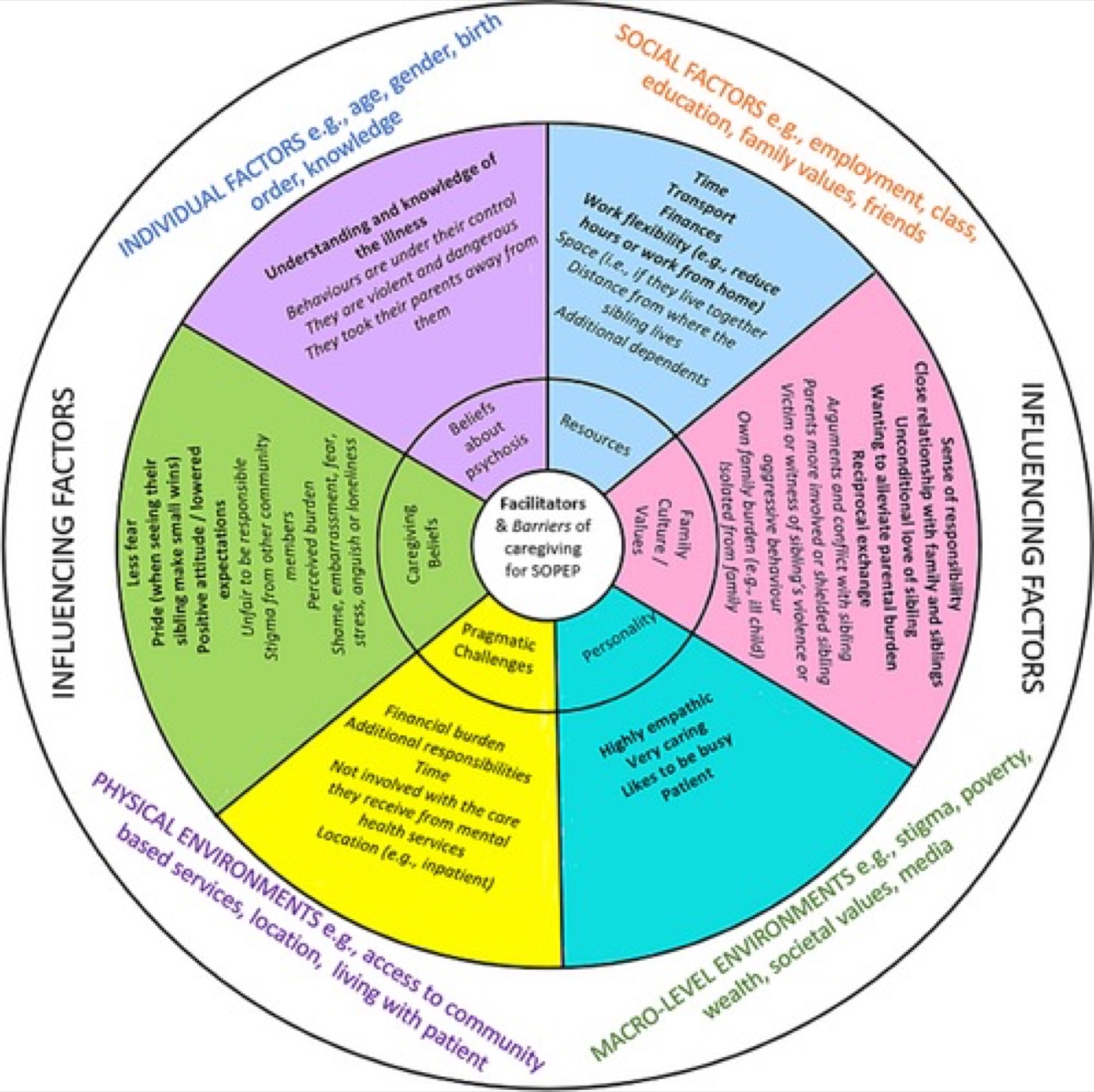
Influencing psychological and social factors may contribute to the development or aggravation of existing mental health difficulties for SOPEP. These stressors may impact SOPEP's relationships with other family members and facilitate or hinder them from providing care or support towards their sibling (see Figure 2). Examples of psychological stressors for SOPEP include witnessing the behaviours and symptoms of psychosis, or behaviours of violence, aggression and suicidal ideation. SOPEP may experience heightened conflict in family relationships and/or feel their needs are not being fully met by their primary caregivers. SOPEP may experience themselves a wide range of complex, layered emotions, impacting on their own mental health. Social stressors for SOPEP can include reduced access to resources, for example, financial burden on the family, reduced education support, limited access to family, community and social support. Psychological and social stressors can interact on SOPEP own psychological well-being, as well as their sibling and family relationships.
3.3.1 Beliefs about psychosis
Social issues such as public stigma towards people with experiences of psychosis may result in negative stereotypes (e.g., aggressive and violent) (Liegghio, 2017; Napa et al., 2017) and discrimination (e.g., unable to own property) (Liegghio, 2017; Paul & Nadkarni, 2017). Negative perceptions of psychosis impacted on SOPEP feeling embarrassed, uncomfortable (Al Sawafi et al., 2022; Amaresha et al., 2015, 2019; Liegghio, 2017; Young & Flannigan, 2021) and isolated from others (Amaresha et al., 2019; Graves et al., 2021; Liegghio, 2017).
One of the neighbours suggested we move out of the neighbourhood … it was after (sibling) had an episode. (Liegghio, 2017)
Negative emotional experiences by SOPEP may be attributed towards their beliefs of their sibling's behaviours being intentional. These criticisms may elicit jealousy when combined with attention focussed on the patient and the SOPEP's needs perceived as less important (Seeman, 2013; Izon et al., 2021).
Yes, he has an illness … but that doesn't mean that he cannot do anything. (Amaresha et al., 2019)
He is sometimes embarrassing you, us as a family. And then you feel those … and others were laughing. It was like he is doing it for fun. (Young & Flannigan, 2021)
Dependent on SOPEP's personal and social identity, their experiences of having an ‘ill’ sibling may vary. This may have an impact for SOPEP during adolescence and early adulthood on the sibling relationship (Graves et al., 2021), relationships with their parents (e.g., feeling abandoned) and their psychosocial functioning. SOPEP who experienced changes within family relationships (i.e., family conflict, involvement in caregiving and less attention/time with parents) may lack the knowledge and understanding of the condition (Al Sawafi et al., 2022; Amaresha et al., 2015; Izon et al., 2021; Liegghio, 2017; Napa et al., 2017; Sin et al., 2017).
We need to know some information such as what Is the nature of the illness? Why does it occur? Why is my brother behaving like this? (Amaresha et al., 2015)
3.3.2 Caregiving beliefs
SOPEP play a key role in caregiving with 17 studies mentioning siblings having a responsibility for the patient, and their families. SOPEP may be socialised to the caretaking role early in life (due to, e.g., parental ill health and bereavement) and expected to care for their ‘ill’ sibling. SOPEP may recognise themselves as adopting a ‘parenting role’ (Graves et al., 2021; Izon et al., 2021), over their lifetime (Day & Petalas, 2020; Graves et al., 2021; Kovacs et al., 2019; Yang et al., 2017). However, some may choose not to engage and avoid caregiving responsibilities and distance themselves from their sibling (Seeman, 2013).
Up to what age are they our sibling? Our responsibility? Until when? Until age 40? Until age 50? Until age 60? (Kovacs et al., 2019)
Studies highlighted the diverse forms of care SOPEP provided: Physical care included managing medication, appointments, providing transport and housing (Amaresha et al., 2019; Napa et al., 2017; Purba, 2017; Udgiri et al., 2017; Yang et al., 2017); emotional support included listening, providing advice and empathy (Al-Sawafi et al., 2021; Al Sawafi et al., 2022; Liu & Zhang, 2019); social support included providing companionship, social interactions and access to activities (Al-Sawafi et al., 2021; Bishop & Greeff, 2015; Dodge & Smith, 2019; Napa et al., 2017; Seeman, 2013); and finally, financial support included transport, bills and disturbances in SOPEP's own occupation (Al-Sawafi et al., 2021; Amaresha et al., 2015, 2019; Purba, 2017; Udgiri et al., 2017; Yang et al., 2017; Young & Flannigan, 2021). Five studies did not mention specific psychosocial demands (Graves et al., 2020, 2021; Izon et al., 2021; Purba, 2017; Sin et al., 2017).
She's, my sister! It is normal for family members to help each other when they are ill. (Liu & Zhang, 2019)
3.3.3 Family and cultural values
In some cultures, psychosis was described as ‘bizarre’ (Graves et al., 2021) or ‘picchi’, ‘hucchu’, ‘madness’ (Amaresha et al., 2015, 2019; Young & Flannigan, 2021) and the result of ‘vamachara’ (black magic) or a ‘Jinn’ (Al-Sawafi et al., 2021; Al Sawafi et al., 2022; Amaresha et al., 2015, 2019; Young & Flannigan, 2021) or a message from God (Park & Lee, 2017). Help-seeking behaviours included accessing traditional healers prior to mental health services (Al-Sawafi et al., 2021; Al Sawafi et al., 2022; Amaresha et al., 2015, 2019; Young & Flannigan, 2021).
We did not know where to go initially … some people told us to take him to temples and person poojas (religious rituals) and some advised seeking help from black magicians. (Amaresha et al., 2019)
Beliefs about caregiving and mental illness may be unique to culture (Amaresha et al., 2015, 2019). It is important to note that the majority of papers included in this review failed to report the researchers' own stances, which may be in line or conflicting with participants' family and cultural values. Variations in caregiving may be dependent on gender, geographic proximity, socioeconomics and other responsibilities of SOPEP (e.g., responsibilities for other children or aging relatives). In some cultures, families provide collectivist support to patients, and demands may be put on siblings rather than parents with expectations of their involvement in caregiving (Napa et al., 2017; Seeman, 2013).
My elder brother and I work together. He said that its very important since I'm in Taiwan and cannot burn out caring for family members. My elder brother works in America and earns money to pay the bills for our ill brother, our parents, and their foreign caregiver. (Yang et al., 2017)
Some SOPEP may avoid caregiving because of the perceived burden and stigma (Day & Petalas, 2020; Graves et al., 2021; Kovacs et al., 2019; Seeman, 2013; Yang et al., 2017) and/or family values (Graves et al., 2020; Kovacs et al., 2019). Stigma and discrimination may impede or delay help-seeking behaviours, further exacerbating symptoms and functioning (Amaresha et al., 2019), or result in families utilising institutions to avoid family burden (Park & Lee, 2017; Yang et al., 2017). SOPEP may rely on their parents to sustain the caregiving role (Dodge & Smith, 2019; Park & Lee, 2017).
When my parents die … I think (caregiving) would fall to me. (Dodge & Smith, 2019)
3.3.4 Personality traits
SOPEP expressed compassion, empathy and patience towards their sibling and wanting to provide a calming presence when socialising together (Al-Sawafi et al., 2021; Al Sawafi et al., 2022; Amaresha et al., 2019; Bishop & Greeff, 2015; Day & Petalas, 2020; Graves et al., 2020; Liu & Zhang, 2019; Park & Lee, 2017; Young & Flannigan, 2021). SOPEP desired patience when communicating with their siblings, mostly when they felt exhausted or frustrated by the sibling's behaviours (Amaresha et al., 2015; Kovacs et al., 2019).
I like to just chill with him and take my guitar … his illness brought me close to him as his brother, I always want to be better! (Young & Flannigan, 2021)
3.3.5 Pragmatic challenges
Most studies described the care demands for SOPEP. Some SOPEP described caregiving as stressful, burdensome and associated negative impacts (Amaresha et al., 2015, 2019; Kovacs et al., 2019; Liegghio, 2017; Park & Lee, 2017; Paul & Nadkarni, 2017; Seeman, 2013; Young & Flannigan, 2021). SOPEP discuss the ‘demands for money’ (Seeman, 2013) and financial burden from hospitalisation fees and medications (Amaresha et al., 2015; Park & Lee, 2017; Yang et al., 2017), whilst others had paid for traditional healers (Al-Sawafi et al., 2021; Amaresha et al., 2019).
I have no idea how to pay the hospitalisation fee. (Yang et al., 2017)
SOPEP in employment or education experienced pragmatic challenges in supporting their sibling to appointments and involvement in their care (Amaresha et al., 2019, 2015; Liegghio, 2017; Sin et al., 2015).
I also decided to leave the school. Oh man, sh*t! Everything is on me! … It's a burden. (Young & Flannigan, 2021)
SOPEP may have additional responsibilities (i.e., families and young children) that create challenges in socialising and involvement in their sibling's care (Amaresha et al., 2015; Yang et al., 2017).
These days I have a lot of pressures both personally and professionally … not able to spend time with my fiancé and friends. (Amaresha et al., 2015)
3.3.6 Access to resources
The need for additional resources for SOPEP was mentioned across all studies. Most studies discuss wanting emotional support within families or peer support around topics including avoidance, grief, stigma, burden and long-term caregiving responsibility. Over half of the studies discuss SOPEP need for knowledge and psychoeducation about topics including symptoms, aetiology, social welfare and legal and financial support.
I would like to know what psychosis is all about? What has caused this illness? How long will it take to cure? (Udgiri et al., 2017)
Five studies (Al Sawafi et al., 2022; Amaresha et al., 2015; Dodge & Smith, 2019; Graves et al., 2020; Paul & Nadkarni, 2017) discuss practical skills and techniques for SOPEP in managing symptoms. Four studies (Day & Petalas, 2020; Liu & Zhang, 2019; Seeman, 2013; Sin et al., 2017) discuss additional resources for healthcare professionals (e.g., culturally valued family intervention training and records of family networks).
Over half of the studies included in the review discuss culturally adapted interventions for SOPEP, due to unique concerns and beliefs about caregiving and possible conflicts with cultural practice. These studies discuss how programs may need to be adapted to account for the differences in language, stigma and involvement of others (e.g., extended family, shamans and monks).
It is important to use simplified language. (Al Sawafi et al., 2022)
All the studies included in this review discuss strategies and programs needed to support SOPEP. The authors grouped resources in Table 3. These were found to help siblings feel less stressed, isolated and confused about the psychosocial demands as a SOPEP and more positive and knowledgeable in how to support themselves and their sibling. These may need to be adapted to the SOPEP's needs depending on their personal and social identity, patient's stage of psychosis and cultural expectations and beliefs of caregiving.
Table 3 — Resources to facilitate caregiving and cope with the psychosocial challenges as a sibling of someone who experiences psychosis.
- Psychosocial needs of siblings: Education to increase knowledge for siblings; Examples of conversations and supportive resources:
- How to manage the illness and treatment (both positive and negative symptoms)
- The aetiology of the illness
- What symptoms and signs to look for in the condition
- Discussions to help reduce stigma and burden (e.g., behaviours within the patient's control)
- Hereditary factors
- Impact for sibling's long-term health and needs
- Empower siblings in managing mental health services
- Psychosocial needs of siblings: Involvement in the patient's mental health care; Examples of conversations and supportive resources:
- Involvement in the treatment plan and how they may support their sibling managing the illness
- Aware of which healthcare professionals are involved in the patient's care
- Involvement in family intervention
- Psychosocial needs of siblings: Access to mental health support for siblings themselves; Examples of conversations and supportive resources:
- Access to emotional support as a consumer in their own right
- Access to respite
- Encouraged to prioritise oneself (i.e., the idea in an aeroplane and put on one's own oxygen mask first)
- Normalise mixed emotions
- Opportunity to discuss the future and caregiving when parents are unable to cope
- Opportunity to discuss distressing topics, e.g., stigma, conflict and burden
- Psychosocial needs of siblings: Access to social support; Examples of conversations and supportive resources:
- Support from peers (e.g., family members and siblings of people with mental illness)
- Involvement of extended family
- Psychosocial needs of siblings: Access to financial advice; Examples of conversations and supportive resources:
- Discussions about their employment and accessing support from work
- Signpost grants and financial support as a carer
- Supporting a sibling who is unemployed
- Psychosocial needs of siblings: Encourage ongoing religious and spiritual support; Examples of conversations and supportive resources:
- Facilitate access to religious support or spiritual sustenance
- Psychosocial needs of siblings: Wider system involvement to develop cultural congruence; Examples of conversations and supportive resources:
- Creation of better links and communication between traditional healers and religious leaders
- Sharing information and connecting with local communities
- Sharing resources (i.e., Figure 2 model) that reduce stigma and promote mental health literacy
Note: Resources found to help siblings feel less stressed, isolated and confused about the psychosocial demands as a sibling of someone with psychosis and more positive and knowledgeable in how to support themselves and their sibling.
4 DISCUSSION
4.1 Summary of findings
This review explored the psychosocial stressors and needs of SOPEP derived from qualitative studies. This narrative synthesis included studies outside western communities to explore SOPEP-specific needs across diverse cultures and understand culturally specific psychosocial sibling-centred support. Most studies included provided clear details about the research, yet the researcher's own role was not often critically considered. All the studies included were deemed valuable research additions to existing literature, with findings important to consider in current practice and policy.
Psychological and social factors can interact with one another and impact on SOPEP's own mental health, as well as their sibling and family relationships. For example, primary caregivers may attend to the needs of their child with experiences of psychosis, which may result in the SOPEP experiencing a lack of affection, feeling isolated and jealous and lead to further withdrawal (Amaresha et al., 2019; Izon et al., 2021; Seeman, 2013). In line with family systems theory (Kerr, 2019; Minuchin, 1988), families are not understood in isolation and one person's actions can shift the equilibrium within a family. Social and psychological factors are dynamic and can become stressors, for example, financial resources or social support may reduce or increase and impact the whole family system. Therefore, the needs of SOPEP may vary depending on influencing factors (i.e., individual and social factors and the physical and macro-level environment; see Figure 2). However, the involvement and education to increase SOPEP's knowledge and provide them with support and resources (see Table 3) is important in facilitating caregiving, providing SOPEP's coping strategies and acknowledging their own psychosocial challenges and any changes within their family relationships.
SOPEP play a key role in caregiving for their sibling and supporting their parents. This may result in SOPEP experiencing family tension or impact on their socio-occupational functioning. Understandably, SOPEP may encounter a wide range of emotions and experiences, including guilt, shame, anger and increased psychological distress. The varying experiences of siblings may be understood by culture that shapes the values and perspectives of different communities. For example, some SOPEP may hold negative attitudes towards caregiving and perceive burden, negative impacts and societal stigma. This may help services to understand why some parents shield patient's experiences from SOPEP, whilst others are involved with care from an early age, and some SOPEP make sacrifices within their personal lifestyle (e.g., family and career), whilst others distance themselves from their sibling.
Over half of the studies in this review discuss SOPEP need for knowledge and psychoeducation about topics including symptoms, aetiology, social welfare and legal and financial support. Of the four studies in this review exploring SOPEP at FEP and ARMS, all discuss the need to involve, support and share information with SOPEP, with three studies commenting on SOPEP dearth of information and understanding. Internet-based information and peer support intervention was found useful and acceptable to SOPEP in the UK (Sin et al., 2015). Providing SOPEP access to digital psychoeducation resources coupled with sibling peer support may benefit some families, although some may need additional support regarding social welfare and legal and financial advice with variations depending on one's culture, language and localisation.
This review builds on the existing literature, highlighting the need for services to incorporate cultural adaptations. SOPEP beliefs and attitudes towards caregiving and mental health may be impacted by individual, social and macro-level factors and their physical environment (see Figure 2). This review recognises the psychosocial stressors to caregiving and facilitators and barriers for SOPEP (e.g., resources and pragmatic challenges). Mental health services may wish to explore these six areas: SOPEP's beliefs about psychosis and caregiving, their family and cultural values, their personality traits (i.e., empathic, caring and patient), pragmatic challenges and access to resources (see Table 3) when engaging with SOPEP to understand their caregiving demands and family cultural beliefs towards caregiving.
4.2 Clinical implications
As symptoms of psychosis emerge this may impact the whole family (Wang et al., 2017), with siblings experiencing the cumulative effects of developmental challenges, combined with family disruption (Graves et al., 2020). The sibling bond is often the longest familial relationship in one's life (Day & Petalas, 2020). Services may wish to consider additional support for SOPEP to feel less stressed, isolated and confused about the psychosocial caregiving demands and more positive and knowledgeable in how to support themselves and their sibling. Most studies in this review discuss emotional support for SOPEP, who may have mixed feelings and have questions about long-term caregiving responsibility. SOPEP involvement in family intervention or peer support may provide them with a space to disclose difficult emotions towards their sibling or adopting a carer role and explore ways to facilitate caregiving.
Outdated language and cultural insensitivity may create barriers to minority groups engaging with mental health services. Understanding SOPEP's experiences and providing acceptable and effective culturally adapted interventions may facilitate their intentions and behaviours in providing care (see Figure 2). Tailored interventions may include exploring cultural values and family beliefs about psychosis and how they respond as a family or community. This may be crucial with some SOPEP from collectivist cultures involved in caregiving, some providing all care, whilst others may not be involved with expectations placed on parents (Napa et al., 2017; Seeman, 2013).
Exploring the beliefs behind caregiving and how SOPEP manage their own feelings and responses to the person may vary dependent values, social stigma and experiences of discrimination. For example, some SOPEP may have additional responsibilities (e.g., their own family and children) but are culturally expected to care for their siblings (Amaresha et al., 2015; Yang et al., 2017). Adapting services to SOPEP across the world may include clinicians providing psychoeducation about psychosis using ‘simplified language’ and recognising SOPEP's beliefs (i.e., ‘vamachara’ or a ‘Jinn’; Al-Sawafi et al., 2021; Al Sawafi et al., 2022; Amaresha et al., 2015, 2019; Young & Flannigan, 2021) or a message from God (Park & Lee, 2017). Services to recognise negative or positive emotional responses may be a result of the type of caregiving, resources personal and identity factors (i.e., gender, geographic proximity and socioeconomics). Some SOPEP may need signposting to financial support as a carer if applicable to their culture. Clinicians should look to build trust with SOPEP from a non-judgmental position, learning from them and identifying their strengths and resources. Services may look to build connections with the community members (e.g., religious leaders, shamans, monks and traditional healers) to facilitate SOPEP's expectations of the caregiving role through religious support or spiritual sustenance, as well as reduce stigma and burden and promote mental health literacy.
4.3 Recommendations for policymakers
- The development of a referral pathway that provides SOPEP access to their own support (i.e., knowledge, financial advice and mental health support; see Table 3).
- SOPEP to be routinely offered psychological therapies within family intervention.
- Services to explore the facilitators and barriers for SOPEP to providing care and support (i.e., Figure 2, six areas).
4.4 Limitations and future research
This review was the first to synthesise the psychosocial stressors of SOPEP across diverse cultures, whilst exploring the quality of the studies. The authors included all the studies that met the inclusion criteria, irrelevant of quality. Justification was that the diverse forms of qualitative studies from varying cultures were deemed valuable research to existing literature, with findings important to consider in current practice and policy.
The review had certain limitations. The authors utilised the reported findings of the included studies, rather than accessing raw qualitative data. The sample sizes within the studies were relatively small, and the authors included studies with mixed samples of relatives (i.e., parents, partners, siblings and grandparents). Furthermore, the definition of ‘sibling’, included step-siblings, half-siblings and uncles (Young & Flannigan, 2021). Combining samples from both the socially constructed phenomena of ‘siblings’ and biologically defined ‘siblings’ limits internal validity of the review. However, integrating the findings and acknowledging how SOPEP may vary across cultures and communities provides external validity. This may help to create culturally adaptable and acceptable interventions for SOPEP (Edge et al., 2018), as well as guide services to providing meaningful resources that meet the psychosocial needs of SOPEP and facilitate caregiving.
Future research exploring the psychosocial needs of SOPEP should give voice to siblings across more cultures, exploring the needs of younger and elder siblings and adopting rigorous qualitative and mixed methodologies. Exploring gender differences of SOPEP, their caregiving roles and psychosocial needs may help services to provide more acceptable support and engage SOPEP and families with mental health services earlier. Understanding the reciprocal sibling relationship and impact of SOPEP on service users and vice versa would be important for future research. Furthermore, most studies included focussed on chronic conditions, whereas future research may wish to explore early psychosis experiences (i.e., FEP and ARMS) and SOPEP's needs.
5 CONCLUSION
This qualitative review identified the needs of SOPEP, facilitators and barriers to providing support and helpful resources to providing care. The review included the psychosocial stressors and needs of SOPEP across a variety of cultures and across the psychosis umbrella. SOPEP have strong emotional connections and compassion towards their sibling and wanting to be a calming presence when socialising together. SOPEP involvement with caregiving may be within the family or they maintain all responsibilities, whilst also supporting their parents. SOPEP may experience negative emotions towards caregiving, their sibling and their family, feelings of burden and/or challenges to meeting their caregiving demands with their available resources. SOPEP's experiences were influenced by various stages: individual factors (e.g., knowledge and gender), social factors (e.g., education and family values), physical environments (e.g., access to community-based services) and macro-level environments (e.g., poverty and societal values). Connecting with local communities (e.g., religious leaders and traditional healers) in education programs may facilitate SOPEP's expectations of the caregiving role and reduce stigma and burden. Globally, SOPEP may benefit from involvement in family interventions and individual support that facilitates caregiving and acknowledged their psychosocial and emotional experiences.
Complexe Systémique: key points
This review usefully shifts the focus: in psychosis, siblings are often the invisible carers, present before the clinical team and often after the parents. The wheel model in Figure 2 can be used directly in practice: beliefs about the illness, beliefs about caregiving, family and cultural values, personality, practical constraints and resources make a simple frame for a genogram or a session with the siblings. A systemic reading nonetheless invites us to go beyond an inventory of “stressors”: a sibling’s jealousy, withdrawal or over-responsibility also speak of how positions and loyalties are redistributed when one child becomes “the ill one”. The limitations are real: quality was mostly rated by a single person, several samples overlap, siblings are sometimes a small minority in the included studies, and the published article still contains “(insert initials)”. Read alongside the article on relationships with individuals at high risk of psychosis, and the article on the culturally adapted family intervention CaFI.
References
Al-Sawafi, A., Lovell, K., Renwick, L., & Husain, N. (2021). Exploring the experience of relatives living with individuals diagnosed with schizophrenia in Oman: A qualitative study. Journal of Psychiatric and Mental Health Nursing, 28(6), 1029–1040. https://doi.org/10.1111/jpm.12786
Al Sawafi, A., Lovell, K., Renwick, L., & Husain, N. (2022). Exploring views of relatives and mental health professionals to inform the cultural adaptation of a family intervention for schizophrenia in Oman: A qualitative study. International Journal of Social Psychiatry, 68(8), 1795-1805.
Amaresha, A. C., Joseph, B., Agarwal, S. M., Narayanaswamy, J. C., Venkatasubramanian, G., Muralidhar, D., & Subbakrishna, D. K. (2015). Assessing the needs of siblings of persons with schizophrenia: A qualitative study from India. Asian Journal of Psychiatry, 17, 16–23. https://doi.org/10.1016/j.ajp.2015.07.011
Amaresha, A. C., Venkatasubramanian, G., & Muralidhar, D. (2014). Needs of siblings of persons with psychosis: A systematic descriptive review. Clinical Psychopharmacology and Neuroscience, 12(2), 111–123. https://doi.org/10.9758/cpn.2014.12.2.111
Amaresha, A. C., Venkatasubramanian, G., & Muralidhar, D. (2019). Perspectives about illness, attitudes, and caregiving experiences among siblings of persons with schizophrenia: A qualitative analysis. Indian Journal of Psychological Medicine, 41(5), 413–419. https://doi.org/10.4103/IJPSYM.IJPSYM_318_19
Arciniegas, D. B. (2015). Psychosis. Continuum: Lifelong Learning in Neurology, 21(3 Behavioral Neurology and Neuropsychiatry), 715.
Bank, S. P., & Kahn, M. D. (2003). The sibling bond. Basic Books.
Ben-David, S., Cole, A. R., Brucato, G., Girgis, R., & Munson, M. R. (2019). A conceptual model of mental health service utilization among young adults at clinical high-risk for developing psychosis. Psychiatric Rehabilitation Journal, 42(1), 17–25. https://doi.org/10.1037/prj0000336
Bishop, M., & Greeff, A. P. (2015). Resilience in families in which a member has been diagnosed with schizophrenia. Journal of Psychiatric and Mental Health Nursing, 22(7), 463–471. https://doi.org/10.1111/jpm.12230
Bowman, S., Alvarez-Jimenez, M., Wade, D., Howie, L., & McGorry, P. (2017). The positive and negative experiences of caregiving for siblings of young people with first episode psychosis. Frontiers in Psychology, 8, 730. https://doi.org/10.3389/fpsyg.2017.00730
Bowman, S., Alvarez-Jimenez, M., Wade, D., McGorry, P., & Howie, L. (2014). Forgotten family members: The importance of siblings in early psychosis. Early Intervention in Psychiatry, 8(3), 269–275. https://doi.org/10.1111/eip.12068
British Psychological Society, BPS. (2021). Family interventions in psychosis guidelines for psychologists and practitioners supporting families and social networks. Retrieved https://www.bps.org.uk/sites/www.bps.org.uk/files/Policy/Policy%20-%20Files/Family%20interventions%20in%20psychosis.pdf
Camacho-Gomez, M., & Castellvi, P. (2020). Effectiveness of family intervention for preventing relapse in first-episode psychosis until 24 months of follow-up: A systematic review with meta-analysis of randomized controlled trials. Schizophrenia Bulletin, 46(1), 98–109. https://doi.org/10.1093/schbul/sbz038
Caqueo-Urízar, A., Miranda-Castillo, C., Lemos Giráldez, S., Lee Maturana, S. L., Ramírez Pérez, M., & Mascayano Tapia, F. (2014). An updated review on burden on caregivers of schizophrenia patients. Psicothema, 26(2), 235–243. https://doi.org/10.7334/psicothema2013.86
Claxton, M., Onwumere, J., & Fornells-Ambrojo, M. (2017). Do family interventions improve outcomes in early psychosis? A systematic review and meta-analysis. Frontiers in Psychology, 8, 371. https://doi.org/10.3389/fpsyg.2017.00371
Critical Appraisal Skills Programme (CASP) International Network. (2013). Retrieved https://casp-uk.net/casp-tools-checklists/
Day, R. L., & Petalas, M. A. (2020). Adult sibling relationships: Perspectives of service users with mental health difficulties. Issues in Mental Health Nursing, 41(5), 404–414. https://doi.org/10.1080/01612840.2019.1671561
Delgado, M., & Tennstedt, S. (1997). Puerto Rican sons as primary caregivers of elderly parents. Social Work, 42(2), 125–134. https://doi.org/10.1093/sw/42.2.125
Dilworth-Anderson, P., Williams, I. C., & Gibson, B. E. (2002). Issues of race, ethnicity, and culture in caregiving research: A 20-year review (1980-2000). The Gerontologist, 42(2), 237–272. https://doi.org/10.1093/geront/42.2.237
Dodge, C. E., & Smith, A. P. (2019). Caregiving as role transition: Siblings' experiences and expectations when caring for a brother or sister with schizophrenia. Canadian Journal of Community Mental Health, 38, 35–47. https://doi.org/10.7870/cjcmh-2019-005
Dyregrov, K., & Dyregrov, A. (2005). Siblings after suicide—‘The forgotten bereaved’. Suicide and Life Threatening Behaviour, 35(6), 714–724. https://doi.org/10.1521/suli.2005.35.6.714
Edge, D., Degnan, A., Cotterill, S., Berry, K., Baker, J., Drake, R., & Abel, K. (2018). Culturally adapted family intervention (CaFI) for African-Caribbean people diagnosed with schizophrenia and their families: A mixed-methods feasibility study of development, implementation and acceptability. NIHR Journals Library.
Edge, D., Degnan, A., Cotterill, S., Berry, K., Drake, R., Baker, J., Barrowclough, C., Hughes-Morley, A., Grey, P., Bhugra, D., Cahoon, P., Tarrier, N., Lewis, S., & Abel, K. (2016). Culturally-adapted family intervention (CaFI) for African-Caribbeans diagnosed with schizophrenia and their families: A feasibility study protocol of implementation and acceptability. Pilot and Feasibility Studies, 2(1), 1–14. https://doi.org/10.1186/s40814-016-0070-2
Fleary, S.A., & Heffer, R.W. (2013). Impact of growing up with a chronically ill sibling on well siblings' late adolescent functioning. International Scholarly Research Notices, 2013.
Graves, J., Marsack-Topolewski, C. N., Chan, K. T., & Shapiro, J. (2021). Emerging adults and developing awareness of siblings' symptoms of schizophrenia. Families In Society.
Graves, J. M., Marsack-Topolewski, C. N., & Shapiro, J. (2020). Emerging adult siblings of individuals with schizophrenia: Experiences with family crisis. Journal of Family Issues, 41(11), 2002–2021. https://doi.org/10.1177/0192513X20905327
Hsiao, F. H., Klimidis, S., Minas, H., & Tan, E. S. (2006). Cultural attribution of mental health suffering in Chinese societies: The views of Chinese patients with mental illness and their caregivers. Journal of Clinical Nursing, 15(8), 998–1006. https://doi.org/10.1111/j.1365-2702.2006.01331.x
Izon, E., Au-Yeung, K., & Jones, W. (2020). The challenges of engaging individuals at high-risk of developing psychosis: Reflections from research assistants within a randomised control trial. Psychosis, 12(4), 339–347. https://doi.org/10.1080/17522439.2020.1779795
Izon, E., Berry, K., Law, H., Au-Yeung, K., & French, P. (2019). “I don't know how to fix it and sometimes it's so overwhelming”. Identifying the barriers and facilitators for family caregivers supporting someone at high-risk of psychosis: A qualitative study. Psychosis, 1–11.
Izon, E., Berry, K., Law, H., & French, P. (2021). ‘If he feels better I'll feel better’ relationships with individuals at high-risk of developing psychosis. Early Intervention in Psychiatry, 1–8.
James, S. L., Abate, D., Abate, K. H., Abay, S. M., Abbafati, C., Abbasi, N., Abbastabar, H., Abd-Allah, F., Abdela, J., Abdelalim, A., Abdollahpour, I., Abdulkader, R. S., Abebe, Z., Abera, S. F., Abil, O. Z., Abraha, H. N., Abu-Raddad, L. J., Abu-Rmeileh, N. M. E., Accrombessi, M. M. K., … Murray, C. J. L. (2018). Global, regional, and national incidence, prevalence, and years lived with disability for 354 diseases and injuries for 195 countries and territories, 1990-2017: A systematic analysis for the global burden of disease study 2017. The Lancet, 392(10159), 1789–1858. https://doi.org/10.1016/S0140-6736(18)32279-7
Kerr, M. E. (2019). Bowen theory's secrets: Revealing the hidden life of families. WW Norton & Company.
Kovacs, T., Possick, C., & Buchbinder, E. (2019). Experiencing the relationship with a sibling coping with mental health problems: Dilemmas of connection, communication, and role. Health & Social Care in the Community, 27(5), 1185–1192. https://doi.org/10.1111/hsc.12761
Kritzinger, J., Swartz, L., Mall, S., & Asmal, L. (2011). Family therapy for schizophrenia in the South African context: Challenges and pathways to implementation. South Africa Journal of Psychology, 41(2), 140–146. https://doi.org/10.1177/008124631104100203
Landis, J. R., & Koch, G. G. (1977). The measurement of observer agreement for categorical data. Biometrics, 33(1), 159–174. https://doi.org/10.2307/2529310
Leung, L. (2015). Validity, reliability, and generalizability in qualitative research. Journal of Family Medicine and Primary Care, 4(3), 324–327. https://doi.org/10.4103/2249-4863.161306
Liegghio, M. (2017). ‘Not a good person’: Family stigma of mental illness from the perspectives of young siblings. Child & Family Social Work, 22(3), 1237–1245. https://doi.org/10.1111/cfs.12340
Liu, N., & Zhang, J. (2019). Experiences of caregivers of family member with schizophrenia in China: A qualitative study. Perspectives in Psychiatric Care, 56(1), 201-212. https://doi.org/10.1111/ppc.12412
Liu, Z., Heffernan, C., & Tan, J. (2020). Caregiver burden: A concept analysis. International Journal of Nursing Sciences, 7(4), 438–445. https://doi.org/10.1016/j.ijnss.2020.07.012
Lively, S., Friedrich, R. M., & Rubinstein, L. (2004). The effect of disturbing illness behaviours on siblings of persons with schizophrenia. Journal of the American Psychiatric Nursing Association, 10(5), 222–232. https://doi.org/10.1177/1078390304269497
Malterud, K. (2001). Qualitative research: Standards, challenges, and guidelines. The Lancet, 358(9280), 483–488. https://doi.org/10.1016/S0140-6736(01)05627-6
McCann, T. V., Lubman, D. I., & Clark, E. (2011). First-time primary caregivers' experience of caring for young adults with first-episode psychosis. Schizophrenia Bulletin, 37(2), 381–388. https://doi.org/10.1093/schbul/sbp085
McClellan, J. (2018). Psychosis in children and adolescents. Journal of the American Academy of Child & Adolescent Psychiatry, 57(5), 308–312. https://doi.org/10.1016/j.jaac.2018.01.021
McGorry, P. D., & Singh, B. S. (1995). Schizophrenia: Risk and possibility. In B. Raphael & G. D. Burrows (Eds.), Handbook of studies on preventive psychiatry (pp. 491–514). Elsevier.
Minuchin, P. (1988). Relationships within the family: A systems perspective on development. In R. A. Hinde & J. Stevenson-Hinde (Eds.), Relationships within families: Mutual influences (pp. 7–26). Clarendon Press.
Moher, D., Liberati, A., Tetzlaff, J., Altman, D. G., & PRISMA Group (2009). Preferred reporting items for systematic reviews and meta-analyses: the PRISMA statement. Annals of Internal Medicine, 151(4), 264–W64. https://doi.org/10.7326/0003-4819-151-4-200908180-00135
Napa, W., Tungpunkom, P., Sethabouppha, H., Klunklin, A., & Fernandez, R. (2017). A grounded theory study of Thai family caregiving process for relatives with first episode psychosis. Pacific Rim International Journal of Nursing Research, 21(2), 158–170.
National Health Service (NHS). (2017). Carers, family and friends. Retrieved https://www.gmmh.nhs.uk/carer-information
Onwumere, J., Wilson, S., Billings, J., Brown, L., Floyd, C., Widuch, K., Lyons, N., Man, L. C., James, G., Afsharzadegan, R., Khan, S., Padayatchi, M., Souray, J., & Raune, D. (2020). First episode psychosis: A comparison of caregiving appraisals in parents caring for the same child. Early Intervention in Psychiatry, 1–11.
Ownsworth, T., & Karlsson, L. (2022). A systematic review of siblings' psychosocial outcomes following traumatic brain injury. Disability and Rehabilitation, 44(4), 496–508. https://doi.org/10.1080/09638288.2020.1769206
Park, M., & Lee, K. J. (2017). Korean sibling caregivers of individuals diagnosed with schizophrenia. Asian/Pacific Island Nursing Journal, 2(3), 97–102. https://doi.org/10.9741/23736658.1066
Paul, S., & Nadkarni, V. V. (2017). A qualitative study on family acceptance, stigma and discrimination of persons with schizophrenia in an Indian metropolis. International Social Work, 60(1), 84–99. https://doi.org/10.1177/0020872814547436
Plessis, L., Wilquin, H., Pavani, J. B., & Bouteyre, E. (2020). Explaining differences between sibling relationships in schizophrenia and nonclinical sibling relationships. Frontiers in Psychiatry, 11, 321. https://doi.org/10.3389/fpsyt.2020.00321
Popay, J., Roberts, H., Sowden, A., Petticrew, M., Arai, L., Rodgers, M., Britten, N., Roen, K., & Duffy, S. (2006). Guidance on the conduct of narrative synthesis in systematic reviews. A Product from the ESRC Methods Programme Version, 1(1), b92.
Purba, J. M. (2017). Caregivers' needs in caring for relatives with Schizophrenia in medan Indonesia: A phenomenological study. Belitung Nursing Journal, 3(6), 656-661.
Rathod, S., Gega, L., Degnan, A., Pikard, J., Khan, T., Husain, N., Munshi, T., & Naeem, F. (2018). The current status of culturally adapted mental health interventions: A practice-focused review of meta-analyses. Neuropsychiatric Disease and Treatment, 14, 165–178. https://doi.org/10.2147/NDT.S138430
Seeman, M. V. (2013). Spotlight on sibling involvement in schizophrenia treatment. Psychiatry: Interpersonal and Biological Processes, 76(4), 311–322. https://doi.org/10.1521/psyc.2013.76.4.311
Shiraishi, N., & Reilly, J. (2019). Positive and negative impacts of schizophrenia on family caregivers: A systematic review and qualitative meta-summary. Social Psychiatry and Psychiatric Epidemiology, 54(3), 277–290. https://doi.org/10.1007/s00127-018-1617-8
Sin, J., Henderson, C., Spain, D., Gamble, C., & Norman, I. (2017). What factors influence successful recruitment of siblings of individuals with first episode psychosis to e-health interventions? A qualitative study. Health Expectations, 20(4), 696–704. https://doi.org/10.1111/hex.12508
Sin, J., Jordan, C. D., Barley, E. A., Henderson, C., & Norman, I. (2015). Psychoeducation for siblings of people with severe mental illness. Cochrane Reviews, 2015(5), Cd010540. https://doi.org/10.1002/14651858.CD010540.pub2
Udgiri, S. M., Nirmala, B. P., & Thirthalli, J. (2017). The care-giving needs of carers of persons with first episode of psychosis: Exploratory qualitative findings from India. Journal of Psychosocial Rehabilitation and Mental Health, 4(2), 159–170. https://doi.org/10.1007/s40737-017-0094-9
United Nations General Assembly. (2017). Report of the special rapporteur on the right of everyone to the enjoyment of the highest attainable standard of physical and mental health. The Hague, United Nations.
Varghese, M., Kirpekar, V., & Loganathan, S. (2020). Family interventions: Basic principles and techniques. Indian Journal of Psychiatry, 62(Suppl 2), S192–S200. https://doi.org/10.4103/psychiatry.IndianJPsychiatry_770_19
Wang, X., Chen, Q., & Yang, M. (2017). Effect of caregivers' expressed emotion on the care burden and rehospitalization rate of schizophrenia. Patient Preference and Adherence, 11, 1505–1511. https://doi.org/10.2147/PPA.S143873
Yang, C. I., Hsieh, M. Y., Lee, L. H., & Chen, S. L. (2017). Experiences of caring for a sibling with schizophrenia in a Chinese context: A neglected issue. International Journal of Mental Health Nursing, 26(4), 409–417. https://doi.org/10.1111/inm.12269
Young, L. S., & Flannigan, R. (2021). My sibling's mental illness: An interpretative phenomenological analysis of experiences of having an adult sibling with a mental illness in semi-rural South Africa. South African Journal of Psychiatry, 27, 7. https://doi.org/10.4102/sajpsychiatry.v27i0.1585
Yung, A. R., Yung, A. R., Pan Yuen, H., Mcgorry, P. D., Phillips, L. J., Kelly, D., Dell'olio, M., Francey, S. M., Cosgrave, E. M., Killackey, E., Stanford, C., Godfrey, K., & Buckby, J. (2005). Mapping the onset of psychosis: The comprehensive assessment of at-risk mental states. Australian and New Zealand Journal of Psychiatry, 39(11–12), 964–971. https://doi.org/10.1080/j.1440-1614.2005.01714.x
Reformatted republication of The psychosocial stressors of siblings of people with experiences of psychosis (SOPEP): A systematic narrative review across cultures, by Emma Izon, Jerica Radez and Matthew T. D. Knight, Clinical Psychology & Psychotherapy, vol. 31, no 1, e2921 (2024), doi: 10.1002/cpp.2921, under a CC BY 4.0 licence. Edition and layout: Complexe Systémique, September 2026 — the work has been modified under the terms of the licence (tables presented as lists). Neither the authors nor the publisher are responsible for this edition; the original version prevails.
This is the original article “The psychosocial stressors of siblings of people with experiences of psychosis (SOPEP): A systematic narrative review across cultures”, published in Clinical Psychology & Psychotherapy (2024) under a CC BY 4.0 licence. Republished by Complexe Systémique: the author’s text is unchanged; only the presentation has been adapted for reading online, as set out at the head of this page.
Read the original articleHow to cite this article
Izon, E., Radez, J., et Knight, M. T. D. (2024). The psychosocial stressors of siblings of people with experiences of psychosis (SOPEP): A systematic narrative review across cultures. Complexe Systémique. https://app.complexe-systemique.com/en_GB/articles/the-psychosocial-stressors-of-siblings-of-people-with-experiences-of-psychosis-sopep (Original work published in 2023 in Clinical Psychology & Psychotherapy, 31(1), e2921 (2024); republished in 2024 by Clinical Psychology & Psychotherapy, https://onlinelibrary.wiley.com/doi/10.1002/cpp.2921)
To go further
- « S’il se sent mieux, je me sentirai mieux » : les relations avec les personnes à haut risque de développer une psychoseSiblings and high risk of psychosis.
- Explorer le point de vue des personnes usagères et des familles sur une intervention familiale culturellement adaptée (CaFI) pour les personnes afro-caribéennes présentant une psychose : une étude qualitativeCulturally adapting family intervention.
- Le programme de soutien à la fratrie : une intervention inédite de soutien par les pairs pour les parents, les personnes aidantes et les frères et sœurs de jeunes souffrant de troubles psychiquesPeer support for siblings.
Related training courses
 Symposium
Digital technology, AI and mental health
Conference in Lyon, 11 December 2026: digital technology, artificial intelligence and mental health. Six talks, replay for participants. In French.
 Short course
The suicidal crisis in adolescents and young adults
Training: assessing and supporting the suicidal crisis in adolescents and young adults. Clinical landmarks and systemic tools. In French.
Related articles
 Scientific
Decolonizing Supervision: A Critical Race and Queer Theory Framework for Marriage and Family Therapy
Supervision is not neutral: a framework drawing on Critical Race Theory and Queer Theory to name and share power in supervision, with a vignette.
 Scientific
How can we BeST? meet the needs of adoptive families? Relevant findings from a major Randomised Controlled Trial of infants in foster care in the UK
The BeST? trial (488 infants in care in the UK) reread for adoption: holistic, ongoing assessment of children and a move to dual registration.
 Scientific
How Venezuelan mothers and their young children use storytelling to process immigration journeys
Seven Venezuelan mothers tell their young children about crossing the Darién: shared memories or superhero tales, six ways of facing fear together.
 Scientific
The AFFIRM Model for Navigating Challenges in Continuously-Interfaith and Divergent-Interfaith Marriages
Thirty happy interfaith couples describe how they navigate their religious differences: five processes, from respecting each other’s choices to religious intimacy, gathered in the AFFIRM model.