Child & Family Social Work · Social work
The quality and developmental pathways in sibling relationships: A qualitative study of Norwegian children admitted to child welfare service care
What becomes of the bonds between brothers and sisters when a child is taken into care? Wenche Hovland and Sarah Hean, of the University of Stavanger, interviewed 25 young people in care in Norway. Survival alliances, parentification, conflict or no bond before placement; close, conflictual, distant or broken relationships afterwards: fourteen pathways emerge, and the relationship before does not predict the one after.
This is a reformatted republication of The quality and developmental pathways in sibling relationships: A qualitative study of Norwegian children admitted to child welfare service care, by Wenche Hovland and Sarah Hean, published in Child & Family Social Work (Wiley) (2021), doi: 10.1111/cfs.12838, under a CC BY 4.0 licence. Prepared by Complexe Systémique in September 2026: the authors’ text is unchanged; the layout has been adapted for reading online, which constitutes a modification of the work under the terms of the licence. Tables are presented as lists. This edition was made neither by the authors nor by the publisher, who are not responsible for its content or for any errors. The original version prevails.
The transition between the home and care, and its impact on sibling relationship, is far from a linear and discrete process.
Wenche Hovland and Sarah Hean
Abstract
Siblings are key actors in the social network of young people in care. This paper explores young people's perceptions of changes in the quality of sibling relationships and the pathways relationships follow during the transition from the biological family into care. A thematic analysis of interviews with young Norwegian people (n = 25) in care showed that, in the biological family, sibling relationships are characterized by alliances, parentification, conflicts or nonexistence. After admission to child welfare services care, sibling relationships developed along multiple pathways. Their sibling relationships reshaped into either close and supportive, conflictual or completely broken relationships. Sibling relationships were dynamic, complex, with the pathway, and its impact on well-being, being unique to each young person. Sibling relationship quality in the biological home did not predict relationship quality after admission to child welfare services. The implications for social worker practice are discussed.
1 INTRODUCTION
Every individual is the centre of a social network (Barnes, 1954; Bott Spillius, 1957). In social network theory (Moreno, 1934), a social network's structure mediates resource flow between actors within this network, enabling individuals to access social capital—positive and negative—within it. Network structure is defined by the number of ties connecting actors. The quality of these are also defined and in numerous ways. These include strength, direction and similarity between connected actors. The latter may be based upon location (i.e., temporal/spatial) and attributes (e.g., gender); by between-actor social relationships, including kinship (e.g., sibling), affection (e.g., hatred or love) or by social network resource flow (e.g., flow of information or other resources) (Borgatti et al., 2009).
Siblings are key members of young people's social network. They are not only family members but also friends, playmates, caregivers and so forth. Most people from the Western world experience a sibling relationship (biological, half, step or adoptive) (Milevsky, 2011). This is often the most long-lasting than relationships with parents, friends or spouses (Dunn, 2000; Gustavsson & Maceachron, 2010).
The literature on sibling relationships presents a mixed picture of influential factors; these include gender (Hetherington, 1989; Milevsky, 2005), birth order (Feinberg & Hetherington, 2001; Milevsky, 2005; Sulloway, 2007), sibling size (Bat-Chava & Martin, 2002; Milevsky, 2005), age gap (Milevsky, 2005), life course (East & Khoo, 2005; Jenkins, 1992; Kim et al., 2006) and family dynamics (Jenkins, 1992; Samuels, 1980; Shanahan et al., 2008). On the one hand, close sibling relationships are essential resources for children's physical, cognitive and social–emotional development (Bornstein et al., 2003; Hegar & Rosenthal, 2011; Linares et al., 2007; Richardson & Yates, 2014; Spitze & Trent, 2006). Siblings with positive relationships have better levels of emotional understanding (Dunn et al., 1991), cognitive abilities (Smith, 1993), social understanding (Downey & Condron, 2004), moral sensibility (Dunn et al., 1995) and psychological adjustment (Kramer & Kowal, 2005; Pike et al., 2005). Social behaviours learned with siblings transfer to other relationships, such as peer friendships (Downey & Condron, 2004; Kim et al., 2006).
On the other hand, sibling relationships may be conflictual (Bank et al., 2004; Garcia et al., 2000) or abusive (Wiehe, 1997), arising from negative relationships between parents (Hetherington, 1989; Noller et al., 2008; Panish & Stricker, 2001), sibling rivalry (Sulloway, 1996), dispositional factors (Prochaska & Prochaska, 1985) or family coalitions (McHale et al., 1995; Volling, 1997). Destructive sibling relationships cause disruptive behaviours (Bank et al., 2004; Garcia et al., 2000; Volling, 2003), and younger siblings can learn negative behaviours from older siblings (Milevsky, 2011; Pinel-Jacquemin et al., 2012). Sometimes, severe family conflicts increase sibling hostility and influence their ability to give empathy and support to their siblings (Bank, 1992; Brody et al., 1992; Dirks et al., 2015; Hetherington, 1989; Riggio, 2001).
Alternatively, to compensate for marital conflict and family hostility, siblings bind together, increasing their intimacy and warmth (Fabing et al., 1956; Kim et al., 2006; Sheehan et al., 2004). In the absence of appropriate parental relationships, siblings care for each other instead (Bank, 1992; Thorpe & Swart, 1992), providing emotional and psychological support (Bank & Kahn, 1982). This is a process of parentification, namely, when young people play a parental role to provide for siblings or support the parents. Depending on siblings' age, the burden of parentification can be too heavy, turning this process into a destructive pathway that impinges the well-being of those who engage in it (Burton, 2007; Hooper et al., 2011). Meanwhile, if mature enough, siblings can gain confidence and benefit from the role (i.e., adaptive parentification) (Burton, 2007; Byng-Hall, 2008).
Sibling relationships become particularly complex if one or more of siblings are taken into the care of child welfare services (CWS). Young people in care are connected to numerous individuals (e.g., biological parents, social workers and friends). Social work policies (e.g., Bunkholdt, 2017; Norwegian Public reports-NOU, 2018) recognize sibling connections as especially important, however, often advocating sibling coplacement. The assumption is that these ties are potential channels to exchange care/support, impacting young people's well-being. The literature shows varied and sometimes contradictory evidence supporting the outcomes of different placement histories. These include different living arrangements and placement histories (Hegar & Rosenthal, 2011; James et al., 2008) evoke different outcomes regarding behavioural problems (Hegar & Rosenthal, 2011) and academic performance (Hegar & Rosenthal, 2011), sibling conflict (James et al., 2008), attachment to the CWS caregiver (Hegar & Rosenthal, 2011; Leathers, 2005), emotional continuity and safety (Shlonsky et al., 2003) and feelings of belonging (Leathers, 2005). On the one hand, sibling bonds provide young people with emotional support during coplacement in CWS homes (Bank et al., 2004; Hegar & Rosenthal, 2011; Henry, 2005; Herrick & Piccus, 2005; McBeath et al., 2014; Richardson et al., 2017; Wojciak, 2016); and siblings may form alliances, supporting themselves when suffering together (Whiting & Lee, 2003). However, this may not always be true, with sibling relationships breaking downs when siblings are placed in the same foster (Vinnerljung et al., 2017).
Although a range of outcomes are reported, there is a paucity of research exploring the process through which the sibling ties develop, when transitioning to CWS care. Despite widespread guidance on the need to coplace siblings, little is understood of the quality of sibling attachments from the young person's perspective under such circumstances (Jones, 2016), nor how separation from the sibling impacts on these (Milevsky, 2011; Seale & Damiani-Taraba, 2017). To fill in these research gaps, we qualitatively explored the nature of these ties from young people's perspectives. We intended to contribute to current research by comparing this relationship before and after the transition and trace the pathways between these. Such knowledge is relevant for stakeholders (e.g., social workers and foster carers) facilitating this process.
1.1 Sibling relationships in Norwegian child protection services
Norway is a useful site to examine young people's perspectives of sibling relationships after moving into care as its policies typically represent international child-welfare policies that recommend coplacement, for example, Norway (Bunkholdt, 2017; NOU 2018:18, 2018), Europe (Lundström & Sallnäs, 2012; Sting, 2013), the United Kingdom (Hollows & Nelson, 2006; Jones, 2016; Yates, 2018) and the United States (Albert & King, 2008; Gustavsson & Maceachron, 2010; Ward, 1984). The Norwegian Child Welfare Act does not contain any direct provisions concerning how siblings should be placed in care other than the child welfare service should facilitate sibling contact. The Norwegian government recommends that ‘children are allowed to grow up with their siblings’ (Sundvollen-erklæringen, 2013), and it is only if it is the best interest of the child that siblings should be separated (NOU 2018:18, 2018). Despite these recommendations, in Norway, 60% of young people going into care are separated from their siblings (Falch-Eriksen, 2017). The main reason is the lack of foster/care home places willing to take sibling groups.
2 METHODS
As an exploratory study, a constructivist philosophy underpinned the descriptive qualitative research approach used (Caelli et al., 2003).
2.1 Sample
The sample was drawn from the population of young people living under the protection of Norwegian CWS. Nationally, 55,623 young people are under CWS care, with 15,140 of them being living in CWS/foster homes (SSB, 2019). In Norway, the most common arrangements are foster homes (i.e., 11,000 people), supervised apartments (2000 people) and institutional care (1000 people) (SSB, 2019). This study took place in one of the 356 Norwegian municipalities of around 143,000 residents. We chose it owing to CWS size and ease of access; first, it had to have a sufficient number of young people to allow researchers to recruit a sample that would suffice for study aims. Second, given that this population is hard to access for research, the fact that the first author had previously worked at—and had research contacts in—this municipality served as a facilitator for access. The municipality's child welfare manager granted permission for 207 young people (16–22 years) living under CWS care to be invited for interview. At this age, young people were deemed mature enough to reflect on their personal circumstances and to provide in-depth data on the impact of care. We set a lower age limit of 16 as below this age, Norwegian policy requires parental consent for participation. An upper limit of 23 was set as, although young people officially can leave care at 18 years, they are not obliged to until 23. At their own discretion, young people were asked to make contact with the first author if they wished to participate. Twenty-five people volunteered; most were living in foster homes (n = 19), and others were in apartments with supervision (n = 4) or institutional care (n = 2).
2.2 Interviews
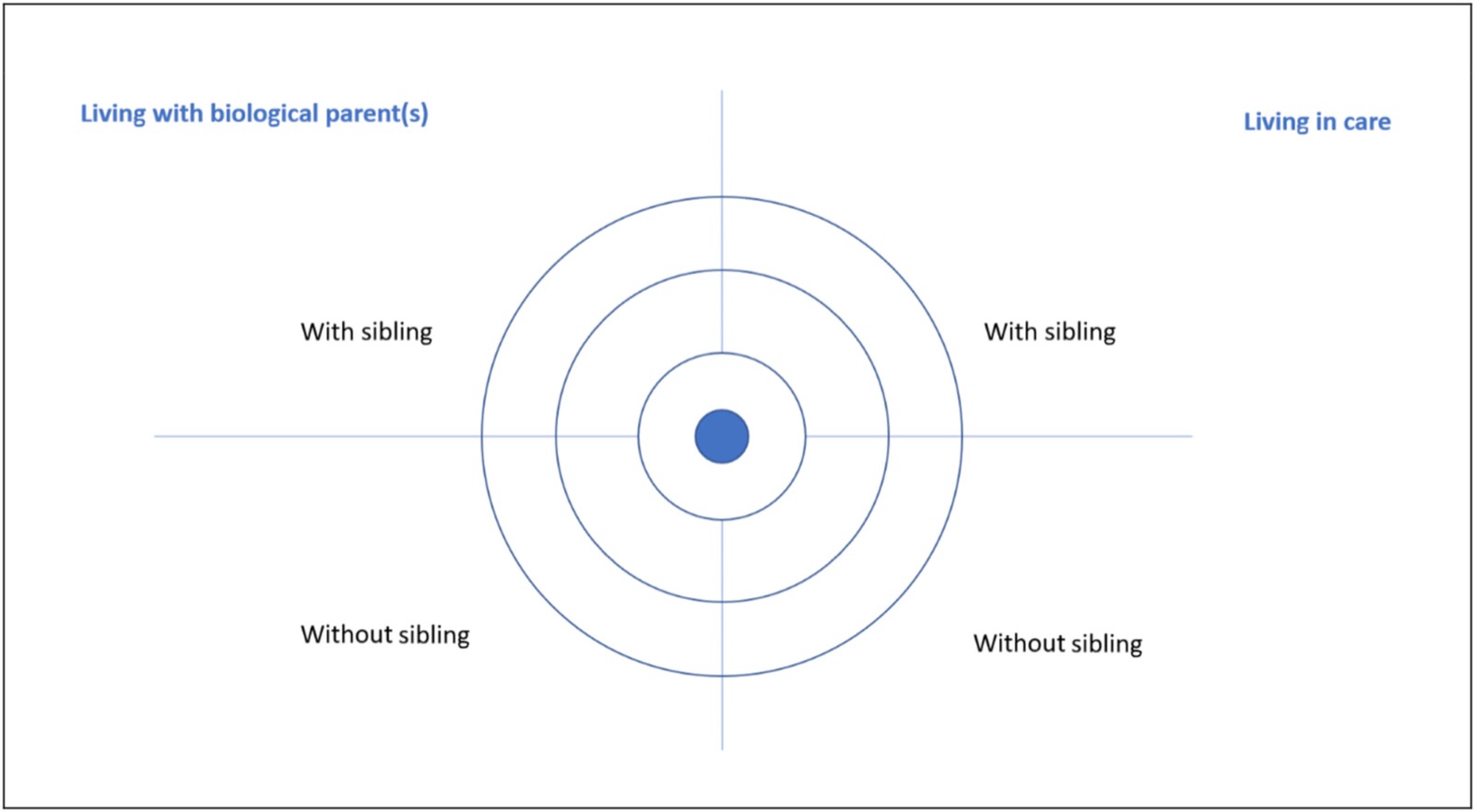
Interviews were conducted by the first author, who has professional expertise in children's social work. Participants underwent semi-structured interviews about their sibling experience during the analysed period. The word ‘Sibling’ is a biological, legal, cultural and/or relational term (Waid, 2014), and people's definition of a ‘real’ sibling vary. The interviews allowed for participants to talk about relationships that were meaningful to them and decide for themselves what they defined as a sibling relationship (Hegar & Rosenthal, 2011). Most talked about their biological siblings, albeit some mentioned step-siblings. Drawing on the social network theory, interviews explored the structure and quality of the ties between the siblings in participants' family network. We paid particular attention to what Borgatti et al. (2009) refers to as the affective nature of these ties, through which resources of love and support might flow. Interviews started with an overview of the structural features of the network: number of siblings in the family, birth order, year of removal from family and sibling age and gender. To obtain in-depth data on participants' reflections about the affective qualities and dynamics of sibling relationships over time (i.e., before and after removal) and space (from the biological home to the CWS environment), participants—together with the interviewer—drew maps of their personal sibling network (Figure 1). These maps were based on Samuelsson et al. (1996)'s study; specifically, the inner most circle represents participants; the concentric circles denote decreasing levels of closeness or affection between siblings in the network, and a quadrant is imposed on these concentric circles. These quadrants represent living with or separately from the sibling and whether participants are referring to the relationship before or after sibling removal when admitted to CWS care. Participants were asked to indicate the place on the diagram that best described their sibling relationship; they then justified the choice. Interview also explored the impact of these relationships on participants' well-being. Interviews lasted from 45 min to 2 h, were audio recorded, and transcribed verbatim—with participants' informed consent.
2.3 Analysis
Interviews were analysed concomitantly to data collection to explore emerging themes in future interviews. The first author (W.H.) anonymized the interview tapes, transcripts, and quotations. First, she divided the data into the following two data sets: those on sibling relationship in the biological home and those on sibling relationships after admission to CWS care. Then she conducted an inductive thematic analysis (Gibbs, 2007; Graneheim & Lundman, 2004). This involved familiarization, identification of meaning units and the assigning of a brief heading to each meaning unit (which summarized the connotation of each meaning unit) in an open coding process. These codes were then grouped into higher level categories, and the first author endeavoured to clearly rationalize the membership of each code by constantly comparing them. Themes and subthemes were constructed from the categories that appeared during the process of abstraction. To confirm the trustworthiness of the categorization and abstraction process (Shenton, 2004), conducted by the first author, the analysis was checked and discussed with the second author. Table 1 shows an illustration of the analytical process. The first author, whom is a native Norwegian speaker, translated the quotations into English, which were then checked by the second author, who is a native English speaker. We used QSR NVivo 12 to manage the data.
Table 1 — Illustration of the analytical process
For each meaning unit: condensed meaning unit (description close to the text; interpretation of the underlying meaning), subtheme and theme.
- Theme: Parentification. Subtheme: Destructive parentification.
- ‘I did 95% of the housework. It wiped me out because I needed to go to school after all’ Description: Experience the tasks as too big and get tired. Interpretation: Overburdening; Lack of time for schoolwork.
- ‘I took a lot of responsibility for them, because it was a lot… my mom was alcoholic, my dad was very violent. So I felt that I had to protect them all the time because they should live in a safe place’. Description: Protects siblings from intoxication and domestic violence. Interpretation: An overwhelming task; The task consists of creating physical and emotional security for siblings.
- ‘I took a lot of responsibility and that it is both positive and negative. It was good that I took the responsibility I did, but it became negative for me’. Description: Takes responsibility. Interpretation: The responsibility taken has positive consequences for siblings, but negative consequences for own development.
- ‘With my smaller siblings, I was very careful. I made lunches, I followed them for workouts, I did … yes, watched if they had done their homework. I made sure they got food, that they had it nice, took them to after school activities, ummm… with my younger siblings I probably had avery responsible relationship. That they should feel good all the time’. Description: Takes responsibility for practical tasks and provides emotional support to siblings. Interpretation: Larger practical and emotional tasks.
- ‘At first, I tried to help him because he meant so much and I had to. But then I felt consumed by him. I could not focus on my own stuff, and then…bang….I had a breakdown..not drug related but anxiety and depression’. Description: Helping his brother, the task becomes too big. Interpretation: The task became too congested, negatively affecting own mental health.
- Theme: Parentification. Subtheme: Adaptive parentification.
- ‘Yes, so they gave me a lot of joy. … (I)like to see that they mastered things, that they feel good, that they feel that become involved in something and manage it even they had a hard time. I help them to have fun, I made them smiled. It meant a lot to me’. Description: Helps siblings and is recognized for the work. Interpretation: The task provides opportunities to experience competence and mastery.
- ‘It gave me that feeling…., not that I'm doing things so well but a feeling that I'm now doing something right. Now I'm doing something positive for someone’. Description: Positive emotional feelings. Interpretation: The task of taking care of siblings provides joy and encouragement.
3 RESULTS
3.1 Sample description
All 25 participants were young people (age range of 16–22 years, average age 18.3). In total, participants had 86 siblings. There were nine boys and 16 girls, and all were removed from their biological families and placed in foster homes or CWS institutions (e.g., youth homes or apartments). Four participants were born outside of Norway, and two were children of immigrant parents. Participants had one to seven siblings (Table 2). Although all participants were removed from their biological families by the Norwegian CWS, the ages at which this occurred varied (Table 3). Most participants were separated from their siblings during some period along the transition to CWS care (n = 17), but removal circumstances and coplacement were complex and highly variable among participants (Table 4).
Table 2 — Number of siblings per participant
- Siblings: 1; Participants (n = 25): 3
- Siblings: 2; Participants (n = 25): 3
- Siblings: 3; Participants (n = 25): 9
- Siblings: 4; Participants (n = 25): 4
- Siblings: 5; Participants (n = 25): 3
- Siblings: 6; Participants (n = 25): 2
- Siblings: 7; Participants (n = 25): 1
Table 3 — Age of removal from biological family
- Age removed: 0–4; Participants (n = 25): 4
- Age removed: 5–10; Participants (n = 25): 5
- Age removed: 11–15; Participants (n = 25): 10
- Age removed: 16–17; Participants (n = 25): 6
Table 4 — Context of removal
- Living in care without sibling (from birth home) n = 17
- Child entered care together with a sibling for a short time (coplaced) but then the child was moved alone into a separate care setting (n = 4).
- Child entered care where sibling already lived. They then were separated from the sibling after several years together (n = 1).
- The child entered care alone and was separated from other siblings. These siblings were either moved to another care setting (23), or/and remained with the birth family (n = 10).
- The child entered care as the only child from the biological family. After a while they were joined by other siblings from the biological home (n = 1).
- The child entered care as the other sibling was already adult (n = 1).
- Living in care with one or more siblings (from birth home) n = 8
- The child entered care at the same time as sibling and had an intact sibling placement (coplaced) (n = 1).
- Child entered care with one of their siblings but was split from other siblings who entered other care settings or stayed at home with the birth family (coplaced and split) (n = 5).
- Child entered care where sibling already stayed but were separated from other siblings who remained in the birth family (n = 1).
- Child entered the care of a grown-up sibling, while other siblings remain in birth family (n = 1).
Two overarching themes arose from the analysis, each comprising of three and four themes respectively and summarized as follows:
Sibling relationship while still living with the biological family
- Alliances between siblings
- Parentification (sibling caretaking)
- Conflict or abuse between siblings
Pathways from the past to current sibling relationships when in care
- Close and supportive sibling relationships when in care
- Sibling relationship in care is in conflict
- Sibling relationship in care is distant
- Sibling relationship in care is broken
3.2 Sibling relationships while still living with the biological family
One of the 25 participants had no siblings before she moved into care, and four were so young when removed that they did not remember sibling relationships while in the birth family. The remainder, with experience of being with their siblings in the vulnerable family home, describe their sibling relationships during this period as a process of alliance formation between siblings, a process of parentification/sibling caretaking or a relationship that was conflictual or potentially abusive:
- Alliances between siblings
Some participants talked about sibling relationships in the biological home almost romantically; a sibling alliance/coalition or survival pathway in times of adversity; ‘In a way I only remember it as a good time’ (Boy, 17). They describe alliances as, what Whiteman et al. (2011) define as ‘a subsystem within families’ (p. 133). These formed as a means to survive common family hardships and in response to parental neglect/abuse. These siblings developed a separate relationship ‘zone’, characterized by high closeness, that, at times, worked against parents.
I would not have [been able to] manage it without my brother, […] he would not have managed it without me (Girl, 19).
Participants remembered mutual care and comfort doing homework together, buying things for each other, playing outside after school and taking part in social activities together. Knowing that they had a stable, loving sibling relationship was important to them. Some remembered quarrels, but that they reconciled afterwards. Despite relationship closeness and harmony and participants describing how they shared their frustrations and provided mutual support with their siblings, they did not discuss their poor care situation explicitly. They also reported the development of symmetrical, horizontal, equal-power sibling relationships defined by ‘give-and-take’ care.
- Parentification (sibling caretaking)
Other participants described asymmetrical sibling relationships in their biological home; they were either caregivers for or being cared for by their siblings. The direction of these relationships was not consistent; a sibling was sometimes a caregiver, and other times a care recipient. One participant talked about the relationship as a care task:
I made lunches; followed them for workouts, […] watched if they had done their homework, […] got food. […] I probably had a very responsible relationship; [I thought] that they should do well all the time (Girl, 19).
These care tasks could be practical like making dinner, food-shopping, preparing school lunches or taking siblings to after-school activities. Psychological care involved making siblings happy and comforting them. One participant said he, at 8 years old, would go to bed last to make sure his sisters and mother were sleeping well. Another one said:
My mom was an alcoholic and dad was very violent. I had to protect them all the time because they lived in such an unsafe place (Girl, 19).
Participants described taking responsibility for siblings' practical/psychological needs was enjoyable but difficult. Sibling caregivers remembered sacrificing homework and socialization time to ensure their siblings, and sometimes sick parents, were cared for. When sibling caregivers were mature enough and able to cope with caregiving, sibling relationships were described as an adaptive parentification process. When caregivers were too immature, not able to cope with care giving and experiencing physical/emotional consequences, relationships were described as a destructive parentification process. Generally, this sibling caretaking pattern, adaptive or destructive, was characterized by a lack of rivalry, quarrels, conflicts and fun, all of which are often seen in more common/horizontal sibling relationships. Sibling caregivers only talked about engaging in fun activities with siblings (e.g., playing outdoors) when they were in weekend homes, a situation in which adults were taking care of them.
- Conflict or abuse between siblings
Participants also reported some strong sibling conflict/abuse in the biological home. The conflicts were often severe enough to negatively influence siblings' normal daily activities (e.g., being with friends, engaging in school and homework, eating and sleeping). Sibling conflicts created ongoing tension in the home that was difficult to cope with, evoking long-term anxiety in affected siblings. Participants perceived these sibling conflicts as different from normal sibling conflicts, having a devastating impact on their well-being. One described the following:
It wasn't just siblings arguing; it was fierce arguing—it was bullying (Girl, 19).
Conflicts sometimes included parents and alliances formed between different family members; these sometimes led to violence: one girl reported sitting close to her dog, as protection against an abusive brother. Some participants reported psychological abuse/by siblings alone or together with parents. One explained that when sibling conflict began, her mentally ill mother would lock herself in the bedroom; this led to a chaotic home, conflict escalation and unclear, unstable sibling relationships. Participants also reported conflict when family members used each other for emotional regulation:
My brother could not be angry at my parents because they could not handle it, so he reacted against me (Girl, 18).
These conflicting siblings again did not discuss poor parental care nor the sibling relationship. They seemingly only reacted against one another.
3.3 Pathways from the past to current sibling relationships when in care
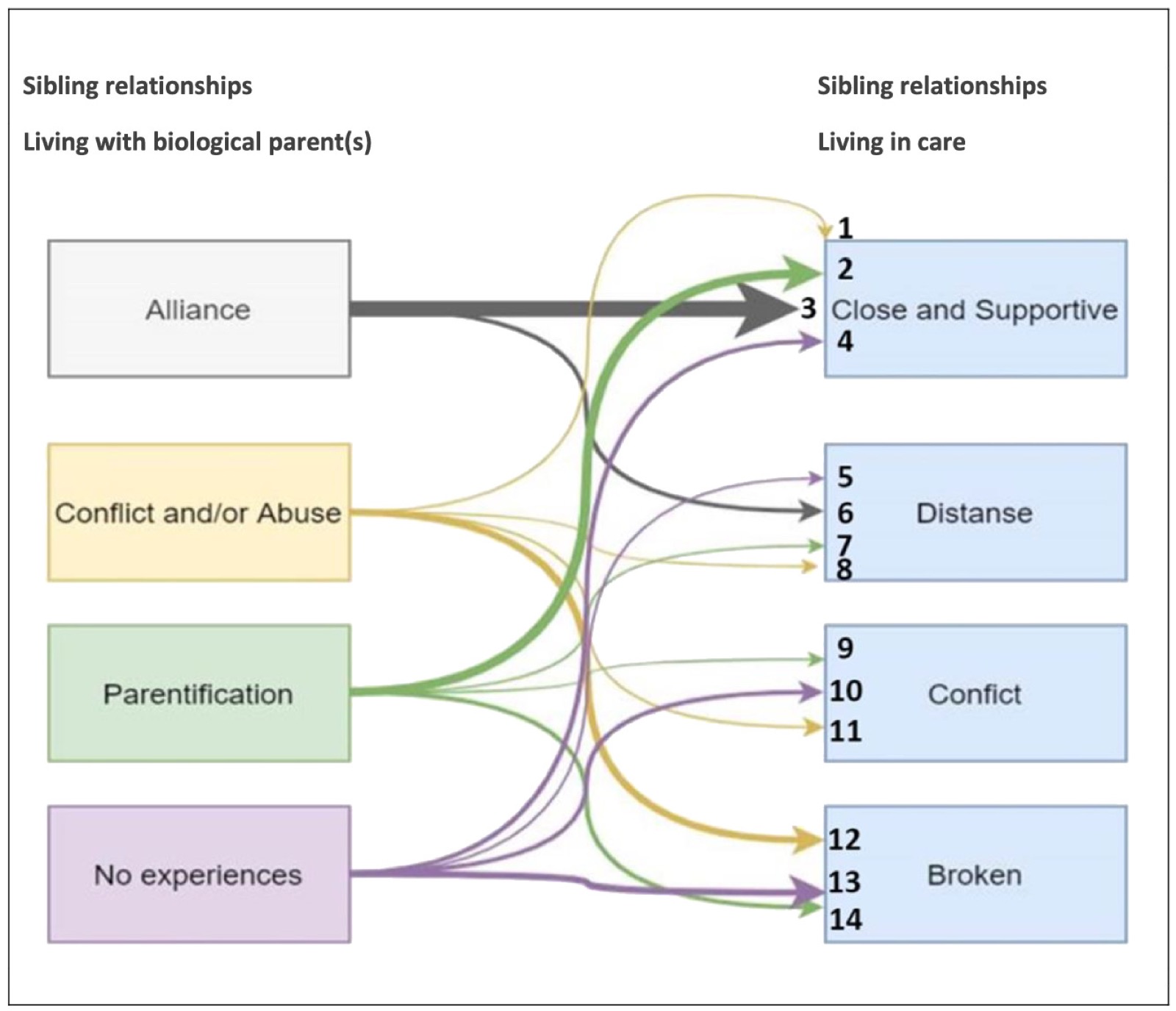
Participants described their current sibling relationships (i.e., after admission to CWS care) under the following four main themes: Close and supportive, Conflictual, Distant or Broken sibling relationships. Participants mentioned numerous transition pathways from the biological home to admission to CWS care-multiple permutations from the relationship before removal to the current one. We observed 14 different pathway descriptions from 25 interviewed participants (Figure 2). Many participants had several siblings, and the pathways usually varied depending on the specific sibling the participant was discussing.
- Close and supportive sibling relationships when in care
Sixteen participants described some or all of their current sibling relationships as close and supportive, deeming them essential for their well-being. Relationships were characterized by mutual care, support during hardships (both practical and emotional) and responsibility for each other's well-being:
So, if one has a hard time…just his presence makes things easier; [it makes things easier] than if I was alone (Girl, 20).
There were several differing onsets for such close relationships; some reported no major sibling relationship changes. They talked of strong alliances in the biological home that remained strong after admission to CWS care (from alliance to close and supportive relationships, arrow 3, Figure 2).
Other participants reported past conflictual relationships that eventually became close and supportive (from conflictual to close and supportive relationship, arrow 1, Figure 2). These participants developed a close sibling relationship after being separated from their siblings. Living apart allowed for individual development in different homes and the space to build stronger and reciprocal sibling relationships:
After I moved out, he started to take it out on dad, so now we have got a good relationship (Girl, 18).
Although separation seemed desirable for some, other participants found sustaining a positive sibling relationship at a distance challenging. Communication between siblings only through social media and/or phone calls was not always ideal. For others, communication with their siblings was not allowed to them by social workers at all. The latter were measures introduced by social workers to help younger siblings to bond with new foster families. Participants reported that this distance from siblings left them worried and uncertain about how to sustain their sibling relationships.
Some participants who reported parentification in the biological home and experienced sibling removal during admission to CWS care developed either conflictual or close, supportive relationships later on (From parentification to close and supportive relationships, arrow 2, or Parentification to conflict arrow 9, Figure 2). One girl described a challenging relationship with her brother; when she left the biological home to live alone, her brother stayed, and the zones and alliances in the family were disturbed. Thereafter, her brother formed an alliance with their mother against her, modifying their sibling relationship from a parentification to a conflictual one; this made her everyday life in her new foster home difficult. The relationship had since improved after this separation.
Some young people did not have any memory of past sibling relationships, but were, later on in their CWS life, coplaced with one of their siblings; these sibling relationships reportedly could also become close and supportive (From no previous experience/memory of the sibling to close and supportive, arrow 4, Figure 2).
- Sibling relationship in care is in conflict
Some participants described their current sibling relationships as conflictual and destructive. They were bullied or undermined by siblings, causing them pain. These conflictual relationships arose when siblings who were left with the family became resentful of the new opportunities given to the relocated sibling, or when coplaced siblings disagreed how to adapt to the foster home. There was little mention of support, empathy or love between these siblings. Some felt they should have good sibling relationships, but that conflict was too intense for this to be achieved. As with the pathways to strong, supportive relationships, pathways to conflict varied. For some young people, the original relationship was already conflictual. But equally, the relationship could have begun as a form of parentification or have been non-existent. For some, family trauma and jealousy in the past (e.g., the damage of living with drug addicted parents) had proven too much for their relationship and was never repaired (Conflict to conflict, arrow 11, Figure 2). Other young people, who had been in parentification relationships in the past, currently felt they had failed to live up to sibling expectations leading to poor relationships today (Parentification to conflict, arrow 9, Figure 2). Some, with no memory of the past relationship, were unable to build new sibling relationships and conflict ensued (No experience to Conflict, arrow 10, Figure 2).
Siblings conflict in the care setting continued or developed whether siblings were separated or not: for some being kept together meant they did not get the distance from each other required to save the relationship. For others, providing distance through separation still did not resolve their conflict and in fact, exacerbated the situation being sustained through phone calls, social media or meetings:
If you have strong conflicts with friends, you can end the relationships. But, it is not possible to end sibling relationships because they are siblings (Girl, 18).
- Sibling relationship in care is distant
Some participants described their current relationships as distant, that is, neither in conflict or strong/supportive but instead was ‘on hold’. Siblings described needing space for themselves to re-evaluate their expectations of their sibling relationships and that there was currently little contact. Some initially parentification relationships developed in this way, siblings wanting the distance provided by separation (Parentification to Distance, arrow 7, Figure 2). For example, one boy, engaged in parentification relationships with his siblings, described needing distance to develop as a person.
Distant sibling relationships also developed from relationships that had been alliances in the birth family (Alliance to Distance, arrow 6, Figure 2), with the new distance between the siblings being a release from these intense alliances. They have found living with siblings who had shared the same experiences of suffering and neglect as uncomfortable, especially if they knew the siblings were still struggling, and they could do nothing about this. For some, the distance was a welcome break from previously conflictual sibling relationships (Conflict to Distance, arrow 8, Figure 2).
Okay I can talk to them now, because now I do not live under the same roof as they anymore. But I'd rather avoid them. I know they are my siblings and I should say I care about them somehow, but I care very little (Girl, 18).
Distant relationship is characterized by minimal contact between siblings, but despite these, participants felt normative pressures to keep some contact, especially when celebrating birthdays and other special days. For others with no experiences of their siblings in the past, some felt it as too late to make contact and develop a meaningful relationship (No experience to Distance, arrow 5, Figure 2). Distance for most of these young people was achieved when the siblings were split when removed from biological parents. For some, this split was wanted, for others, the separation geographically made it difficult reshape their sibling relationships into the supportive one they ideally want. They repeatedly have to get to know each other at each infrequent meeting:
I think it's awful that they live so far away from me. With my little brother, it was 5 years since I had seen him (Girl, 16).
- Sibling relationship in care is broken
In this theme, siblings report no contact with each other now they are in care. Some had some contact after going into care but not anymore. Some had never established a relationship because of large age gaps or living in different birth families from birth (e.g., siblings from different parents). For some young people, this cessation of contact is deliberate. They do not phone siblings or make contact via social media and avoid places where they might meet. This is an act of self-preservation. These broken relationships arose from a range of beginnings: for some, the relationship in the home had been strong conflictual (Conflict to Broken, arrow 12, Figure 2), physically or psychologically violent leading to a complete relationship break down. Memories are so traumatic that young people need to break all contact in order to cope. One girl was abused by both parents and her brother. Another girl was used by the family as a scapegoat for family. Relationship breakdown also occurred because other siblings had serious problems, often related to drug use or mental health issues. It can be too painful or risky for the child to sustain these relationships and they fear the sibling will bring them down with them.
Parentification relationships also break down (Parentification to Broken, arrow 13, Figure 2). One girl had an older sister, who cared of her when they lived together with a mentally ill mother. They were dependent on each other but were also jealous of each other. There was no adult to help them manage and reshape their relationship and no contact at all seemed the only way forward.
A final pathway to a broken sibling relationship were those where no initial relationship (No Experience to Broken, Arrow 14, Figure 2). Here, young people spoke of older siblings that they only knew the name of or had never, or seldom, met in the past. They did not see the point of establishing a relationship with these siblings.
I do not think I can have an equal relationship with the two elders anyway, that chance has somehow gone (Girl, 19).
All the relationships that are broken today were either young people who had been split by Child Welfare when they were moved from birth family or who had grown up in another separately family.
4 DISCUSSION
Social networks, the quality of ties and the flow of resources within them are vital in our lives, and siblings play a central role in these networks—for good or bad (Gustavsson & Maceachron, 2010; Rast & Rast, 2014; Whelan, 2003; Wojciak, 2016; Wojciak et al., 2013).
Young people in care in this study place an emphasis on the significance of these sibling relationships for them. They expend much energy on constructing/reconstructing or destroying these. For some, it is the most important relationship in their lives, and they spend much time with, or thinking about, siblings. Constructing the sibling relationship is an ongoing process, and removal from the biological home is a major transitional event, as is starting school, developing close relationships and puberty (Conger et al., 2009). Even when sibling relationships seem destructive, these are central to the social network of young people in care, as it is for any young person (Sting, 2013). On the one hand, ongoing conflicts become a major focus for everyday life, and if unresolved, relationships can become distant, broken or conflictual. On the other hand, young people separated from siblings, but who still work hard to keep a close and supportive relationship with them, are also struggling. Young people describe both situations as exhausting, making it hard for them to live ordinary lives and compromising mental health. Managing the sibling relationship appears to have critical impact on their well-being now and in their future. If sibling relationships are thought to impact on young people's lives more than the parental relationship (Gustavsson & Maceachron, 2010), this may be especially true for young people in care.
Young people in this study describe sibling kinship ties in the biological family, in variable ways: siblings may act as parents or as allies but relationships may also be conflictual and abusive. For some, there is no direct contact with the siblings in their wider social network at this time. However, these initial sibling relationships are not set in stone but are dynamic features of the siblings' social network that reshape when young people leave the birth family and move into care. This reshaping of sibling relationships is an ongoing natural process for all young people as they mature, but for those in care, there are added challenges because of the removal from a vulnerable family situation and potential separation from one or more of their siblings. Some are struggling for reconciliation to improve the relationship while others take care of themselves by distancing themselves or breaking contact altogether. These dynamic features of the sibling relationships, means that initial status of the relationship in the biological home does not necessarily dictate the quality of the relationships in care. For example, relationships with strong conflict in the past can move to supportive and good relationships in current situations and vice versa.
The reshaping of sibling relationships that occurs during the transition into care is a complex process. This is reflected in the multiple pathways presented in Figure 2 that describe the potential ways through which sibling relationships can develop. For some young people, being taken into care strengthens sibling ties, unblocking channels within the network and allowing the flow of love and support between siblings in a reciprocal relation. However, for others, there may be the need to weaken ties or temporarily disconnect them (or connect them indirectly through a foster parent or social worker), so that the flow of negative energy between siblings may be averted. The pathway taken, and the impact on well-being, is unique to each young person and their varied circumstances. Each young person has their own way of handling each of their sibling relationships in the new context, and over time. They have different individual needs, sibling histories, social capacity and motivations for re-shaping their sibling relationships. Relationships will vary even within the same family. The complex, dynamic nature of sibling relationships described in our study and the challenges facing the construction, reconstruction or destruction of the relationship after removal of the child from the family make these challenges typical of so-called wicked problems (Rittel & Webber, 1973). As a ‘wicked problem’, the challenges facing young people in care are often difficult to define, are unique to each person and are in a constant state of flux, which suggest the solution to these challenges must similarly be flexible and dynamic also. There are likely to be many potential solutions to each family situation and a decision to coplace the young person or not, and in what circumstances, is not a question of what is right or wrong but what may be more or less acceptable at that time and for that individual. Any intervention introduced by the social worker is unlikely to have fast or immediate impact but each action they take is likely to be significant with long term impact. The eventual outcome for each young person is unlikely to be only the result of the coplacement intervention but be multifactorial, influenced by the nature of the original relationship (as highlighted in this study) but also personal characteristics and circumstance.
Despite the importance of sibling relationships for young people in care, there was little mention by young people of social worker engagement in supporting this relationship. Neither is there mention of reliance on any other key actor in the young person's network, who may offer support, such as the foster carer. It would seem, from the young person's perspective in the Norwegian context, that there is little systematic help with management of their sibling relationships. Young people must reshape these relationships themselves as best they can. It is possible that social workers, or foster carers, prioritize the parent–child relationship, paying less attention to the sibling relationship. These professionals should therefore be encouraged to monitor the sibling, as well as parental, relationships after removal to understand each young person's experiences of these. They need to support them reshape these relationships in the best interest of all in the sibling group, both if they are separated from each other but also if they are kept together. Help may be particularly required to build sibling relationships when children are young, when they depend most on an adult to build and maintain these relationships in such a way that benefits them (Drapeau et al., 2000; Richardson et al., 2017).
Social workers have key decisions to make on whether to separate siblings or not when moving a person into care. Some researchers advocate for coplacement of siblings (Hegar, 1988; Herrick & Piccus, 2005). Others point out that there is little empirical support for this (James et al., 2008; Linares et al., 2007). Our research suggests there is no definitive answer and that it is hard to predict the outcomes of a coplacement. Our research finds cases that supports research that some children do as well when placed together (Albert & King, 2008; Hegar, 2005; Hegar & Rosenthal, 2011; James et al., 2008; Jones, 2016; Wojciak et al., 2013). Coplacement can help siblings bond and minimizes the trauma children experience when separated from parents (Albert & King, 2008; Wojciak et al., 2013). Siblings feel more emotionally supported (Hegar & Rosenthal, 2011) and children report higher well-being than those in care alone (Davidson-Arad & Klein, 2011). Coplacement has been associated with fewer emotional and behavioural problems (Herrick & Piccus, 2005), less loneliness and depression (Milevsky, 2005), less placement disruptions (Leathers, 2005) and can speed up the reunification processes (Albert & King, 2008). On the other hand, our research also found there were some young people for whom separation had advantages. As in other studies (James et al., 2008; Jenkins & Dunn, 2009; Linares, 2006; Richardson et al., 2017; Ryan, 2002), not all children had close sibling relationships, and distance between siblings may be beneficial in some cases especially if sibling bullying and violence are prevalent. In our findings, some children specifically ask for distance even though they had had close sibling relationships in the past: they needed ‘space to find themselves’ or had found it too hard to be constantly reminded of the trauma they had lived under together.
Our findings also show that, while the data are clearly categorized into what young people remembered of their relationships in the biological family and how they saw them now that they were in care, the pathways between these time points are highly variable. It is premature therefore from this analysis to draw conclusions on how the circumstances of removal (together or separate placements) has impacted on these multiple pathways described in Figure 2. What our study contributes however is insight into the complexity of the context and the dimensions that make it up. Social workers and foster carers may desire standardized approaches to sibling coplacement. However, our analysis suggests that attempts to categorize the current state of sibling relationship by form of sibling coplacement may oversimplify a complex phenomenon. It may be that there is no one-size-fits-all solution for the form of sibling placement that should be followed by social workers and that each young person, and the sibling, be treated as an individual case. In line with Drapeau et al. (2000), the decision on whether to separate or coplace siblings is more complex than simply a yes or no. Instead, an individual assessment of each case is required. Social workers should take into account the type of sibling relationship in the biological home, but understand that sibling relationships that then develops in care are not a forgone conclusion. The type of placement that is best suited to the young person is likely to vary widely from one case to another. This complexity is illustrated in the pathways diagram (Figure 2) showing multiple and crisscrossing lines between themes connecting the nature of the sibling relationship before and after removal. The transition between the home and care, and its impact on sibling relationship, is far from a linear and discrete process.
5 LIMITATIONS AND THE WAY FORWARD
This is an exploratory study presenting the range and depth of participants' views. The sample descriptions (Tables 2–4) of the specific circumstances of the participants assure some transferability of the findings to other national and international settings. However, as a qualitative study, the sample size is characteristically small, and future quantitative research is now required to test some of the hypotheses created through the study. Key here is to explore in larger samples the prevalence/distribution of each pathway in the care population. In this small sample, no pattern was immediately obvious in terms of placement type largely because of the many varied characteristics of each participant themselves and their varied relationships/transition pathways with each of their siblings respectively. These dimensions however may now serve as the substantive content required for survey tools and quantitative multilevel analysis follow-up studies in which participants could be asked to name each sibling, whether they are separated or not from this sibling and to categorize the relationship with this named sibling in terms of before (parentification, none, alliance and conflict) and after being taken into care (close, conflict, distant and broken). This is now required to more definitively determine the impact of sibling coplacement. Larger scale surveys of this kind could also test if significant relationships can be detected between placement type (and other environmental factors including participant attributes of gender and size of sibling group) and each of 14 pathways described in our current study. These analyses will shed light on reasons why in some cases separation of siblings strengthens some sibling relationships but not others. These studies may also be able to control for some of these multiple environmental factors, that are likely to be influencing the sibling relationship, in addition to placement type.
Qualitatively, the interviews have also told us little of how exactly the processes of construction, reconstruction and destruction of the sibling relationship actually took place along the pathways highlighted in Figure 2. Apart from phone and social media, young people do not elaborate on how relationships are maintained or changed. We suggest this reflects a gap in competence in these young people. The paper recommends that, in the absence of children being able to articulate strategies of how to build positive sibling relationships, it is for social workers/foster carers to help them develop these. Currently, and from childrens' own reports, these adults do not yet provide them this support. Future research is required to explore if indeed social workers and foster carers do offer this support and, if so, how it is done. This could include investigating social workers/foster carer views of the benefits of developing in children various forms of communication style to use with their siblings, such as social media, but also helping them negotiate its dangers.
The view of the social worker/foster carer is also worth exploring as an alternative perspective to that of the young person. Not because the young person's report of their own experience is of lesser value, but as a different subjective view of reality that triangulates with that of the young person. It could maximize the chances of understanding the conditions needed to maximize the young person's well-being.
6 CONCLUSION
This paper aimed to explore young people's perceptions of how sibling relationships change when they move from the biological family into care. It shows sibling relationships to be important for young people and describes the quality of sibling ties when in the biological family (parentification, close, conflictual or nonexistent) and then the quality of these social ties when in care (broken, conflictual, close or distant). The study has uncovered multiple pathways in which the quality of these kinship ties change as the young person moves from the family into care. This suggests firstly the complexity and bespoke nature of this transition but also the possibility that an appropriate sibling relationship in care is possible regardless of the initial relationship in the biological home.
There is a need for a bespoke solution to the needs and circumstances of each sibling pair, that is difficult to predict or standardize, if the ideal sibling relationship for the young person is to be reached. We recommend that social workers, together with foster careers, place explicit focus on the dynamic construction of the sibling relationship when a child is removed from the home. Any decision on placement should be made on a person centred, flexible approach that allows for the changes in this dynamic relationship as best suits the child. Better strategies and tools to managing the reconstruction of the sibling relationships need to be explored and applied.
Complexe Systémique: key points
The study’s merit is to look at the sibling group as a living network rather than as a block to be placed together or apart. Before placement, the young people describe survival alliances, parentification that is sometimes sustaining and sometimes crushing, or conflicts that border on abuse; afterwards, close, conflictual, distant or broken ties, linked by fourteen pathways. The decisive point is that the relationship before does not predict the one after, and that coplacement is in itself neither a guarantee nor a mistake. For systemic practice, this invites us to assess each sibling bond in its own right, to hear the distance some request as protection rather than failure, and to actively support the rebuilding of bonds that these young people say they currently reshape without help. The limits lie in a small sample from a single municipality, retrospective accounts from only one member of each sibling group, and the absence of the perspective of social workers and foster carers. Read alongside the article on sibling stories of parental mental distress, and the article on high parental conflict as a wicked problem.
Notes from the original
Ethics statement. Ethical clearance for the study was obtained from the Privacy Ombudsman for research, the Norwegian Social Science Data Service (NSD).
Conflict of interest. The authors have no conflict of interest to declare.
References
Albert, V. N., & King, W. C. (2008). Survival analyses of the dynamics of sibling experiences in foster care. Families in Society, 89(4), 3–541. https://doi.org/10.1606/1044-3894.3819
Bank, L., Burraston, B., & Snyder, J. (2004). Sibling conflict and ineffective parenting as predictors of adolescent boys antisocial behavior and peer difficulties: Additive and interactional effects. Journal of Research on Adolescence, 14(1), 99–125. https://doi.org/10.1111/j.1532-7795.2004.01401005.x
Bank, S. P. (1992). Remembering and reinterpreting the sibling bond. In Children's sibling relationships: Developmental and clinical issues. Lawrence Erlbaum Associates.
Bank, S. P., & Kahn, M. D. (1982). The sibling bond. New York: Basic Books.
Barnes, J. A. (1954). Class and Committees in a Norwegian Island Parish. Human Relations, 7(1), 39–58. https://doi.org/10.1177/001872675400700102
Bat-Chava, Y., & Martin, D. (2002). Sibling relationships of deaf children: The impact of child and family characteristics. Rehabilitation Psychology, 47(1), 73–91. https://doi.org/10.1037/0090-5550.47.1.73
Borgatti, S. P., Mehra, A., Brass, D. J., & Labianca, G. (2009). Network analysis in the social sciences. Science, 323(5916), 892–895. https://doi.org/10.1126/science.1165821
Bornstein, M. H., Davidson, L., Keyes, C. L. M., Moore, K. A., & Foege, W. H. (2003). Well-being: Positive development across the life course. London: Psychology Press. https://doi.org/10.4324/9781410607171
Bott Spillius, E. (1957). Family and social network roles, norms and external relationships in ordinary urban families. London: Tavistock.
Brody, G. H., Stoneman, Z., & McCoy, K. J.(1992). Associations of maternal and paternal direct and differential behavior with sibling relationships: Contemporaneous and longitudinal analyses. Child Development, 63(1), 82–92.
Bunkholdt, V. (2017). Fosterhjemsarbeid: Fra Rekruttering Til Tilbakeføring. 4. Utg. Gyldendal akademisk.
Burton, L. (2007). Childhood Adultification in economically disadvantaged families: A conceptual model. Family Relations, 56(4), 329–345. https://doi.org/10.1111/j.1741-3729.2007.00463.x
Byng-Hall, J. (2008). The significance of children fulfilling parental roles: Implications for family therapy. Journal of Family Therapy, 30(2), 147–162. https://doi.org/10.1111/j.1467-6427.2008.00423.x
Caelli, K., Ray, L., & Mill, L. (2003). “Clear as mud”: Toward greater clarity in generic qualitative research. International Journal of Qualitative Methods, 2(2), 1–13. https://doi.org/10.1177/160940690300200201
Conger, K. J., Clare, S., McGuire, S., Kramer, L., & Conger, K. J. (2009). Sibling socialization: The effects of stressful life events and experiences. New Directions for Child and Adolescent Development, 2009(126), 45–59. https://doi.org/10.1002/cd.256
Davidson-Arad, B., & Klein, A. (2011). Comparative well being of Israeli youngsters in residential care with and without siblings. Children and Youth Services Review, 33(11), 2152–2159. https://doi.org/10.1016/j.childyouth.2011.06.022
Dirks, M. A., Persram, R., Recchia, H. E., & Howe, N. (2015). Sibling relationships as sources of risk and resilience in the development and maintenance of internalizing and externalizing problems during childhood and adolescence. Clinical Psychology Review, 42, 145–155. https://doi.org/10.1016/j.cpr.2015.07.003
Downey, D. B., & Condron, D. J. (2004). Playing well with others in kindergarten: The benefit of siblings at home. Journal of Marriage and Family, 66(2), 333–350. https://doi.org/10.1111/j.1741-3737.2004.00024.x
Drapeau, S., Simard, M., Beaudry, M., & Charbonneau, C. (2000). Siblings in family transitions. Family Relations, 49(1), 77–85. https://doi.org/10.1111/j.1741-3729.2000.00077.x
Dunn, J. (2000). State of the art: Siblings. Psychologist, 13(5), 244.
Dunn, J., Brown, J., Slomkowski, C., Telsa, C., & Youngblade, L. (1991). Young children's understanding of other people's feelings and beliefs: Individual differences and their antecedents. Child Development, 62(6), 1352–1366. https://doi.org/10.1111/j.1467-8624.1991.tb01610.x
Dunn, J., Brown, J. R., & Maguire, M. (1995). The development of children's moral sensibility: Individual differences and emotion understanding. Developmental Psychology, 31(4), 649–659. https://doi.org/10.1037/0012-1649.31.4.649
East, P. L., & Khoo, S. K.(2005). Longitudinal pathways linking family factors and sibling relationship qualities to adolescent substance use and sexual risk behaviors. Journal of Family Psychology, 19(4), 571–580.
Fabing, C. J., Bossard, J. H. S., & Boll, E. S. (1956). The large family system. The American Catholic Sociological Review, 17(3), 252. https://doi.org/10.2307/3709245
Falch-Eriksen, A. (2017). Søsken og plassering i fosterhjem: Rapport om utfordringer, hindringer og tiltak ved søskenplassering i fosterhjem (Vol. 11/17). Oslo: NOVA.
Feinberg, M. E., & Hetherington, E. M. (2001). Sibling differentiation in adolescence: Implications for behavioral genetic theory. Child Development, 71(6), 1512–1524. https://doi.org/10.1111/1467-8624.00243
Garcia, M. M., Shaw, D. S., Winslow, E. B., & Yaggi, K. E. (2000). Destructive sibling conflict and the development of conduct problems in young boys. Developmental Psychology, 36(1), 44–53. https://doi.org/10.1037/0012-1649.36.1.44
Gibbs, G. R. (2007). Analyzing qualitative data. London: SAGE. https://doi.org/10.4135/9781849208574
Graneheim, U. H., & Lundman, B. (2004). Qualitative content analysis in nursing research: Concepts, procedures and measures to achieve trustworthiness. Nurse Education Today, 24(2), 105–112. https://doi.org/10.1016/j.nedt.2003.10.001
Gustavsson, N., & Maceachron, A. (2010). Sibling connections and reasonable efforts in public child welfare. Families in Society, 91(1), 39–44. https://doi.org/10.1606/1044-3894.3956
Hegar, R. L. (1988). Legal and social work approaches to sibling separation in foster care. Child Welfare, 67(2), 113–121.
Hegar, R. L. (2005). Sibling placement in foster care and adoption: An overview of international research. Children and Youth Services Review, 27(7), 717–739. https://doi.org/10.1016/j.childyouth.2004.12.018
Hegar, R. L., & Rosenthal, J. A. (2011). Foster children placed with or separate from siblings: Outcome based on a national sample. Children and Youth Services Review, 33(1), 1245–1253. https://doi.org/10.1016/j.childyouth.2011.02.020
Henry, D. L. (2005). The 3–5–7 model: Preparing children for permanency. Children and Youth Services Review, 27(2), 197–212. https://doi.org/10.1016/j.childyouth.2004.09.002
Herrick, M. A., & Piccus, W. (2005). Sibling connections: The importance of nurturing sibling bonds in the foster care system. Children and Youth Services Review, 27(7), 845–861. https://doi.org/10.1016/j.childyouth.2004.12.013
Hetherington, E. M. (1989). Coping with family transitions: Winners, losers, and survivors. Child Development, 60(1), 1–14. https://doi.org/10.2307/1131066
Hollows, A., & Nelson, P. (2006). Equity and pragmatism in judgement-making about the placement of sibling groups. Child & Family Social Work, 11(4), 307–315. https://doi.org/10.1111/j.1365-2206.2006.00410.x
Hooper, L., Doehler, K., Wallace, S., & Hannah, N. J. (2011). The parentification inventory: Development, validation, and cross-validation. The American Journal of Family Therapy, 39(3), 226–241. https://doi.org/10.1080/01926187.2010.531652
James, S., Monn, A. R., Palinkas, L. A., & Leslie, L. K. (2008). Maintaining sibling relationships for children in foster and adoptive placements. Children and Youth Services Review, 30(1), 90–106. https://doi.org/10.1016/j.childyouth.2007.07.001
Jenkins, J. (1992). Sibling relationships in disharmonious homes: Potential difficulties and protective effects. In F. Boer & D. J. Hillsdale (Eds.), Children's sibling relationships: Developmental and clinical issues. Lawrence Erlbaum Associates.
Jenkins, J., & Dunn, J. (2009). Siblings within families: Levels of analysis and patterns of influence. New Directions for Child and Adolescent Development, 126, 79–93. https://doi.org/10.1002/cd.258
Jones, C. (2016). Sibling relationships in adoptive and fostering families: A review of the international research literature. Children & Society, 30(4), 324–334. https://doi.org/10.1111/chso.12146
Kim, J., Mchale, S. M., Wayne Osgood, D., & Crouter, A. C. (2006). Longitudinal course and family correlates of sibling relationships from childhood through adolescence. Child Development, 77(6), 1746–1761. https://doi.org/10.1111/j.1467-8624.2006.00971.x
Kramer, L., & Kowal, A. K. (2005). Sibling relationship quality from birth to adolescence: The enduring contributions of friends. Journal of Family Psychology, 19(4), 503–511. https://doi.org/10.1037/0893-3200.19.4.503
Leathers, S. J. (2005). Separation from siblings: Associations with placement adaptation and outcomes among adolescents in long-term foster care. Children and Youth Services Review, 27(7), 793–819. https://doi.org/10.1016/j.childyouth.2004.12.015
Linares, L. O. (2006). An understudied form of intra-family violence: Sibling-to-sibling aggression among foster children. Aggression and Violent Behavior, 11(1), 95–109. https://doi.org/10.1016/j.avb.2005.07.001
Linares, L. O., Li, M., Shrout, P. E., Brody, G. H., & Petti, G. S. (2007). Placement shift, sibling relationship quality, and child outcomes in Foster Care: A controlled study. Journal of Family Psychology, 21(4), 736–743. https://doi.org/10.1037/0893-3200.21.4.736
Lundström, T., & Sallnäs, M. (2012). Sibling contact among Swedish children in foster and residential care—Out of home care in a family service system. Children and Youth Services Review, 34(2), 396–402. https://doi.org/10.1016/j.childyouth.2011.11.008
McBeath, B., Kothari, B. H., JBlakeslee, J., Lamson-Siu, E., Bank, L., Linares, L. O., Waid, J., Sorenson, P., Jimenez, J., Pearson, E., & Shlonsky, A. (2014). Intervening to improve outcomes for siblings in foster care: Conceptual, substantive, and methodological dimensions of a prevention science framework. Children and Youth Services Review, 39(4), 1–10. https://doi.org/10.1016/j.childyouth.2013.12.004
McHale, S. M., Crouter, A. C., McGuire, S. H., & Updegraff, K. A. (1995). Congruence between mothers' and fathers' differential treatment of siblings: Links with family relations and children's well-being. Child Development, 66(1), 116–128. https://doi.org/10.1111/j.1467-8624.1995.tb00859.x
Milevsky, A. (2005). Compensatory patterns of sibling support in emerging adulthood: Variations in loneliness, self-esteem, depression and life satisfaction. Journal of Social and Personal Relationships, 22(6), 743–755. https://doi.org/10.1177/0265407505056447
Milevsky, A. (2011). Sibling relationships in childhood and adolescence: Predictors and outcomes. New York: Columbia University Press. https://doi.org/10.7312/mile15708
Moreno, J. L. (1934). Who shall survive?: A new approach to the problem of human interrelations. Washington: Nervous and Mental Disease Publishing Co (APA Psycbooks). https://doi.org/10.1037/10648-000
Noller, P., Feeney, J. A., Sheehan, G., Darlington, Y., & Rogers, C. (2008). Conflict in divorcing and continuously married families: A study of marital, parent–child and sibling relationships. Journal of Divorce & Remarriage, 49(1–2), 1–24. https://doi.org/10.1080/10502550801971223
NOU 2018:18. (2018). Trygge Rammer for Fosterhjem. https://www.regjeringen.no/no/dokumenter/nou-2018-18/id2622734/
Panish, J., & Stricker, G. (2001). Parental marital conflict in childhood and influence on adult sibling relationships. Journal of Psychotherapy in Independent Practice, 2(1), 3–16. https://doi.org/10.1300/J288v02n01_02
Pike, A., Coldwell, J., & Dunn, J. F. (2005). Sibling relationships in early/middle childhood: Links with individual adjustment. Journal of Family Psychology, 19(4), 523–532. https://doi.org/10.1037/0893-3200.19.4.523
Pinel-Jacquemin, S., Cheron, J., Favart, E., Clémence, D., & Scelles, R. (2012). Violence among siblings and joint placement: A review of the literature. Early Child Development and Care, 188(7), 963–980. https://doi.org/10.1080/03004430.2012.699965
Prochaska, J. M., & Prochaska, J. O. (1985). Children's views of the causes and “cures” of sibling rivalry. Child Welfare: Journal of Policy, Practice, and Program, 64(4), 427–433.
Rast, J., & Rast, J. E. (2014). Neighbor to family: Supporting sibling groups in foster care. Families in Society, 95(2), 83–91. https://doi.org/10.1606/1044-3894.2014.95.11
Richardson, S. M., & Yates, T. M. (2014). Siblings in foster care: A relational path to resilience for emancipated foster youth. Children and Youth Services Review, 47, 378–388. https://doi.org/10.1016/j.childyouth.2014.10.015
Richardson, V., Boylan, J., & Brammer, A. (2017). Contact, welfare and children in care: Revisiting the significance of birth family relationships after finding significant harm. Journal of Social Welfare and Family Law, 39(1), 67–82. https://doi.org/10.1080/09649069.2016.1275124
Riggio, H. R. (2001). Relations between parental divorce and the quality of adult sibling relationships. Journal of Divorce & Remarriage, 36(1–2), 67–82. https://doi.org/10.1300/J087v36n01_04
Rittel, H. W. J., & Webber, M. M. (1973). Dilemmas in a general theory of planning. Policy Sciences, 4(2), 155–169. https://doi.org/10.1007/BF01405730
Ryan, E. (2002). Assessing sibling attachment in the face of placement issues. Clinical Social Work Journal, 30(1), 77–93. https://doi.org/10.1023/A:1014278412336
Samuels, H. R.(1980). The effect of an older sibling on infant locomotor exploration of a new environment. Child Development, 51(2), 607–609.
Samuelsson, M., Thernlund, T., & Ringstrom, J. (1996). Using the five field map to describe the social network of children: A methodological study. International Journal of Behavioral Development, 19(2), 327–345. https://doi.org/10.1177/016502549601900206
Seale, C. E., & Damiani-Taraba, G. (2017). Always together? Predictors and outcomes of sibling co-placement in foster care. Child Welfare, 95(6), 1–28.
Shanahan, L., McHale, S. M., Crouter, A. C., & Osgood, D. W. (2008). Linkages between parents' differential treatment, youth depressive symptoms, and sibling relationships. Journal of Marriage and Family, 70(2), 480–494. https://doi.org/10.1111/j.1741-3737.2008.00495.x
Sheehan, G., Darlington, Y., Noller, P., & Feeney, J. (2004). Children's perceptions of their sibling relationships during parental separation and divorce. Journal of Divorce & Remarriage, 41(1–2), 69–94. https://doi.org/10.1300/J087v41n01_05
Shenton, A. K. (2004). Strategies for ensuring trustworthiness in qualitative research projects. Education for Information, 22(2), 63–75. https://doi.org/10.3233/EFI-2004-22201
Shlonsky, A., Webster, D., & Needell, B. (2003). The ties that bind: A cross-sectional analysis of siblings in foster care. Journal of Social Service Research, 29(3), 27–52. https://doi.org/10.1300/J079v29n03_02
Smith, T. E. (1993). Growth in academic achievement and teaching younger siblings. Social Psychology Quarterly, 56(1), 77–85. https://doi.org/10.2307/2786647
Spitze, G., & Trent, K. (2006). Gender differences in adult sibling relations in two-child families. Journal of Marriage and Family, 68(4), 977–992. https://doi.org/10.1111/j.1741-3737.2006.00308.x
SSB. (2019, 25.11.2020). Barnevern. https://www.ssb.no/barneverng
Sting, S. (2013). Sibling relations in alternative child care results of a study on sibling relations in SOS Children's villages in Austria. Kriminologija & Socijalna Integracija, 21(1), 119–128.
Sulloway, F. J. (1996). Born to rebel: Birth order, family dynamics, and creative lives. New York: Pantheon Books.
Sulloway, F. J. (2007). Birth order and intelligence. Science (American Association for the Advancement of Science), 316(5832), 1711–1712. https://doi.org/10.1126/science.114474
Sundvollen-erklæringen. (2013). Politisk Plattform for En Regjering utgått Fra Høyre og Fremskrittspartiet: Sundvollen. https://www.regjeringen.no/no/dokumenter/politisk-plattform/id743014/
Thorpe, M., & Swart, G. T. (1992). Risk and protective factors affecting children in foster care: A pilot study of the role of siblings. The Canadian Journal of Psychiatry, 37(9), 616–622. https://doi.org/10.1177/070674379203700904
Vinnerljung, B., Sallnäs, M., & Berlin, M. (2017). Placement breakdowns in long-term foster care—A regional Swedish study. Child & Family Social Work, 22(1), 15–25. https://doi.org/10.1111/cfs.12189
Volling, B. L. (1997). The family correlates of maternal and paternal perceptions of differential treatment in early childhood. Family Relations, 46(3), 227–236. https://doi.org/10.2307/585120
Volling, B. L. (2003). Sibling relationships. In M. H. Brostein, L. Davidson, C. L. M. Keyes, & K. A. More (Eds.), Well-being: Positive development across the life course, crosscurrents in contemporary psychology. Lawrence Erlbaum Associates. https://doi.org/10.4324/9781410607171
Waid, J. (2014). Sibling foster care, placement stability, and well-being: A theoretical and conceptual framework. Journal of Family Social Work, 17(3), 283–297. https://doi.org/10.1080/10522158.2014.885474
Ward, M. (1984). Sibling ties in foster care and adoption planning. Child Welfare, 63(4), 321–332.
Whelan, D. (2003). Using attachment theory when placing siblings in foster care. Child and Adolescent Social Work Journal, 20(1), 21–36. https://doi.org/10.1023/A:1021463302680
Whiteman, S. D., McHale, S. M., & Soli, A. (2011). Theoretical perspectives on sibling relationships. Journal of Family Theory & Review, 3(2), 124–139. https://doi.org/10.1111/j.1756-2589.2011.00087.x
Whiting, J. B., & Lee, R. E. (2003). Voices from the system: A qualitative study of Foster Children's stories. Family Relations, 52(3), 288–295. https://doi.org/10.1111/j.1741-3729.2003.00288
Wiehe, V. R. (1997). Sibling abuse: Hidden physical, emotional, and sexual trauma. London: Sage.
Wojciak, A. S. (2016). ‘It's complicated.’ Exploring the meaning of sibling relationships of youth in foster care. Child & Family Social Work, 22(3), 1283–1291. https://doi.org/10.1111/cfs.12345
Wojciak, A. S., McWey, L. M., & Helfrich, C. M. (2013). Sibling relationships and internalizing symptoms of youth in foster care. Children and Youth Services Review, 35(7), 1071–1077. https://doi.org/10.1016/j.childyouth.2013.04.021
Yates, P. (2018). Siblings as better together: Social worker decision making in cases involving sibling sexual behaviour. British Journal of Social Work, 48(1), 176–194. https://doi.org/10.1093/bjsw/bcx018
Reformatted republication of The quality and developmental pathways in sibling relationships: A qualitative study of Norwegian children admitted to child welfare service care, by Wenche Hovland and Sarah Hean, Child & Family Social Work, vol. 26, no 4 (2021), doi: 10.1111/cfs.12838, under a CC BY 4.0 licence. Edition and layout: Complexe Systémique, September 2026 — the work has been modified under the terms of the licence (tables presented as lists). Neither the authors nor the publisher are responsible for this edition; the original version prevails.
This is the original article “The quality and developmental pathways in sibling relationships: A qualitative study of Norwegian children admitted to child welfare service care”, published in Child & Family Social Work (2021) under a CC BY 4.0 licence. Republished by Complexe Systémique: the author’s text is unchanged; only the presentation has been adapted for reading online, as set out at the head of this page.
Read the original articleHow to cite this article
Hovland, W., et Hean, S. (2021). The quality and developmental pathways in sibling relationships: A qualitative study of Norwegian children admitted to child welfare service care. Complexe Systémique. https://app.complexe-systemique.com/en_GB/articles/the-quality-and-developmental-pathways-in-sibling-relationships-a-qualitative-study (Original work published in 2021 in Child & Family Social Work, 26(4), 559-571 (2021); republished in 2021 by Child & Family Social Work, https://onlinelibrary.wiley.com/doi/full/10.1111/cfs.12838)
To go further
- Récits de fratries face à la souffrance psychique parentaleSiblings facing parental distress.
- « Comme marcher sur du verre » : l’expérience émotionnelle de la parentification dans l’enfanceParentification lived as a child.
- Blessure, perte, joie et pardon : les relations de jeunes adultes ayant connu le placement avec leurs parents de naissanceAfter care, the birth parents.
Related training courses
 Short course
The suicidal crisis in adolescents and young adults
Training: assessing and supporting the suicidal crisis in adolescents and young adults. Clinical landmarks and systemic tools. In French.
 Symposium
The Abnormal Normals and the Normal Abnormals
Conference replay: six clinicians explore normality — diagnoses, norms, adolescents, therapists. Immediate, lifetime access. Talks in French.
Related articles
 Scientific
Family group conference provision across the lifespan of child welfare intervention: A mixed-method realist-informed evaluation comparing three stages of welfare concern
Early help, child protection or children in care: among 155 UK families, experiences and outcomes of family group conferences vary very little by stage.
 Scientific
How can we BeST? meet the needs of adoptive families? Relevant findings from a major Randomised Controlled Trial of infants in foster care in the UK
The BeST? trial (488 infants in care in the UK) reread for adoption: holistic, ongoing assessment of children and a move to dual registration.
 Scientific
Internal Family Systems Therapy as Part of the ‘Family of Systemic Therapies’: A Critical Exploration of Systemic Practice in the Intra-Personal Domain
Does IFS belong to the family of systemic therapies? A critical exploration, grounded in a family court vignette, of systemic work with “parts”.
 Scientific
Implementing Family Group Decision-Making within statutory child protection social work in Scotland: Challenges and opportunities
Family group decision-making offered automatically in Scottish child protection: families find a voice, social workers doubt the plans, and everyone wants it offered earlier.