AI-assisted translation
This version was translated from French by Complexe Systémique with the help of artificial intelligence. In case of doubt, the original version prevails.
The craft · Being a therapist
Are therapists normal people?
I asked myself this question fairly early in my practice. Not because I had read a learned paper on the subject, but because, very concretely, I was doing things other people found surprising. What if normality were not a verdict to endure, but something to work with?
I could use humour where seriousness was expected. Allow myself a step sideways where I would have been advised to “stay within the frame”. Ask a question that shifts the story instead of confirming it. And sometimes, coming out of a session, I felt that peculiar mixture: the satisfaction of having opened something up… and the vague embarrassment of not resembling the image of the “shrink” I carried in my head.
That was when Robert Neuburger came to matter to me. Not as an injunction to do “as he did”, but as permission to think differently. His ideas — so acute in the way they grasp relationships, loyalties, the games of position and the share of social construction in what we take for granted — helped me look at this question no longer as an identity test (“Am I normal?”) but as a clinical angle (“Which normality are we talking about, and what is it for?”). And everything changed: normality became something to work with, not a verdict.
What the word “normal” carries with it
The word already carries a history. Norma is the carpenter’s square: the tool that traces the correct angle. Nomos is the law, the established order, what distributes and what classifies.
And we slide very quickly from a description (“this is frequent”) to a prescription (“this is desirable”). Georges Canguilhem showed it very well: a norm is never merely an observation, it is also a way of saying what ought to be.
“What if the norm were not the opposite of madness… but its twin sister?”
A provocative idea, but a useful one in clinical work
Because in session, you see it: what causes suffering is not always the symptom. Sometimes it is the invisible norm that judges it, locks it in, or prevents it from making sense.
Three regimes of normality
To find my bearings, I distinguish three regimes, which do not say the same thing at all.
1
Statistical normality
The average, the frequencies, the measured ordinary. It is useful for orientation. But if we turn the average into an ideal, we crush singularities.
2
Social normality
What the group values or sanctions. It changes with eras, milieus and cultures. What is normal here may be odd elsewhere.
3
Vital normativity
The capacity, for a person or a system, to invent norms that hold in the situation, to reorganise in the face of life’s accidents. Here, normal does not mean compliant, but liveable.
And that is where I situate our profession: we navigate constantly between these three regimes. We converse with statistical markers, we work in worlds saturated with social norms, and above all we try to support vital normativity: what makes life breathable.
A new factory of the normal: algorithmic normalisation
A major shift is under way: the norm is no longer only familial, cultural or institutional. It is also media-driven and algorithmic.
Platforms do not merely show the world: they manufacture a version of it. And they manufacture the normal through three very simple mechanisms.
- Repeat: hear an idea often enough and you find it plausible.
- Inflate: a minority viewpoint can look like a majority one inside a digital bubble.
- Install: whatever is made hyper-visible becomes the main object of our attention.
The result: perceived normality depends less on relevance than on sheer quantity of exposure.
In the consulting room, we see the effects every day. A teenage girl who feels abnormal because her body does not look like what she sees twenty times a day. A father who experiences himself as a failure because he does not match the economic showcase of his feed. An exhausted mother trying to meet the standard of perfect parents.
In this context, part of our work consists in helping people take back control of their representations. Not by telling them “that is false”, but by making the manufacture of the norm visible to them.
Deviation is not a void: it is a signal
A sentence from Canguilhem often stays with me: “abnormal” does not mean the absence of a norm. It means deviation. And deviation is not a void: it is a signal. Often, without the deviation, the rule stays invisible. It is the abnormal that reveals the norm and makes it discussable. In a family, the abnormal is sometimes a highlighter: it shows where the rule needs renegotiating.
Today, when I hear “that is not normal”, I ask four questions.
- By which norm?
- Compared to what?
- For whose benefit?
- At what cost?
These questions immediately shift the scene: we leave the courtroom (“this is good / this is bad”) and enter exploration (“what is this for, here, now?”).
When the norm becomes a silent weapon
Normalisation can do good… or do harm. It becomes toxic when it shrinks variety for the convenience of a third party, or when it serves to restore a power relation under cover of common sense. Two filters help me discern.
- With whom are the criteria built? If the criteria come from one person and serve the interests of that one person, the norm becomes a weapon of power.
- Who are they useful to, here and now? If the rule mainly reassures whoever already holds the power, it is not caring.
Normalising should never mean “making compliant”, but making possible the coexistence of several ways of functioning, without humiliation or domination.
And us, the therapists: normal or not?
I like the idea of irreverent curiosity: staying curious without excessive reverence towards the first version of the problem. For me, irreverence is not cynicism, it is a benevolent desacralisation — and a good reason to look closely at what we call neutrality.
And my ethics, if I have to sum them up, fit in one sentence: act so as to widen the range of possibilities. Every time an intervention opens up a possibility of thinking or acting otherwise, it heals. Every time it closes one down, it becomes power.
In a world that manufactures the normal through repetition, inflation and saturation, I believe our work is almost an act of quiet resistance: injecting variety in the right place. Refusing normopathy, that normality which anaesthetises whatever is alive.
So, are therapists normal people? I think we are fighting the wrong battle when we try to be normal. What I want is to be alive, singular, coherent with myself, and free enough not to let myself be reduced by dominant narratives. Because they assail us continuously: ready-to-wear stories, models of success, simplified definitions of what a couple, a parent, a professional, a body, a life that is “going well” should be. And the more these narratives impose themselves, the greater our responsibility: not to mistake them for reality.
Worth keeping
Let us cultivate our differences and carry them with pride. Not as a narcissistic flag, but as embodied proof that a human being cannot be locked into a single version of themselves.
In this world saturated with self-evidence, I want therapists to be scouts: the ones who calmly but firmly remind us that the world is always more complex than it looks, and that complexity is not a problem… it is often the way out.
Personally, I am a therapist. I am also a tank warrior in World of Warcraft, a geek, a devoted reader of Victor Hugo and Romain Gary, a hypochondriac in remission. None of that makes me less credible. It makes me more human. And that may well be, in the end, one of the conditions of care.
Reading markers
- Georges Canguilhem, Le normal et le pathologique.
- W. Ross Ashby, An Introduction to Cybernetics.
- Gianfranco Cecchin, Hypothesizing, circularity, and neutrality revisited.
- Gregory Bateson, Steps to an Ecology of Mind.
- Henri Nouwen, The Wounded Healer.
- Michael White & David Epston, Narrative Means to Therapeutic Ends.
- Robert Neuburger, clinical and systemic work on couples, families, loyalties and relational norms.
The spoken version of this reflection, with a few extra detours, is just below — in French.
How to cite this article
Besse, J. (2026, January 4). Are therapists normal people?. Complexe Systémique. https://app.complexe-systemique.com/en_GB/articles/are-therapists-normal-people
To go further
- Yes, even your therapist judges you…The therapist judges too: the whole question is how to judge without reducing.
- Neutrality in therapy: deconstructing a myth?If no norm is neutral, the therapist’s neutrality deserves a closer look.
- The therapy wars: who really has the right to treat?Behind the quarrels over titles, another way of questioning the norms of the profession.
Related training courses
 Webinar
Extramarital affairs: what does the therapist do when the couple explodes?
Free webinar: how to position yourself as a systemic therapist in the crisis of the extramarital affair. Revelation, secrecy, multipartiality.
 Symposium
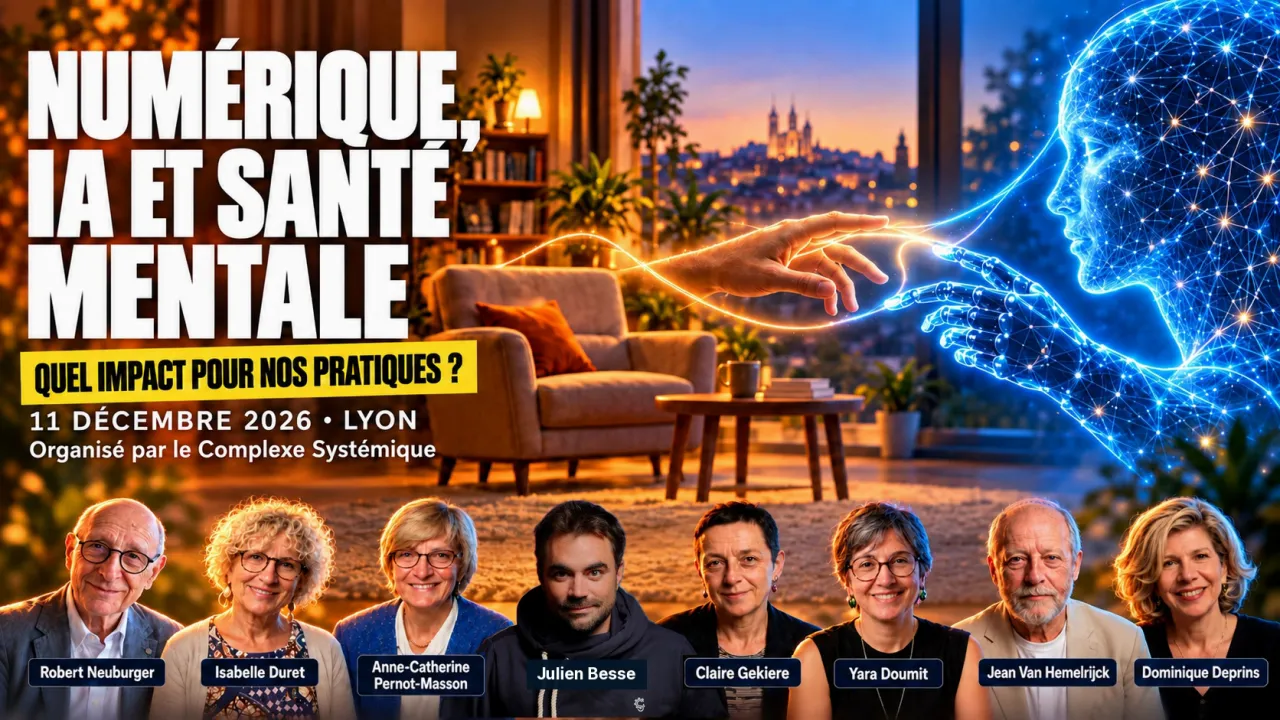
Digital technology, AI and mental health
Conference in Lyon, 11 December 2026: digital technology, artificial intelligence and mental health. Six talks, replay for participants. In French.
 Short course
The suicidal crisis in adolescents and young adults
Training: assessing and supporting the suicidal crisis in adolescents and young adults. Clinical landmarks and systemic tools. In French.
 Certifying course
Training in Systemic Therapy and Interventions – Cycle 1
Certifying training cycle in systemic therapy and interventions – year 1. Courses, supervision and practice, aligned with EFTA/SFTF. In French.
Related articles
 Scientific
 Decolonizing Supervision: A Critical Race and Queer Theory Framework for Marriage and Family Therapy
Supervision is not neutral: a framework drawing on Critical Race Theory and Queer Theory to name and share power in supervision, with a vignette.
 Scientific
 How can we BeST? meet the needs of adoptive families? Relevant findings from a major Randomised Controlled Trial of infants in foster care in the UK
The BeST? trial (488 infants in care in the UK) reread for adoption: holistic, ongoing assessment of children and a move to dual registration.
 Scientific
 Internal Family Systems Therapy as Part of the ‘Family of Systemic Therapies’: A Critical Exploration of Systemic Practice in the Intra-Personal Domain
Does IFS belong to the family of systemic therapies? A critical exploration, grounded in a family court vignette, of systemic work with “parts”.
 Blog
Blog Toxic, narcissistic, borderline: what therapy speak does to your relationships
Narcissistic, borderline, toxic: therapy speak has left the consulting room. Julien Besse shows how these labels close the debate and relieve us of our own part.
Comments 0
Log in to join the discussion. Log in