Counselling and Psychotherapy Research · Couples
Compulsive sexual behaviours and relational consequences: A phenomenological study on intimate female partner impacts
When a woman discovers that her partner engages in compulsive sexual behaviours, what breaks, and with whom? In Australia, Fakri Seyed Aghamiri’s team interviewed twelve partners and fifteen therapists: detective work, shame and isolation, spiritual crisis, and two thirds of the women having self-harmed or had suicidal thoughts.
This is a reformatted republication of Compulsive sexual behaviours and relational consequences: A phenomenological study on intimate female partner impacts, by Fakri Seyed Aghamiri, Johannes M. Luetz and Karenne Hills, published in Counselling and Psychotherapy Research (Wiley) (2025), doi: 10.1002/capr.12850, under a CC BY 4.0 licence. Prepared by Complexe Systémique in September 2026: the authors’ text is unchanged; the layout has been adapted for reading online, which constitutes a modification of the work under the terms of the licence. Tables are presented as lists; Figure 2, a participant’s artwork, is not reproduced; end-of-article statements and the two footnotes are grouped in the notes; author biographies and the data availability statement are not included. This edition was made neither by the authors nor by the publisher, who are not responsible for its content or for any errors. The original version prevails.
The impacted women expressed that they suffered more from their intimate partner's lies and deception than from the CSB itself.
Fakri Seyed Aghamiri, Johannes M. Luetz and Karenne Hills
Abstract
Background. Studies on sexual addiction (SA) and compulsive sexual behaviour (CSB) outline a new area of counselling research touching on a variety of social, gendered, and cultural repercussions for those who are affected, including individuals, families, intimate partners, and society. Taboos surrounding SA/CSB frequently cast the topic in an ignorant and shameful light.
Aims/Methods. Although SA/CSB in men is gaining scholarly attention, very few studies have examined the complex relational effects on intimate female partners (FPs). This study closes this knowledge gap through a descriptive phenomenological research design. Using in-depth semi-structured interviews, FPs (n = 12) and professional therapists (n = 15) articulated relational impacts and experiences.
Results/Discussion. The results reveal intra- and inter-relational fractures, often contributing to detective work, self-harm, and suicidal ideation in SA/CSB-affected women.
Conclusion. For a variety of stakeholder groups, this study is important because it highlights methods by which academics, therapists, and religious organisations might provide more specialised support during the healing and recovery process.
Implications for Practice and Policy
- For a variety of stakeholder groups, this study is important because it highlights methods by which academics, therapists, and religious organisations might provide more specialised support during the healing and recovery process.
- Based on the results, there are indications with implications for policy that female partners benefit from multifaceted support systems suited to transcend the challenging, complex and stressful processes of discovery/disclosure. Meeting expressed felt needs in these areas will also augment associated recovery prospects.
1 INTRODUCTION
Sex and hypersexuality have gained increased social acceptance in industrialised nations (Garcia et al., 2013; Kraus & Sweeney, 2019), largely due to their pervasive presence in media and popular culture (de Alarcón et al., 2019; Lewczuk et al., 2022; Sigusch, 2001; Ter Bogt et al., 2010). The rise of internet and digital technologies has further expanded both online and offline sex industries (de Alarcón et al., 2019; Seyed Aghamiri, 2020; Seyed Aghamiri et al., 2022b). This environment has contributed to the prevalence of sexual addiction (SA) or compulsive sexual behaviour (CSB), areas that are linked to the accessibility and cultural acceptance of sexually explicit materials and rewards (Carnes, 2011; de Alarcón et al., 2019; Wéry & Billieux, 2017).
Davis (2009) highlights SA/CSB as a pressing social issue that exists at the intersection of science and culture. Pertinent behaviours are often characterised by an inability to control strong sexual impulses, leading to repetitive conduct that impairs social functioning and may have lasting consequences (Carnes & Adams, 2019; Grubbs et al., 2020; Reid & Kafka, 2014; Sassover & Weinstein, 2024). Other related terms include obsessive-compulsive sexual behaviour disorder (CSBD) and out-of-control sexual behaviour (Briken et al., 2022; de Alarcón et al., 2019; Potenza et al., 2017; Sassover & Weinstein, 2020; WHO—World Health Organization, 2019). The World Health Organization (WHO) recognised CSBD in its 2019 ICD-11 classification (WHO—World Health Organization, 2019), emphasising its impact on individuals and relationships (Seyed Aghamiri et al., 2022a, 2022b; Seyed Aghamiri & Luetz, 2021).
Individuals involved in SA/CSB often engage in non-paraphilic activities that disrupt personal and professional lives, such as excessive use of pornography, compulsive masturbation and sexual encounters with strangers (Giordano et al., 2024; Seyed Aghamiri, 2023a, 2023b; Slavin et al., 2020a, 2020b). Negative outcomes include financial issues, legal problems, social isolation and strained intimate relationships (Reid et al., 2011; Walton & Bhullar, 2020; Yamamoto, 2020), with relationship satisfaction and trust often diminishing, even with online pornography consumption (Schneider et al., 2012). Hall (2016) notes the unique harm SA inflicts on partners, intertwining addiction with relationship integrity.
Dysfunctional sexual behaviours significantly affect mental health and relational dynamics (Vasconcelos et al., 2022). Furthermore, SA/CSB can lead to betrayal trauma (BT) for female partners (FPs), characterised by profound emotional pain and psychological harm following the discovery of a partner's compulsive behaviours (Bergner & Bridges, 2002; Freyd, 1998, 2008; Seyed Aghamiri, 2023a, 2023b; Rachman, 2010; Steffens & Rennie, 2006; Weiss, 2019). Additionally, BT can mimic post-traumatic stress disorder (PTSD) symptoms, causing despair and intrusive thoughts, which may further complicate recovery for affected FPs (Bergner & Bridges, 2002; Seyed Aghamiri et al., 2022a, 2022b; Steffens & Means, 2009; Tirone et al., 2021).
Despite the extensive implications of SA/CSB, research primarily focusses on those exhibiting these behaviours, leaving a gap in understanding the experiences of FPs affected by their male partners' SA/CSBs (Vogeler et al., 2018). Existing studies have touched on some of the relational impacts and trauma responses but offer limited insights into the lived experiences of these women (Williams, 2019; Zitzman & Butler, 2009). While SA/CSB affects individuals regardless of gender, the majority of those involved are heterosexual men, who reportedly experience higher rates of obsessive behaviours (Ballester-Arnal et al., 2013; Cooper et al., 2000; Kishor et al., 2018; Kürbitz & Briken, 2021).
This study aimed to explore the relational effects of BT on women in relationships with men exhibiting SA/CSB. It investigates areas in which counsellors may provide more specialised support. Finally, it identifies opportunities for future research in associated areas of partner dynamics.
1.1 Literature review
Although there is no consensus in the literature on a universally espoused definition of SA and CSB (Seyed Aghamiri et al., 2022a, 2022b), there are indications that these concepts are starting to attract growing professional attention in areas of human health, therapy and treatment (Badii et al., 2020; Lew-Starowicz et al., 2022). Notably, the WHO International Classification of Diseases (ICD-11)1 recently classified CSBD as an impulse control disorder (Briken et al., 2022; Grubbs et al., 2024; Kraus et al., 2018; Lew-Starowicz et al., 2022). Research on SA/CSB is critical because it may highlight approaches therapists may take to provide more specialised individual and relational support, including during healing and recovery.
People have a strong desire to be connected since they are social and relational beings (Fiske, 2018; Machia et al., 2020; Morales-Vives et al., 2021). According to this viewpoint, when long-term, healthy intimate connections persist, they transform the attachment bond (Gómez-López et al., 2019). In contrast, relationships that encounter disruption or betrayal—such as those resulting from SA/CSB—cause psychological and physical pain (Campbell & Stanton, 2019; Schneider et al., 2012; Weiss, 2019). Relatedly, SA/CSB has been conceived as a maladaptive reaction to stressors in life and dysphoric emotional states (Chatzittofis et al., 2022; Grubbs et al., 2024).
McCormack and Wignall (2017) assert that pornography has become more commonplace due to the internet's influence on popular culture. This phenomenon is known as ‘the pornographic action of mainstream’ culture (McNair, 2013, p. 3), which some people view as a way of augmenting their relationship (Kohut et al., 2018). However, the idea that viewing relational pornography together might increase a couple's level of sexual satisfaction has little evidence to back it up (Grubbs et al., 2019; Weiss, 2020). Consuming pornography has been shown to harm partners' well-being since it undermines relationship trust and weakens the integrity of the relationship (Hastings & Lucero Jones, 2023; Maas et al., 2018; Schneider et al., 2012; Steffens & Means, 2009).
Maddox et al. (2011) found a substantial correlation between compulsive pornography consumption (a type of SA) and relationship betrayal. Furthermore, the second Australian Longitudinal Study of Health and Relationships (Richters et al., 2014) found that while the number of males viewing X-rated films decreased, the number of men accessing online sex sites increased. According to Richters et al. (2014), this might point to increased availability of the large range of easily accessible sexually explicit materials made possible by developments in digital technology. Several studies indicate that watching pornography has a detrimental impact on intimacy, sexual satisfaction and relationship satisfaction in heterosexual relationships—both dating and married—even though it shows acts that are relational in nature. This is especially true when the pornography user is a man (Maddox et al., 2011; Minarcik et al., 2016; Perry & Hayward, 2017; Vieira & Griffiths, 2024).
To date, no other studies have examined thoroughly the relationship consequences of SA/CSB on intimate partners following the discovery/disclosure of such behaviours. As noted above, a detrimental effect of SA/CSB that can cause harm to an intimate partner in various ways is BT, which can be triggered by the discovery/disclosure of SA/CSB (Hunyady et al., 2008; Seyed Aghamiri et al., 2022a, 2022b; Weiss, 2021; Williams, 2019). Relationship trauma is characterised by the term ‘BT’ (Freyd, 1996, 1998), which is linked to betrayals of trust (Birrell et al., 2017). To put it more accurately, the theory holds that the degree of betrayal rises with one's relationship's proximity and apparent necessity to the offender or offenders (Freyd, 1994; Kahn & Freyd, 2008). Furthermore, the profound psychological trauma that an intimate partner who has been betrayed experiences is akin to the attachment injury that a baby endures when separated from its mother (Johnson et al., 2001; Warach & Josephs, 2021). Like BT, attachment trauma is associated with existential pain and suffering when a person experiences traumatic interpersonal events that go against their inner belief that someone else is a reliable and trustworthy source of support (Bowlby, 1969, 1977; Hazan & Shaver, 1987). Relatedly, Steffens and Means (2009) indicate that:
Although trauma and posttraumatic stress have been recognised as common occurrences in the human experience for over a century, the acknowledgement of relational trauma evolved later as researchers began to note the extreme emotional pain and psychological damage we experience when betrayed or victimised by someone close (p. 4).
Research suggests that betrayal plays a significant role in the development of posttraumatic sequelae (Gómez et al., 2014; Kelley et al., 2012). According to Gómez et al. (2014), BT activates the fear centre, thus leading to complex trauma or PTSD and the associated symptoms. In fact, Steffens and Rennie (2006) found that, except for criteria A1 (a life-threatening event), 69.6% of female participants met all of the criteria for PTSD. These authors discovered that the FPs' reactions to the male partner's SA/CSB included hypervigilance, avoidance, recurrent flashbacks and dissociation. Furthermore, they noted that revelation ‘sends a jolt of adrenaline into the body that sets off a stress reaction’ (Steffens & Rennie, 2006, p. 251). As Fitness (2006, p. 74) notes, the act of betrayal implies the rejection or ‘discounting of one person by another’, and is extremely stressful due to the potential loss of the relationship. According to Maercker and Hecker (2016), interpersonal relationships (i.e. with the family system, culture and society), and—above all—the intimate partner are typical places for BT recovery to occur. Carnes and Lee (2014) peripherally noted, however, that the nature of SA/CSB and the process of uncovering an intimate partner's covert actions are traumatising and can lead to social isolation and alienation, making it difficult for the impacted partners to reach out to others. Betrayal trauma has a different impact on the brain than other forms of trauma, particularly when the victim is reliant on the offender (Courtois, 2014). Consequently, BT victims often find it difficult to acknowledge the reality of what has happened because of their physical, psychological or relational dependency, which compromises their entire sense of identity and existence (Freyd, 1994).
Fear of stigma and condemnation associated with SA/CSB (Carnes & Lee, 2014; Hall, 2016) combined with impacted partners' BT, grief and attachment injuries can result in a variety of relational repercussions. One form of relational ramification is the spiritual–relational disconnect that may create anger towards God/higher power (Carnes & Lee, 2014; Seyed Aghamiri et al., 2024c). Research has shown that a superior quality of life and relationships is contingent upon spiritual well-being (Büssing et al., 2014; Peerawong et al., 2019) and that spirituality can influence how individuals interact with friends, family and other people (Büssing et al., 2014). Spirituality encompasses many aspects of life's meaning and human existence, such as those related to the environment, body, mind, emotions, and soul (Luetz & Nunn, 2023; Nunn & Luetz, 2021; Santos & Michaels, 2022). Research indicates that traumatic experiences can cause spiritual relationship crises (Carnes & Lee, 2014; Weiss, 2019). Importantly, partners may experience multiple stages and various types of discovery/disclosure, thus experiencing confusion, fear, pain, disconnection from a higher power/God and abandonment as consequences (Seyed Aghamiri et al., 2024c; Seyed Aghamiri & Luetz, 2021). Grant (1999) stated that a traumatic experience changes or perhaps completely destroys a person's preconceptions about life, meaning and purpose. This can cause a serious spiritual and religious crisis (Carnes & Lee, 2014; Mahoney et al., 2012) that involves resentment against God/ higher power (Pargament et al., 2000).
In synthesis, the scant literature that is currently available on this subject suggests promising directions for further investigation. After learning of their partner's SA/CSB, no other peer-reviewed study has specifically allowed women to communicate the genuine significance of their lived experiences and relevant relational viewpoints. Discussing SA/CSB in conjunction with relationships and connectedness has been described as an essential first step, given the significance of an individual's well-being and functioning. This is especially true if the thematisation of these issues can be meaningfully ‘mainstreamed and normalized—rather than moralized—for the greater good of both sufferers and society’ (Seyed Aghamiri & Luetz, 2021, p. 443). Further in-depth understanding of women's relational lived experiences and perspectives in this domain would be beneficial for specialists, professional caregivers and faith-based organisations. Finding opportunities for recovery and healing may be aided by using a thorough qualitative analytical approach.
2 METHODOLOGY
The methodological approaches to data collection and analysis from counsellors (supplementary participants) and intimate FPs (primary participants) are addressed in this section to explore the relational implications associated with the discovery/disclosure of SA/CSBs in intimate relationships. This research design was deliberately chosen to advance this rapidly evolving domain. When it comes to developing research methods, qualitative approaches analyse events within a particular context, while quantitative research methods characterise variables and test hypotheses (Creswell, 2015; Peoples, 2020). In the light of this, the current effort expands the body of theory generation research by producing hypotheses (Chen & Luetz, 2020).
Despite some limited research suggesting that SA/CSB has negative effects on intimate partners, as previously mentioned, there is a substantial knowledge gap in the peer-reviewed academic literature about systematic qualitative studies that portray the relational lived experiences of BT-affected FPs (Benfield & Birchard, 2018; Bergner & Bridges, 2002; Schneider, 2000; Schneider et al., 1998, 2012; Williams, 2019; Zitzman & Butler, 2009). In the light of the relational effects of BT, the present qualitative technique was developed and is used to give voice to this understudied community, improve knowledge and distil its essence. A thorough examination of this population's real experiences may highlight contextual or cultural similarities or differences among the affected women (Milrad, 1999; Schneider, 2000; Steffens & Rennie, 2006; Williams, 2019; Zitzman & Butler, 2009).
Thus, a qualitative approach is best suited to enhance the provision of health care since it facilitates a thorough comprehension of the relationships between biopsychosocial phenomena (Boyle, 1991; Seyed Aghamiri & Luetz, 2021). Moreover, utilising a qualitative approach helps to better understand the impacted women and develop methods for supporting their sexual recovery and overall well-being concerning SA/CSB and BT, while at the same time facilitating the creation of suitable social policies (Seyed Aghamiri, 2023a, 2023b; Weiss, 2021). Phenomenology is a qualitative methodology aptly suited to these aims and objectives. The primary objectives of phenomenology are to comprehend how people perceive their experiences and assess language use in social, political and interpersonal contexts. To understand lived experiences as well as viewpoints, researchers usually delve extensively into the feelings and thoughts of the audience (Peoples, 2020; Seyed Aghamiri et al., 2024a, 2024b; van Manen, 1997). By applying a phenomenological approach, it became feasible to explore the wide range of experiences that the impacted women shared and generate fresh perspectives and ideas regarding their lived experiences. Accordantly, the study deliberately designed and employed a phenomenological framework, functioning within a qualitative paradigm of enquiry, to accomplish these goals and objectives.
The following research question guided the investigation: What are the lived experiences of women following the discovery/disclosure of their male partner's SA/CSBs?
To explore and characterise lived human experiences, a qualitative framework emphasising phenomenological understandings was the most appropriate methodological approach for this study. Thus, to gather and analyse the data and provide an answer to the research question, descriptive phenomenological approaches were used. A phenomenological investigation, which is part of the qualitative paradigm, focusses on all of the experiences that study participants have to offer. It presents several points of view and concepts to provide a novel interpretation of the event (Creswell, 2015; Giorgi et al., 2017; Peoples, 2020). Fundamentally epistemological, the philosophy of Husserl's phenomenological approach reveals knowledge that is correlated with human experience (Husserl, 1970; Neubauer et al., 2019). Consequently, the lived experience must be prioritised in descriptive phenomenology together with a comprehensive and in-depth explanation of the universal core of participants' experiences and meaning-making. This approach also acknowledges the lived experiences and well-being of women who are affected by their male partner's SA/CSB by allowing them to accurately share their experiences. Moreover, the study sought to elucidate the nuances and complexity of interpersonal interactions and get a thorough comprehension of relevant interpretation techniques (Willig, 2013). Crucially, qualitative methods were the most suitable since this study focussed on the importance and calibre of experiences (Denzin & Lincoln, 2013).
2.1 Data collection and research ethics approval
Obtaining study ethics committee approval, recruiting and selecting participants, collecting demographic information, ensuring participant anonymity, obtaining informed consent forms and conducting in-depth semi-structured interviews were all part of the data collection process. The study received research ethics approval through the Human Research Ethics Committee (HREC) at Alphacrucis University College (AC).
2.2 Selection and recruitment of participants
Age, ethnicity, duration of relationship with male partner, education, income level, occupation, religious or spiritual background, and number and age of children were among the data collected from a heterogeneous group of primary participants (Table 1). The Sexual Addiction Screening Test (SAST), created by Carnes (1991, 2000), was used as the recruitment instrument to avoid biased selection.
Table 1 — Female participants (primary cohort): demographic data.
- Female partners: FP 01; Gender: Female; Age: 40; Nationality: Greek/Australian; Marital status: Married; Duration of relationship (year): 10; Education: Year 12; Number of children: 1; Religion before CSB: Christian; Religion after CSB: Christian; Interview: Face-to-face interview
- Female partners: FP 02; Gender: Female; Age: 29; Nationality: Egyptian/Australian; Marital status: Partnership; Duration of relationship (year): 9; Education: Year 12; Number of children: 2; Religion before CSB: Muslim; Religion after CSB: None; Interview: Face-to-face interview
- Female partners: FP 03; Gender: Female; Age: 51; Nationality: Australian; Marital status: Married; Duration of relationship (year): 20; Education: Bachelors degree; Number of children: 0; Religion before CSB: None; Religion after CSB: Buddhism; Interview: Face-to-face interview
- Female partners: FP 04; Gender: Female; Age: 48; Nationality: Australian; Marital status: Separated; Duration of relationship (year): 20; Education: Bachelors degree; Number of children: 3; Religion before CSB: Practising Christian; Religion after CSB: Non-practising; Interview: Face-to-face interview
- Female partners: FP 05; Gender: Female; Age: 21; Nationality: Australian; Marital status: Married; Duration of relationship (year): 3; Education: Bachelors degree; Number of children: 0; Religion before CSB: Christian; Religion after CSB: Christian; Interview: Face-to-face interview
- Female partners: FP 06; Gender: Female; Age: 64; Nationality: Australian; Marital status: Separated; Duration of relationship (year): 42; Education: Masters degree; Number of children: 4; Religion before CSB: Christian; Religion after CSB: Christian; Interview: Face-to-face interview
- Female partners: FP 07; Gender: Female; Age: 59; Nationality: Australian; Marital status: Divorced; Duration of relationship (year): 9; Education: Year 12; Number of children: 1; Religion before CSB: Christian; Religion after CSB: Christian; Interview: Face-to-face interview
- Female partners: FP 08; Gender: Female; Age: 51; Nationality: Australian; Marital status: Married; Duration of relationship (year): 34; Education: Diploma; Number of children: 4; Religion before CSB: Christian; Religion after CSB: Christian; Interview: Phone interview
- Female partners: FP 09; Gender: Female; Age: 60; Nationality: Afghan/Australian; Marital status: Married; Duration of relationship (year): 40; Education: Year 12; Number of children: 3; Religion before CSB: Muslim; Religion after CSB: Christian; Interview: Face-to-face interview
- Female partners: FP 10; Gender: Female; Age: 63; Nationality: Australian; Marital status: Partnership; Duration of relationship (year): 2–1/2; Education: Bachelors degree; Number of children: 0; Religion before CSB: Christian; Religion after CSB: Christian; Interview: Excluded via phone interview
- Female partners: FP 11; Gender: Female; Age: 55; Nationality: NZ/AUS; Marital status: Divorced; Duration of relationship (year): 34; Education: Year 12; Number of children: 4; Religion before CSB: Christian; Religion after CSB: None; Interview: Face-to-face interview
- Female partners: FP 12; Gender: Female; Age: 20; Nationality: Australian; Marital status: Engaged; Duration of relationship (year): 2–1/2; Education: Year 12; Number of children: 0; Religion before CSB: None; Religion after CSB: Christian; Interview: Face-to-face interview
- Female partners: FP 13; Gender: Female; Age: 34; Nationality: Chinese/Australian; Marital status: Married; Duration of relationship (year): 10; Education: Masters degree; Number of children: 2; Religion before CSB: Christian; Religion after CSB: Christian; Interview: Phone interview
- Female partners: FP 14; Gender: Female; Age: 58; Nationality: Australian; Marital status: Separated; Duration of relationship (year): 37; Education: Year 10; Number of children: 3; Religion before CSB: Christian; Religion after CSB: Christian; Interview: Excluded via phone interview
2.3 Research aims
This research sought to investigate FPs from the paradigmatic perspective of social construction. Consequently, no medical diagnostic tools were used to identify research participants who qualified for the study. The study employed non-random sampling to recruit 12 Australian FPs aged between 21 and 63 years (the primary group) and 15 counsellor participants (C; supplementary group). Recruitment of the impacted female participants was contingent upon being (or having been) in a committed, exclusive relationship for a minimum of 12 months.
An appropriately small sample size is ideal for phenomenology research (Creswell, 2015); this qualitative study recruited a manageable number of participants (n = 27) who were specifically selected to allow for in-depth examination and interpretation of a phenomenon (Patton, 2002). As a result, the methodological goal of this study was to conduct in-person interviews with each of the main participants at a private counselling centre in Brisbane, Queensland (Australia). A small number of female participants were also recruited via 12-step programmes organised by Sex Addicts Anonymous (SAA) and Sexaholics Anonymous (SA), in which male partners regularly attended meetings to get support from the group over their SA/CSB. Additionally, snowball sampling—which is appropriate for studies examining hidden research populations—was employed to locate more female participants (Naderifar et al., 2017).
A wide range of demographic groups were represented by counsellors, which included pastors with counselling credentials, psychologists and doctors working as professional therapists, all of whom had at least 10 years of professional experience. Through triangulation, methodological rigour was enhanced by incorporating this extra research participant group (Creswell, 2015; Fusch et al., 2018). This group of supplementary study participants (Table 2) increased methodological rigour through triangulation (Creswell, 2015; Fusch et al., 2018). Even so, the emphasis was purposefully placed on elevating the voices of the FPs, with the professional therapists' viewpoints serving as an additional verification (triangulation method) to validate the female participants' experiences and narratives.
Table 2 — Counsellors (supplementary participant cohort): demographic data.
- Counsellors: C 01; Gender: Female; Profession: Counsellor
- Counsellors: C 02; Gender: Male; Profession: Educator/Counsellor
- Counsellors: C 03; Gender: Female; Profession: Clinical psychologist
- Counsellors: C 04; Gender: Male; Profession: Educator/Counsellor
- Counsellors: C 05; Gender: Female; Profession: Counsellor
- Counsellors: C 06; Gender: Female; Profession: Medical specialist/Counsellor
- Counsellors: C 07; Gender: Male; Profession: Medical specialist/Counsellor
- Counsellors: C 08; Gender: Female; Profession: Counsellor
- Counsellors: C 09; Gender: Female; Profession: Counsellor
- Counsellors: C 10; Gender: Female; Profession: Counsellor
- Counsellors: C 11; Gender: Female; Profession: Pastor/Counsellor
- Counsellors: C 12; Gender: Female; Profession: Counsellor
- Counsellors: C 13; Gender: Male; Profession: Counsellor
- Counsellors: C 14; Gender: Male; Profession: Pastor/Counsellor
- Counsellors: C 15; Gender: Male; Profession: Pastor/Counsellor
2.4 Instruments: In-depth semi-structured interviews
During the semi-structured interview process, the participants were allowed to provide as much or as little information as they desired.
2.5 Semi-structured interview questions
A pre-test of all interview questions was conducted by several academics, pastors, counsellors and couples who had experienced SA/CSB to create the final set of interview questions. The subsequent revision of interview questions ensured that all questions were appropriately specific, clear and without bias. This resulted in a final list of 13 open-ended questions in the data collecting instrument that queried the FPs (primary participants) about their experiences after finding out about their male partner's SA/CSBs. The following are some examples of questions from the instrument:
- When and how did you first learn about your partner's engagement in compulsive sexual behaviours?
- What impacts, if any, on your relationship and well-being have resulted from these behaviours?
- How has the discovery/disclosure impacted your relationship with your partner and other people?
Four open-ended questions were also posed to the professional counsellors (supplemental participants), inviting them to share their professional insights from working with this population. One example question is provided:
- What impacts, if any, have you observed on the female partners' well-being (emotionally, physically, spiritually) that may be associated with the discovery/disclosure of their mate's self-described sexual addiction/compulsive sexual behaviours?
Data were obtained between 2021 and 2023. After collection, these data were examined using an analytical approach that aided in the process of developing the themes and codes. This method involved several rounds of computer coding in NVivo 12 after hand coding (QSR International, 2021). Thematic data analysis was done from the beginning of the data collection process until the conclusion. To distil the core of the experiences of the FPs, emergent patterns and themes were examined in the interviews. This method necessitated reflection journaling and field notes to better comprehend the data. The methodological approaches of Sundler et al. (2019) and the philosophical prerequisites of Husserl (1960) were employed to analyse the data in this study. To understand the data, reading the transcripts with an open mind is required. Major themes from the transcript started to emerge after it was read aloud several times ‘with an open mindset’ (Seidman, 2006, p. 117). Additionally, to identify themes and meanings, interview transcripts were read aloud several times, and audio recordings were simultaneously listened to. To decipher the subtle meanings found in the text and language, it was useful to listen to the tone of voices while reading the text. Since relevant primary meanings suggested a thorough description, they were categorised, arranged and coded into several groupings. The coding process comprised identifying distinctive traits and annotations deemed useful in addressing the research question (Merriam & Tisdell, 2016). Lastly, data analysis entailed grouping the subjects into a meaningful whole. This was accomplished by carefully screening the participant descriptions for noteworthy expressions. It was important not to force meanings to be established rapidly but to allow them to develop naturally.
3 RESULTS
This study identified multifaceted relational impacts on FPs whose relational trust had been violated due to their male partner's concealed CSBs. The study's findings provide a thorough analysis of the relational lived experiences and general well-being of FPs of males with SA/CSB after such behaviours were revealed.
Subthemes of ‘detective work’ and feelings of isolation emerged in the FPs' narratives of their lived experiences and relational impacts after first learning about their male partners' CSBs. One of the most common themes that emerged was the experience of discovery or disclosure. Every FP (100%) acknowledged that the initial finding they had made was minuscule compared with the full extent of the secret activities of their male counterparts. One affected woman, for instance, said that she was still unaware of the extent of her partner's CSBs. She made clear how desperate she was to know the truth, but her husband would not provide a thorough or accurate explanation for his actions. She then went on to play detective, stating:
…I would be very upset and ring him up at work, check his phone, go on his computer thoroughly and look through it even though I was bad with technology and probably wouldn't find anything. I just felt so out of control because how can I know? I need you to tell me the truth, and you don't tell me the truth, so how can I ever trust you again? (FP 05)
Another added:
I found out because he told me he was being blackmailed by a person … He disclosed to me a portion—only the portion that was related to blackmail—and he was asking me for help to get him out of the situation he got himself into. When he explained the situation to me, it was a one-off minor cyber sexual experience with a young woman. He said it was once, and he never touched her … and he was the victim. That was just the first discovery; he also made up a whole lot of lies to frighten me at that point—like people had been to our house … ice gang leaders—and it was gaslighting basically. I was so worried about people coming to our house and blackmailing us, and that was the trauma, so for the first few weeks, I was petrified that someone was going to come around to our house or someone in the street would come up to me or something and I felt threatened and unsafe. He also told me at that time that he had gone to cybersex because I was not kinky enough and that he was just a horny guy and he needed sex more than other men, and that he was trying to save me from his kinkiness because I wouldn't like that sex (FP 03).
It was clear that these FPs suffered continuous distress as a result of not being able to easily learn the truth. One enraged woman stated that following the initial finding, she ‘…discovered more information and more betrayal only through playing detective’ (FP 08). Similarly, another said, ‘I started detective work, and little by little, I discovered more. It was hell. Within a few months, almost everything came out due to my detective discoveries’ (FP 09). Every female participant conveyed the unbearable suffering they endured upon learning that their respective partners had withheld the truth from them. One woman talked about how she had once trusted her husband predominantly. But once she made the first discovery, she felt forced to act like a detective and became suspicious about everything to find out for herself because he would not tell her the truth about his past actions. She continued: ‘…I've never done this before in our entire marriage, and I checked his phone for the first time ever. I checked his Uber account, and a brothel was in his history’ (FP 11). Notably, every FP reported on aspects of ‘detective work’. Specifically, one of the younger FPs reflected on her experience in this context and said:
…I first found out that he would masturbate when I was asleep. I looked through his phone history when he was sleeping and figured it out. A few months later, that happened again. Something in me told me to press the history button on his phone, and that's when it all came up. He disclosed a bit. I always needed to know what he was doing (FP 12).
The consequences of BT impacted the women's relationships with others and also contributed to self-imposed isolation. One participant shared that she felt ashamed and was unable to reach out to anyone. She further said, ‘…his family just shamed him even further when things came out. He blamed me since it ruined his façade with them, but it was only a tiny amount of the whole truth’ (FP 02). The account of another woman highlighted her same unwillingness to express her suffering and her sense of duty to withdraw into solitude. She continued, ‘with my parents, I was embarrassed about what had happened to me and my life. I'm sad for them that they've had to see me go through this. I was ashamed and embarrassed that he could choose to do that’ (FP 04). Most affected women conveyed to have felt isolated and alone because of the absence of societal transparency and knowledge about CSBs. As a result, FPs experienced a wide range of difficult feelings, such as deep shame and feelings of hopelessness, loneliness, despair and fear of judgement. One FP in this situation described her personal experiences and made the following assertion: ‘…people don't understand SA, and it made me shut down because I didn't want to talk to anyone’ (FP 12). Learning of their male partners' CSBs came at a considerable cost for most women, who also worried that other people would view them as defective or guilty. Because of this, they were forced even further into shame, isolation and seclusion. These feelings were echoed by the experience of an elderly participant who stated:
After learning about his behaviours, I disconnected from everyone. I was embarrassed and carried lots of shame. I felt everyone knew and could smell it on us. I felt alone and isolated. I kept myself in the house. I couldn't talk to my church community due to fear of stigma and judgment (FP 09).
For instance, a FP highlighted this mindset when she said: ‘I used to pride myself on how great my marriage was. I was up my ass about it and how lucky I was. It embarrasses me that I was so proud of that. I feel embarrassed and ashamed’ (FP 11).
The identified themes and statements made by FPs were confirmed by the counsellors based on their observations and therapeutic interactions with them. They restated the assertions made by the female partners and said that impacted partners
Very often tend to keep these things secret from their friends and family, so they might stop going to religious gatherings in the church because they just don't want their family or friends to see them hurt or they're under a compulsion with their partner to keep it secret (C 13).
Several verbatim remarks demonstrate how the FPs' relational lived experiences and their responses to SA/CSBs are comparable and connected. For instance, one woman reported, ‘a lot of things trigger me and … I tend just to disassociate. I feel so damaged’ (FP 02). The narratives of another affected woman regarding her personal encounters were as follows: ‘because of the trauma, I would just go numb … I was so stressed. The memories and associated trauma sit on your shoulder and jump out every so often just to let you know that they haven't gone away yet’ (FP 07). Another woman disclosed struggling with feelings of self-doubt:
I was struggling with the feeling maybe I deserved it … I wish I didn't need to say no so many times in a specific tone for him to understand. Even now, I sit here, and I doubt myself, and I doubt my memories, and I doubt everything that happened because he's so persuasive, and it's not until I'm away from him that I recognise things that might not be normal or might not be okay. In the moment, it's so easy to believe everything and you're the one that's crazy and wrong regardless of how much validation you get from people around you. When you're back in that hole with that person, it's consuming, I guess … My whole reality is different these days, I don't know reality sometimes, and that's been a massive shift (FP 02).
Similar sentiments were expressed by another woman:
All our marriage, I always felt inferior sexually. He's always told me he wanted sex more, so I always felt like I was never good enough sexually. I remember once he was sitting there trying to ask me what my fantasies are, but I didn't have any, so it felt like I was always the naïve innocent one while he was the virile know-it-all lover … [over time] he changed significantly and was withdrawing and spending a lot of time on his own, angry all the time, hating work, hating life, nothing was ever good enough—or fluctuating between those negative things and being really charming and funny because that's his modus operandi and that's how he gets away with stuff. All his life was to make a joke, make it funny, make it amusing, and people think he's the funniest person—it's a defence. He was fluctuating between these. At one stage, I remember thinking to myself, ‘I wonder if he's having an affair’, but I didn't think he could because he didn't have the time, and I always knew where he was, or so I thought. I didn't even remember that at one point, money started going missing from an account, and I challenged him on that, which was bad because he got really, really angry with me, and he went into a huge blame thing and said my family hated him (FP 03).
The intimate relationship between the FPs and their male partners was also negatively impacted by the continual deceptions, resulting in significant relational compromise and fracturing. One impacted woman shared her experiences as follows:
My partner never made me feel loved or desired or like I mattered to him. All it was about was the sexual release … I felt like to be the women he was watching online, I had to act a special role to give him the satisfaction he needed, and that broke me even more because I didn't like some of these roles I was engaging. He didn't ask me if I was comfortable with it, and he didn't ask me maybe some of them if they were painful or impossible to do. As I said, I wasn't comfortable. That broke me. I felt like I was a used thing there, used for him to get the release (FP 01).
Another said:
I was made out to be the one that's the problem [which would only go away] if I was more open-minded, on a higher level, and an ‘advanced person’ who understands that multiple sexual partners are a thing blah blah blah (FP 02).
Following the initial discovery, every FP reported that their partner's response had been one of denial and deceit. Furthermore, it seemed that the men who engaged in these compulsive behaviours sometimes found them so disrespectful and inappropriate that they themselves were unsure, fearful and/or ashamed, thus preferring to continue and deceive rather than to stop and offer an honest disclosure. Following confirmation from her partner via disclosure, one woman emphasised, ‘he had … compartmentalised2 for so long that he didn't even comprehend how much he had done’ (FP 09). He had apparently vowed to himself ‘to take all those dark secrets to his grave’ (FP 09). After the initial discovery, one of the FPs shared her personal experiences and said, ‘he only gave me a certain amount of truth until I started being really suspicious and going through his phone, and that's when I realised the extent. I would question him about it. A lot of it was half-truths’ (FP 02). Likewise, others mentioned, ‘I felt rejected’ (FP 08) or thought, ‘I was going crazy’ (FP 09). A tearful participant shared, ‘It was just such a big bombshell to try to contemplate. I'm sad’ (FP 11). Also, a woman, weeping, stated that she had thought there were no more concealed behaviours following the initial revelation, but that was before she discovered the deception:
I went on the hunt, and every single piece of paper I would find was analysed in case it had a password or a link to something. Through that process, I identified that he had a whole other name and email and things set up in a false name. So, there was a period … I would say almost three months, where I kept finding things out about him, and you just don't think it's ever going to end. That period was a horrible period of just finding out things … He's still not admitting that he has any problems. He's still the horny guy that got out of control a bit. But by this stage, I have evidence of 47 women, and I have hotel receipts. I've gone on Google Maps and been able to trace his every car ride … I have spreadsheets of what he did, so it became harder and harder for him to pretend nothing was wrong. (FP 03)
For the impacted women, the consequences of learning of their male partner's SA/CSB extended beyond their personal relationships and influenced their spiritual relationships with God/higher power as well. According to this study's findings, relationship breakdowns caused by BT-related SA/CSB for affected women were also observed to have a significant negative impact on spiritual relationship dimensions. Even those who identified as atheists (FP 09), agnostics (FP 02) or who said they ‘did not believe in God’ (FP 02) acknowledged initially feeling angry with God and doubting his justice (FP 03). One woman disclosed sentiments of diffidence:
It has been a slow eroding of my sense of self and worth, and that's come out in a lot of spiritual ways, and I just feel disconnected and unsure of who I am and whether I'm even worth anything (FP 02).
Complex and potentially harmful spiritual–relational crises seemingly occur in many ways. For example, even female intimate partners who self-identified as agnostic or atheist reported sentiments of rage towards God/higher power. They seemed to be angry with God and felt unfairly treated. Women who experienced BT also often expressed grief, which exacerbated their spiritual crises. Despite coming from relatively diverse demographic backgrounds, the women shared a great deal of commonality about their relational and spiritual experiences. Their faith was often shattered—in God/higher power, the male partner, themselves and other people—and they felt that their spirituality/faith had failed and deceived them because God had permitted the offence to occur. They expressed notions of unfairness and ‘being angry towards God’ (FP 08). They could not fathom why women who had been pillars of their church/faith community would suffer in this way. Several women stated that they believed that God ‘isn't going to help me’ (FP 02), and therefore, ‘He must hate me’ (FP 03), or questioned ‘why my loyalty to Him is not reciprocated’ (FP 13), compelling some to ‘move away from God’ (FP 04). Many women of religion also remarked about how their faith-based communities had failed to provide them with adequate assistance or had been plainly unhelpful. They consequently experienced a greater sense of spiritual alienation and disconnection. For instance, a Christian woman disclosed:
I couldn't talk to my church community due to stigma and judgment … I was physically and emotionally unstable, and those who were supposed to care for me didn't do a good job of keeping me safe … I would have healed faster if I had my faith-based community around me (FP 09).
One woman expressed dissatisfaction with her pastor, who asked her to ‘read the Bible and be forgiving’ (FP 09). Another Christian woman wondered,
does this make me a bad Christian because I'm struggling to forgive him? Because every time I look at him or every time he wants sex, it reminds me again, and I remember again that I haven't forgiven him (C 08).
The vast majority of counsellors (including pastors, C 11, C 14 and C 15) noted observing indications of resentment or separation from God. These perspectives corroborated the information provided by the FPs. They declared that ‘a lot of women are feeling spiritually betrayed, that God has let them down’ (C 04) and ‘having found out they've been deceived in one area, they might spiritually wonder if they had been deceived in other areas’ (C 06). A medical professional who served as a counsellor additionally stated:
The spiritual impacts would be similar to PTSD. It would be traumatising, and sometimes there may be a physical and emotional resolution, but their spirit is still in shock. So, there are leftover effects of separation, rejection, withdrawal, [and] disconnection from God as well as other people (C 07).
Another severe relational consequence of SA/CSB was the intra-relational aspect of how the affected women related to themselves and felt driven to participate in self-harming behaviour and/or suicide ideation. A significant percentage of the women (66%) had engaged in self-harming behaviours or had considered or attempted suicide. Surprisingly, the women who self-harmed, wished to die or thought about suicide were also among the ones who insisted that their male partners had not betrayed them in any way—whether physically, sexually or by compulsively and secretly watching porn and masturbating. For instance, one FP said, ‘I took a drug overdose and ended up in hospital’ (FP 11). Another one said she found out her partner was secretly watching porn and masturbating, much like her father. She stated: ‘Covid and isolation I found very difficult, and sometimes I engaged in self-harm after my discovery at the beginning of 2020. I punched myself mostly, and it was partly because of that disconnection from my body, and I was also angry towards my dad and my partner’ (FP 05). Similarly, another woman stated:
In 2017, I would have that moment where I was done with life and didn't want to live anymore—I definitely had suicidal thoughts. I felt like no one could help or understand me, so I shut myself off from the world. But in doing that, I had unprocessed things, so I decided that too much is too much, and I couldn't take it anymore, so I did think about suicide a few times. This was probably four years after the initial discovery (FP 13).
Another relational ramification expressed by impacted FPs was the compulsive tendency to compare themselves to other women and engage in self-objectification (evaluating themselves based on their appearance). For example, one said,
I think I was looking at other attractive women way more than him. That was really difficult, and I would get very obsessed with what they were wearing, and if what I was wearing was attractive … I would be obsessed with how other women would look versus me (FP 05).
Another FP acknowledged a tendency to self-objectify or compulsively compare herself with other women:
I just viewed myself with so much disgust: ‘If only I were this girl, if only I were like this.’ I realised that the only thing I was missing was being a completely different person. It's the fact that I cannot be someone else that makes you feel so hopeless. Even until now, I hate that I view other women as competition. I hated the way I saw other women. I hate that I look at them and instantly look straight at their boobs or the comparisons, ‘Oh, they have nice legs, they have nicer legs than me. They have bigger boobs; if only I had that.’ I even slowly viewed my sisters as different, as they were more deserving of loving relationships because they were more attractive (FP 02).
In summary, FPs shared a myriad of relational impacts that impinged on their sense of relational identity and safety. Issues raised included narratives of ‘detective work’ to uncover the truth, ongoing deception by their male partners, self-imposed isolation, social embarrassment and stigma, fractured intimate relationships with self, partner, God and/or others, and lastly, disclosures of self-harm, suicidal thoughts or attempts, and compulsive self-comparisons to other women, in addition to self-objectification, among others.
4 DISCUSSION
Aligned with previous research (Courtois, 2014; Minwalla, 2014; Zitzman & Butler, 2009), the current study discovered that 100% of impacted women reported experiencing BT, BT-linked attachment injury and/or different forms of relational trauma (Campbell & Stanton, 2019; Steffens & Means, 2009). Research by Atwood and Schwartz (2002), Laaser et al. (2017) and Schneider et al. (2012) also discovered that the negative impacts on partners are often the same regardless of the type of CSB or whether secretive activities are carried out online or offline; those discoveries are similarly confirmed by this study. According to Laaser et al. (2017), 60.89% of impacted partners showed signs of PTSD and regarded their experiences as extremely traumatic, irrespective of the type of relational betrayal.
According to the findings of the current study, CSBs have a comparable detrimental effect on intimate relationships (i.e. diminished relational trust and detective work) and result in long-lasting relational impairments (i.e. isolation, self-perceived shame and social shame) in the afflicted partners since they all experienced deception, dishonesty and a betrayal of relational trust. Considering the women's varied demographic backgrounds, it was surprising to discover that they all had similar trauma responses. Consistent with the findings of Schneider et al. (2012), it did not seem to matter if their partners had only participated in virtual CSB or real-life interactions; the essence of betrayal (denial, deceit and duplicity) and its effects were still evident. The most important finding was that every woman described having various BT-related negative consequences. The women's revelation of the concealed and ongoing lies caused the first relational fracture in the intimate relationship, compelling the women to start investigating and playing detectives (Gottman, 2011; Gottman et al., 2013).
The impacted women's perplexing experiences of being misled, manipulated, coerced and fooled by their male partners to preserve their secretive behaviours made them feel compelled to engage in detective work to re-establish relational safety and prepare for probable future repeated behaviours. This result aligns with other studies conducted by Carnes (2018), Carnes & O'Connor (2016), and Johnson et al. (2001), which came to similar findings. They suggested that these behaviours stem from attachment trauma or harm brought on by betrayal or infidelity in relationships and that they are driven by a need for protection.
The social embarrassment, shame and isolation that the FPs in this study experienced corroborate the findings of other studies (Carnes, 2018; Manning & Watson, 2008; Porges, 2018; Skinner, 2020). According to Manning and Watson (2008), ‘68% of the women experienced some type of isolation in the wake of disclosing or discovering problematic sexual behaviours in their marriage’ (p. 242). However, the results of the current study showed that because of their partners' CSBs, 100% of the FPs experienced feelings of humiliation, embarrassment or loneliness. The apparent differences in occurrence rates draw attention to the need for more research in this area, which Futrell (2021) notes has received too little scholarly attention.
Upon careful scrutiny of gathered data, it was revealed that immediately following the discovery/disclosure of their partner's SA/CSB, every single woman in the current study—100% of them—felt alone and afraid of social stigma. This study confirms Vanzant's (2015) findings that when people think love is missing, fear—a natural response—takes over. Vanzant continued by saying that a lack of love communicates a sense of danger in life, which causes the mind to create pictures of isolation and loneliness. The female participants in the current study seemingly refrained from reaching out because they were afraid of being judged and shamed by others. Rather, they felt forced to stay in isolation and silence. This is also consistent with what Skinner (2020, p. 124) reported in ‘sex addicts’ partners:
Shame is one of their biggest fears; they fear that others will judge them for not taking action earlier and wonder how others will see them if they disclose what is happening in their marriages. Shame and embarrassment often prevent these individuals from seeking necessary support.
The current study's findings indicate that, regardless of whether they decided to remain in their relationships or terminate them, the betrayed women felt lost and powerless to understand why they felt stuck and unable to go on with their lives. This confirms Gottman's (2011) research, which found that it is unclear why individuals experiencing BT choose not to end their relationships or move on with their lives. Despite the prevalent belief that the trauma will end when the relationship ends, prior research indicates that ending the relationship does not make the hurt go away (Gottman, 2011; Hall, 2016). The results of the present study, which showed that the women who had left their committed relationships continued to feel stuck, sad and uncertain, are consistent with this. Not only do SA/CSBs represent uncertainty, pain and shame, but they can also bring criticism and concern from uninformed and critical onlookers, which can exacerbate relationship problems. According to Hall (2016), women who are impacted by retrospective thinking may experience increased emotions of guilt, inadequacy and self-doubt. This is mostly because they were not able to notice their partner's behaviours earlier.
This study's purpose of examining all relationships outside the intimate, immediate relationship seemingly deviates from earlier research. A few of the female participants in the present investigation emphasised that being separated did not imply they could move on with their lives or were free from suffering. Instead, many expressed feeling emotionally stuck and dealing with additional difficulties and concerns. Separation can also be difficult due to other factors such as having children and being financially or religiously dependent. These results are consistent with the research conducted by Black and Tripodi (2012), who found that ending a relationship caused additional difficulties and unpleasant experiences for intimate partners.
Apart from challenges concerning romantic relationships, the current study's findings indicate that shame, remorse or a general lack of trust may damage other relationships with friends, family, co-workers and faith-based communities. These results are consistent with those of Carnes (2011), who discovered that many different types of social relationships—including those with friends, family and children—are severely disturbed or even terminated when a partner's CSB is revealed. Similarly, Cohn (2014, p. 77) reported that connections between the sex-addicted partner and others break down due, in large part, to ‘shame and remorse… both on the part of the sufferer and others’. The results of the current study support this earlier research (Black & Tripodi, 2012; Carnes, 2011) and demonstrate that for impacted FPs, separation may cause fresh trauma and unanticipated new challenges. The current results, however, are also unique in that they demonstrate that the BT and unresolved questions regarding the ‘why’, ‘how’ and specific ‘what’ of the compulsive behaviours persist after separation, contributing to the severe and ongoing trauma responses and grief that the FPs endure.
A significant number of FPs (83%) stated that they were unaware of and perplexed by their male partners' real identities and capabilities after discovering the extent of their betrayals and deceptions. The results of the current study were especially significant because the women uncovered startling fresh perspectives on their partners' identities. What the women perceived as unusual behaviour and the unimaginable new character of a man they did not know were major contributing factors to their shock and disbelief. Similar to what Weiss (2020) reported, every FP in the current study stated that lying and deceit caused them considerable suffering. Deception connected to CSB, and particularly the duration of the deception, has the power to upend all relational trust and unmask a partner who has suddenly and unequivocally turned into a complete stranger (Seyed Aghamiri, 2023a, 2023b). Remarkably, no peer-reviewed study to date has addressed the FPs' startling confusion and even shock about their apparent unawareness of their partners' concealed identities and the corresponding linkages to their experienced trauma. Nonetheless, this type of double life or duplicity may be a prevalent feature of SA/CSB, making it perplexing and vexing for the impacted intimate partners to comprehend or accept when it is revealed.
Consistent with earlier research (Atwood & Schwartz, 2002; Carnes, 2011; Kibby & Costello, 2001; Zitzman & Butler, 2009), the current study's findings show that deceit associated with CSBs contributes to the erosion of relational trust because the individuals may present an exaggerated or false persona when engaging in sexual ‘acting out behaviours’. One way that CSB and its associated nature of deceit benefited from the internet is its capacity to create new identities or accentuate the features of existing identities (Carnes, 2011; Kibby & Costello, 2001). Similarly, Carnes (2011) asserts that individuals may use digital technology to deceive others into initiating sexual encounters or contemplating an electronic relationship, all while concealing or presenting a false identity. Therefore, deception associated with SA/CSB has been found to have a substantial impact on the loss of relational trust and the shift in the impacted partners' general perception of their men (Zitzman & Butler, 2009).
Consistent with other research, this study also found that SA/CSB-linked BT contributes to a partner's complex grief processes due to diverse associated losses (Black, 2019; Skinner, 2015; Weiss, 2020, 2021). Although the impacted women in this study experienced their own unique suffering and losses, they all had several things in common, expressing grief at losing:
- their sense of self as a partner and a lover;
- the cherished characteristics and qualities of their partners as they perceived them;
- their previous existence and reality;
- the life they had become acquainted with;
- unwavering certainty about a secure future with their partner;
- their mental stability because of the potential for their male partner to relapse, or worse—the reluctancy of their partner to stop engaging in CSBs;
- relational commitment and the value of fidelity, beyond all else—the impacted women in this study seemed to have lost sight of the sacredness of being together in a committed dyad (Carnes, 2011, 2014; Hall, 2016; Weiss, 2020);
- trust in people and their relationships (friends, family and other relationships, including those with oneself, God or a higher power);
- their former openness to sexual intimacy, which became encumbered by intrusive thoughts, triggers, self-doubt and the perceived inability to compete with the individuals or images that their male partner engaged with;
- financial stability;
- more relaxed and carefree interpersonal interactions (with their partners and others);
- their customary family structure;
- health issues resulting from mental, sexual, and/or physical problems (e.g. STIs); and
- identity or spiritual stability (e.g. several women questioned God's sincerity, pondering what type of God would permit such heinous betrayal to occur).
Faith-based communities and the general public seemingly continue to hold strong, divergent and contradictory opinions regarding who is responsible for men's CSB (Barna Group, 2016; Edger, 2010; Laaser & Adams, 2019). Several impacted women in this study acknowledged experiencing narrow-minded and incorrect sentiments being expressed by members of faith-based communities (Seyed Aghamiri & Luetz, 2021; Weiss, 2019). Crucially, the study's female participants recurrently indicated that they were routinely accused of contributing to or even making their partners' SA/CSB worse by disregarding their expected gender role responsibilities (i.e. sexually fulfilling their male partners). Such indictments may be connected to persistent cultural, sexual, and religious scripts and hierarchical gender norms that support such accusatory attitudes (Laaser & Adams, 2019; Hackett et al., 2016; Hastings & Lucero Jones, 2023; Laaser & Adams, 2019; Neves, 2021).
Based on the current study's results, BT-impacted partners had multiple broken relationships, including the relationship with themselves, which likely magnified their feelings of desolation and loneliness, leading to an elevated propensity to engage in self-harm or preoccupation with suicidal ideation. The startlingly high rate of self-harm and suicide thoughts/attempts among FPs may be related to feelings of inadequacy and being ‘not enough’, broken relationships outside intimate relationships, self-blame or being blamed by others, the taboo surrounding SA/CSB, social embarrassment, loss of relational trust, shock at a trusted partner's betrayal, inability to escape the imposed pain, shame and isolation, loss of control and inability to detect their partners' deceptions sooner, which may all be linked to intensified fixations on such contemplations and conducts.
Notably, the FPs of males who participate in CSBs have received little attention in the literature regarding topics such as suicidality and self-harming behaviours. The findings of this study suggest that some women self-harm to divert their attention, lessen their suffering or exact revenge on themselves for feeling betrayed and/or guilty. Despite the seriousness of the topic, no in-depth peer-reviewed research has been published specifically on the self-harm behaviours of FPs after learning of their male partner's SA/CSBs. Similarly, Caron et al. (2017) found a dearth of studies investigating the relationship between romantic relational attachment and self-harm; however, studies on self-harm generally indicate that women are more affected than males (Motz, 2020). As a form of retaliation or a coping mechanism, the affected partners harm themselves in a variety of ways (such as binge drinking, using drugs, overeating or undereating, compulsive spending or sexually acting out), commonly in the early traumatic phase of discovery (Hall, 2016).
The study's findings also imply that the FPs' compulsive self-objectification and comparisons with other women were commonplace. Their relationships with others of the same sex at times became unhealthy or even fear-based. Their stated experiences suggested that these repercussions were unpleasant, trauma-related and hard to overcome. Moreover, this study supports the research of Schneider (2003), Schneider et al. (2012) and Skinner (2017), who discovered that betrayed partners often compare themselves with other individuals or images, which only serves to deepen their feelings of despondency or hopelessness. This behaviour is a trauma response, according to Skinner (2017), when women retreat inward and hold themselves responsible for the acts of their partners—74% of betrayed partners engaged in this kind of comparison and felt less positive about themselves. However, the results of the present study were unique in that all of the FPs (100%) reported adverse relational effects that followed the discovery/disclosure of their male partner's SA/CSB.
In summary, the results were consistent with and transcended previous research. Even so, several findings pointed to enduring knowledge gaps concerning relational consequences in impacted women, including managing experienced shock and grief over awareness of the male partners' concealed double life/identity, high prevalence of self-harm and suicidal thoughts or attempts, compulsive self-comparison with other women and issues of self-objectification, to mention a few.
Concluding synthesis: implications, limitations and opportunities
The current study found that the discovery/disclosure of SA/CSB in an intimate male partner frequently results in BT-associated emotions in the FPs, such as melancholy, anxiety, shock, low self-esteem, social shame, isolation, self-doubt and other trauma responses. Additionally, the women's other relationships were frequently negatively impacted and extended beyond the intimate partnership. Intra- and interpersonal fractures, emotional instability, hopelessness, desolation and shock were expressed by all the participants. Many of the affected women were undecided between remaining in the relationship—and running the risk of further uncertainty and potentially unfavourable outcomes—or terminating their intimate relationship.
Depending on their value of forgiveness or adherence to ideas of a relational covenant and its objectives, some women may choose to remain in their relationships. Having children emerged as one reason to stay, often with compromised contentment. While struggling to embrace their relationship for what it is, the exposed truth compels them to let go of their preconceived notions about it. The revelations and their male partner are sources of triggers and reminders about a dubious past and a disturbing present. Those who stayed in their relationships seemed to be forced to give up their pride, dignity and self-respect to live in constant terror of what their partner was capable of and the likelihood that they would revert to the same compulsive behaviours in future.
Notably, the impacted women expressed that they suffered more from their intimate partner's lies and deception than from the CSB itself; they felt their trust had been betrayed on multiple fronts when they learned that their relationship had been characterised by persistent lies and deceit, often sustained over many years. A sense of hopelessness, loneliness and feeling disadvantaged by society accompanied the grief and perplexity experienced by most of the impacted women, who did not receive the appropriate support or assistance. Their shared narratives about the seeming casualisation, normalisation or lack of critical analysis regarding pornography and explicit sexual practice in society, as well as the more significant ramifications of these frequently overlooked social constructs, effectively conveyed complicated emotional and traumatic experiences.
The female participants who remained in their relationships post-discovery/disclosure stated a sense of not experiencing true relationship intimacy due to their mates' prior covert behaviours and prolonged deception. On the contrary, those who decided to separate were still dealing with loss and grief, a plethora of unanswered questions and multi-layered perceptions of betrayal. The affected women who ended their intimate relationships also had to deal with a variety of other challenges in life that they never anticipated as single women.
Following the discovery/ disclosure of SA/CSBs, the women's experiences revealed a clear division between ‘life before’ and ‘life after’. Life after discovery/disclosure presented them with a clear loss of identity, multiple damaged intra- and interpersonal connections and a sudden shift in reality that added to their trauma and shock. The humiliation they felt from learning about the betrayal was compounded by the shame they felt from wondering what more might have happened that they were unaware of or what was wrong with them for not detecting these behaviours sooner, which exacerbated their seeming guilt and embarrassment.
The betrayals were shocking and perplexing simultaneously, begging them to ask ‘why’, ‘what’, ‘how’ and ‘when’ these acts occurred. As a result, all women felt they had to investigate and act as detectives to uncover the full truth because their partners' disclosures rarely provided a coherent and reliable story. Seeking to uncover the truth seemed like frantic attempts to control, limit or lessen hurt or suffering. But when each new piece of information surfaced, this resulted in more shock and re-traumatisation. Significantly, according to the women's accounts, none of the male partners in this study made an initial voluntary disclosure; all the betrayed women discovered elements of their male partner's SA/CSB on their own. Because of this, every single woman reported going through forms of BT-related grief and suffering. According to Victor Frankl (1985), ‘suffering, in and of itself, is meaningless; we give our suffering meaning by the way we respond to it … Forces beyond your control can take away everything you possess’ (p. x). The women in the current study reported their relational lived experiences as a ‘personal hell’ (P 01) and said they ‘felt lost … a shell … destroyed’ (P 02), felt ‘out of control’ (P 03), found it a ‘devastating’ (P 05) and ‘traumatic time’ (P 04), in which they were ‘suffering … [and] plummeted into disarray’ (P 06). This amounted to an ‘incredibly traumatic … horrible experience’ (P 07), in which they ‘felt dead’ (P 08), ‘shocked … broken’ (P 09), ‘wanted to die’ (P 11) and ‘felt dirty’ (P 11), ‘angry’ (P 12) and ‘suicidal’ (P 13).
Given their varied demographic characteristics and the different CSBs the males had engaged in, it was revealing to discover that all of the women exhibited very similar trauma responses. The nature of betrayal (denial, deceit and duplicity) and its repercussions (devastation) seemed similar regardless of whether their partners had simply participated in online CSB or had progressed to actual physical encounters. Above all, the women described the pain and grief they endured as being intolerable. Suffering ‘completely fills the human soul and the conscious mind, no matter whether the suffering is great or little—it's similar to the behaviours of a gas, which, when pumped into a chamber, will fill the chamber, no matter how big or small’ (Frankl, 2014, p. 42). The expressed narratives by the impacted women imply that SA/CSB is fostered by dishonesty and is a significant factor in trauma, pain, grief and manifold strained relationships.
Loss of an intimate bond between the impacted women and their attachment figure (the male partner) was found to be a significant factor in their diminished sense of safety and reality. Because they were unable to make a definite decision, all of the FPs expressed feeling stuck, as though they were on a pendulum swinging in opposite directions. They both desired and dreaded the attachment. Upon learning the truth about their partner's behaviour, all affected women suffered significant and multifaceted losses. Losses include their self-perception as a lover and partner, the qualities and traits of their assumed mate, their past, memories and reality, their envisioned future, their faith and trust in themselves and others, their sexual freedom and their relationship with themselves and others. Crucially, as they wrestled with the choice of remaining with their partner or parting ways, they had to navigate through a plethora of losses while also feeling anxious, uncertain and overwhelmed with the scope of their reality. This is a significant finding because it sheds light on the complexities and depths of the grief and pain processes brought on by SA/CSB.
Significantly, this study is unique in that it revealed a high prevalence of self-harm, death desire and suicidal thoughts among FPs. At least eight factors contributed to the occurrence of self-harm and suicidal thoughts, including (1) feeling guilty for not seeing or stopping the transgressions sooner; (2) feeling unworthy and like a ‘fool’; (3) wanting to escape the unbearable pain of betrayal; (4) using self-harm as a way to gain control and agency when feeling helpless in the face of what had happened; (5) as a means to get attention; (6) as a mechanism to express revenge and retaliation; (7) a trauma reaction; and (8) believing that life has no purpose and feeling forsaken, alone and hopeless. Furthermore, the high rate of self-harm and preoccupations with suicide ideations among the female participants in this study emphasises the necessity of additional research to fully examine this underexplored topic.
Following BT, the affected women displayed unconscious tendencies of self-objectification or compulsive comparison with other women, which seemed to be a coping mechanism and trauma reaction. For some, it appeared to serve as a maladaptive strategy that pointed to their self-perceived flaws and explained why their partners had to find pleasure elsewhere. This uncomfortable and unconscious BT-linked obsession implied that the affected women were often triggered by other women. Likewise, it demonstrated an effort to rationalise the irrational actions of their male partners and an attempt to provide compelling answers to their own incessant questions.
All impacted women lost confidence in their own competence and self-worth. They appeared to find this extremely distressing, further complicating their perspectives on reality and self-perceived efficacy in making decisions. Intense self-disappointment and a lack of self-forgiveness were apparent in the shared narratives since the ongoing deceit went undiscovered for extended periods. Their inability to trust themselves and their tendency to self-blame affected every other relationship, which further highlighted the need for them to take care of their own healing and grieving process. Every affected woman voiced disappointment and self-anger for not learning about CSBs earlier. However, SA/CSB seems to be difficult to identify unless partners are educated and equipped to recognise its indicators, as it is easily concealed. SA/CSB is distinguished from other forms of addiction, such as alcoholism, which can be recognised by odour; substance addiction, which can be identified by distinctive behaviours; and gambling, which can be discovered by missing funds. Additionally, SA/CSB appears to be a unique, easily concealable and undetectable form of addiction in terms of presentation—that is, until others become aware of the signs. Stated differently, perhaps since honest people do not actively seek or suspect dishonesty, SA/CSB (entwined with concealment and deceit) is difficult to pinpoint. According to the accounts of all the impacted women, they were unaware of such behaviours and compulsions until they were directly involved and had to experience them—like being entangled in an unseen spider web.
Most women reported severe and seemingly irreversible harm to their spiritual identity after learning of their partner's SA/CSB. The ‘why’ question consumed all impacted participants, who reported feeling spiritually detached from their spiritual practices and relationships with or towards the Divine. All impacted women (100%) reported the same detrimental effects in their spiritual or religious relationships, regardless of their spiritual or religious orientation. Furthermore, most impacted partners believed that God or their spiritual communities had abandoned them and were generally unsupportive.
Importantly, after learning the truth, the impacted women also had to endure the lingering pain of coming to terms with their male partner's confusing and unidentifiable concealed character. They felt forced to construct a new reality based on their experiences after learning the truth about their partner and relationship, which meant that the world they had previously known as predictable and safe had vanished. Nevertheless, attempting to reconstruct a new identity for the suddenly unfamiliar male partner and make sense of the occurrences left them feeling even more disoriented and perplexed. This finding points to a major research gap in the literature that still needs to be addressed.
Initially, all BT-impacted women experienced a sense of being trapped on an emotional pendulum that oscillated between dread and the desire to feel connected to their partner, preventing them from making firm decisions regarding their relationships. Moreover, several women expressed that they were still carrying heavy burdens and felt broken as a result of relationships that were damaged or lost. Their eloquent and in-depth descriptions elucidated the core and significance that suggested some of the women's pain might never fully heal. Ultimately, the narratives that the impacted women shared revealed that the grievance they experienced was a unique form of grief; unlike traditional grief resulting from the loss of a loved one, the impacted women suffer in silence without support from others who sympathise and empathise without passing judgement. Several prevalent testimonies by the affected women echoed the following sentiments:
I will not be who I was. I will not return to normal. I will not move on and forget about this time. And if I could do all of those things, wouldn't it be sort of tragic? Because boy has there been pain and misery on this path, just as there are on the paths of all of us who face changes they did not choose. (Berger, 2012, p. 9)
The essence of the FPs' relational lived experiences following the discovery/disclosure of their male partners' SA/CSB was that they lost a significant part of themselves, including their identity and other relationships, which they might or might not be able to recover in future. The women's desire for society to stop trivialising CSB and start referring to it as a real and serious relationship killer with far-reaching societal effects was echoed in the unanimity of the narratives. It appears SA is like a dreadful type of disease that seemingly strikes the unsuspecting intimate partner worse than the one engaging in the CSB (Seyed Aghamiri & Luetz, 2023).
5.1 Research implications and contributions
This study contributes to the literature by addressing knowledge gaps that are relevant for faith-based groups, healthcare providers and individuals regarding the relational experiences of FPs affected by their partners' SA/ CSB. It is one of the few investigations focussed on Australian women, highlighting the emotional challenges they face, such as feelings of isolation and social embarrassment. The research emphasises the need for group support among these women and reveals heightened risks of self-harm and suicidal thoughts post-disclosure. The findings highlight potential benefits for affected women and facilitate broader societal awareness, encouraging men involved in such behaviours to understand their impact on relationships. The study advocates for developing screening and counselling interventions prioritising women's safety and health, which could enhance both theoretical understanding and practical application in this area. For instance, Griffin-Shelley (2018) lists reality checks, reduced shame and accountability as advantages of psychotherapy and group therapy. Additionally, accessing social support and being in a group environment may promote intimacy and maturity and reduce feelings of loneliness (Dahlen et al., 2008; Tirone et al., 2021). Furthermore, in order to address SA/CSB, CBT and mindfulness have been demonstrated to be helpful in both group and one-on-one settings (Birchard, 2018; Chandiramani, 2018; Van Gordon et al., 2016). Nonetheless, there remains a dearth of research on the affected FPs and their specific therapy demands and healing requirements.
Effective strategies for supporting women affected by SA/CSB involve respecting their dignity, refraining from criticising their choices and providing ongoing support. Acknowledging that intimate relationships or partners do not cause SA/CSB can empower those affected and improve prospects for targeted interventions. The study's findings also extend to churches and faith communities to reassess their practices to avoid re-traumatising women. Religious organisations should create safe, non-judgemental spaces that validate women's experiences and offer appropriate assistance or referrals to specialised healthcare professionals. Some opportunities for therapists and counsellors to use these findings to develop more effective interventions are reflected in Table 3.
Table 3 — Opportunities for therapists and counsellors to develop effective interventions.
Opportunities and potential benefits for counselling professionals and clients.
- Informing treatment approaches. Understanding the relational effects of BT on women with partners exhibiting SA allows counsellors to create tailored therapeutic strategies for both those engaging in CSB and their partners
- Enhancing support for partners. The study emphasises the emotional, psychological and relational impacts of SA/CSB on partners, aiding counsellors in developing specialised strategies to help them cope with betrayal trauma and navigate relationship recovery
- Reducing stigma and isolation. By validating partners' experiences through empirical evidence, the research findings help reduce stigma around SA/CSB and BT, fostering a more supportive therapeutic environment and helping clients feel better understood
- Educational resources. The study can facilitate the creation of educational materials for counsellors and clients that may help to better recognise the signs of SA/CSB, understand the raft of relational impacts and offer clearer guidance on seeking help
- Policy and community awareness. The research findings can contribute to policy discussions and community initiatives regarding SA/CSB and BT, thereby informing the development of improved resources, support networks and preventative measures
- Advancing couple therapy. Insights into the impact of SA/CSB on relationship dynamics can enhance couples therapy, thus enabling counsellors to develop interventions focussed on rebuilding trust, improving communication and restoring intimacy
Overall, this research has the potential to not only deepen understanding within the counselling profession but also improve outcomes for clients by providing targeted support and tailored interventions that address the complexities of SA/CSB and BT within relationships.
5.2 Research limitations
This research has some limitations and points to opportunities for future research. The comparatively small sample size of 27 participants (though considered large for phenomenology research) imposes some limitations on generalisability. Non-random and snowball sampling may introduce biases, potentially affecting the diversity of the sample. The focus on Australian FPs implies limitations of scope and restricts the study's applicability to other contexts. More specifically, the study included only Australian women living in the greater Brisbane area. Moreover, reliance on self-reported data from interviews can lead to recall bias. Triangulation through counsellor insights may reflect professional biases rather than objectively validating the women's experiences. Lastly, the phenomenological approach may overlook broader systemic factors influencing the impact of SA/CSBs on intimate relationships, such as the ubiquity of pornographic materials and the ease with which both adults and minors may access them. Other limitations include that the research only invited data from respondents in heterosexual relationships. Furthermore, the perspective of men impacted by their FPs' CSBs was not taken into consideration. Finally, the participant cohorts did not include Indigenous Australians, thus implying opportunities to extend this research to other populations, including in relation to investigating alternative worldviews and forms of spirituality. Consequently, several perspectives remain underexplored and are therefore viewed as a rich ground for future study. Academics, therapists, supervisors and religious communities are just a few of the stakeholder groups that this research may help by offering more specific information, unique counselling insights and targeted support during healing and recovery.
5.3 Summary
In the end, BT fundamentally produced a critical rupture in inter- and intrapersonal trust that profoundly affected relationships, interactions and connections. Figure 1 depicts the relational dimensions of the lived experiences of women following the discovery /disclosure of their male partners' SA/CSB. Ultimately, BT affected all research participants adversely, shattering their relationships, creating doubts, and undermining their self-efficacy. Every impacted woman began to ask questions such as: ‘Who is this stranger that I have thought of as my partner?’, ‘Who are we together?’, ‘Who am I, and how do I carry this secret?’, ‘Was our relationship all a lie?’, ‘What would others think of me/us?’, ‘Is there anything real about my other relationships?’, ‘Who do I tell about this and how?’ and ‘Who can I put my trust in and how?’ These and other similar questions reveal the extent to which BT related to SA/CSB may weaken, erode or damage relational trust towards self, others, God/higher power and intimate relationships.
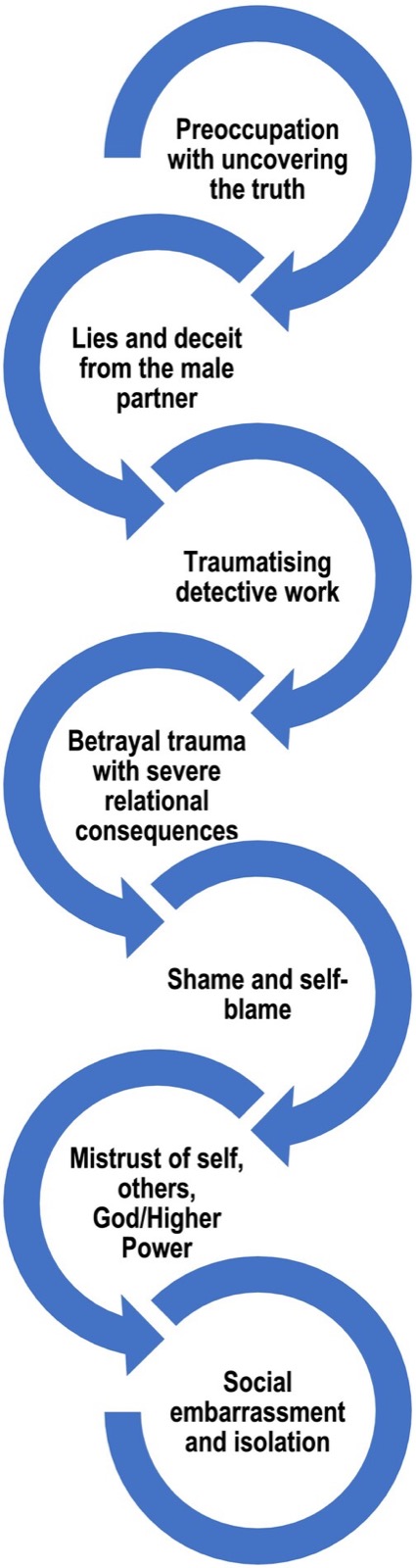
Participant 9 provided the photograph depicted as Figure 2. She gave permission to publish the picture to illustrate that even after years of intense relationship therapy, she still feels devastated and has a significant hole in her heart. The image's depiction of ‘brokenness’ and ‘healing’ reflects her personal experience and perception of healing and recovery after her husband's full confession, acknowledgement and a protracted and continuous time of relationship reconciliation.
[FIGURE 2 (Illustration of ‘Brokenness and Healing’ by FP 09) — artwork by a participant, not reproduced here.]
Complexe Systémique: key points
The study shifts the focus: what wounds first is not the sexual behaviour but the lying that surrounds it and the drip-feed of discovery. “Detective work” can then be read as an attempt to restore attachment security rather than as jealousy to be corrected, and shame spreads through the whole system: family, friends, church. For clinical practice, one can retain the need not to make the partner the cause of the behaviours, to name the grief for lost certainties, to screen systematically for self-harm and suicidal ideation, and to be wary of early injunctions to forgive. Reading calls for caution, however: twelve women recruited through a counselling centre and twelve-step groups, 100% figures in such a small sample, therapists who are partly pastors for the triangulation, and a “sexual addiction” framework that remains debated. Men, same-sex couples and Indigenous people are absent. Read alongside the article on the decision to stay together after infidelity, and the article on the treatment of traumatised sexuality.
Notes from the original
1 https://icd.who.int/browse/2024-01/mms/en#1630268048.
2 Compartmentalisation is a psychological defensive mechanism that the brain uses to keep out unwanted information (Clifford et al., 2019).
Acknowledgements. The authors thank all the research participants for generously sharing their experiences and perspectives. A special note of appreciation goes to Female Participant 09 for taking and sharing the photograph depicted as Figure 2.
Funding information. Alphacrucis University College funded the transcription of the participant interviews. The Article Processing Charge (APC) for the open-access publication of this article is funded by the University of the Sunshine Coast through the Council of Australian University Librarians (CAUL).
Conflict of interest statement. The authors have no competing interests to declare that are relevant to the content of this article.
Ethical approval. This study was conducted according to the guidelines of the National Statement on Ethical Conduct in Human Research (2007) National Statement (2007) developed jointly by the National Health and Medical Research Council (NHMRC), the Australian Research Council (ARC) and Universities Australia, and published by the Australian Government (2007) https://www.nhmrc.gov.au/about-us/publications/national-statement-ethical-conduct-human-research-2007-updated-2018 (accessed 19 May 2023). The study was approved by the Alphacrucis Human Research Ethics Committee (HREC no. EC00466) on 31 August 2020 (participant group 1: female partners) and 1 June 2021 (participant group 2: therapists).
Informed consent. Informed consent was obtained from all individual participants included in the study. Effective 1 January 2024, the National Statement on Ethical Conduct in Human Research 2007 (updated 2018) has been revoked and updated, whereupon the study applied the ethical guidance from the 2023 National Statement. https://www.nhmrc.gov.au/about-us/publications/national-statement-ethical-conduct-human-research-2023 (last accessed 19 October 2024).
Consent for image publication. The authors affirm that the female participant (FP 09) provided informed consent for the publication of Figure 2.
References
Atwood, J. D., & Schwartz, L. (2002). Cyber-sex. Journal of Couple & Relationship Therapy, 1(3), 37–56. https://doi.org/10.1300/j398v01n03_03
Badii, A., Cyrine, M., Amjed Ben, H., Ahmad, M., Ferid, Z., & Lotfi, G. (2020). Sexual addiction, self-esteem and personality dimensions. Journal of Addiction Therapy and Research, 4(1), 006–012. https://doi.org/10.29328/journal.jatr.1001011
Ballester-Arnal, R., Castro-Calvo, J., Gil-Llario, M. D., & Giménez-García, C. (2013). Relationship status as an influence on cybersex activity: Cybersex, youth, and steady partner. Journal of Sex & Marital Therapy, 40(5), 444–456. https://doi.org/10.1080/0092623x.2013.772549
Barna Group. (2016). The porn phenomenon: The impact of pornography. https://www.barna.com/the-porn-phenomenon/
Benfield, J., & Birchard, T. (2018). The Routledge international handbook of sexual addiction. Routledge.
Berger, J. (2012). Growing complex. https://www.cultivatingleadership.com/site/uploads/Jennifer-Garvey-Berger-LTL-final.pdf
Bergner, R. M., & Bridges, A. J. (2002). The significance of heavy pornography involvement for romantic partners: Research and clinical implications. Journal of Sex & Marital Therapy, 28(3), 193–206. https://doi.org/10.1080/009262302760328235
Birchard, T. (2018). Group cognitive behavioural therapy for compulsive sexual behaviour. In T. Birchard & J. Benfield (Eds.), The Routledge international handbook of sexual addiction (pp. 190–202). Routledge/Taylor & Francis. https://doi.org/10.4324/9781315639512-17
Birrell, P., Bernstein, R., & Freyd, J. (2017). With the fierce and loving embrace of another soul. In Reconstructing meaning after trauma (pp. 29–43). Elsevier Academic Press. https://doi.org/10.1016/b978-0-12-803015-8.00003-6
Black, C. (2019). Deceived: Facing the trauma of sexual betrayal. Central Recovery Press.
Black, C., & Tripodi, C. (2012). Intimate treason: Healing the trauma for partners confronting sex addiction. Central Recovery Press.
Bowlby, J. (1969). Attachment and loss: Attachment. Basic Books.
Bowlby, J. (1977). The making and breaking of affectional bonds. British Journal of Psychiatry, 130(3), 201–210. https://doi.org/10.1192/bjp.130.3.201
Boyle, J. (1991). Field research: A collaborative model for practice and research. In Qualitative nursing research: A contemporary dialogue (pp. 273–299). SAGE. https://doi.org/10.4135/9781483349015
Briken, P., Wiessner, C., Štulhofer, A., Klein, V., Fuß, J., Reed, G. M., & Dekker, A. (2022). Who feels affected by ‘out of control’ sexual behaviour? Prevalence and correlates of indicators for ICD-11 compulsive sexual behaviour disorder in the German health and sexuality survey (GeSiD). Journal of Behavioural Addictions, 11(3), 900–911. https://doi.org/10.1556/2006.2022.00060
Büssing, A., Baumann, K., Hvidt, N. C., Koenig, H. G., Puchalski, C. M., & Swinton, J. (2014). Spirituality and health. Evidence-based Complementary and Alternative Medicine, 2014, 1–2. https://doi.org/10.1155/2014/682817
Campbell, L., & Stanton, S. C. (2019). Adult attachment and trust in romantic relationships. Current Opinion in Psychology, 25, 148–151. https://doi.org/10.1016/j.copsyc.2018.08.004
Carnes, P. J., & Adams, K. M. (Eds.). (2019). Clinical management of sex addiction ( 2nd ed.). Routledge. https://doi.org/10.4324/9781315755267
Carnes, S. P. (2014). Mending a shattered heart: A guide for partners of sex addicts ( 2nd ed.). Gentle Path Press.
Carnes, P. (1991). Don’t call it love: Recovery from sexual addiction. Bantam Books.
Carnes, P. (2000). Sexual addiction and compulsion: Recognition, treatment, and recovery. CNS Spectrums, 5(10), 63–74. https://doi.org/10.1017/s1092852900007689
Carnes, P. (2011). Recovery start kit: A 100-day plan for addiction recovery. Gentle Path Press.
Carnes, P. J. (2018). Betrayal bond, revised: Breaking free of exploitive relationships. Hci.
Carnes, S., & Lee, M. A. (2014). Picking up the pieces. Behavioural Addictions, 2014, 267–284. https://doi.org/10.1016/b978-0-12-407724-9.00011-2
Carnes, S., & O'Connor, S. (2016). Confirmatory analysis of the partner sexuality survey. Sexual Addiction & Compulsivity, 23(1), 141–153. https://doi.org/10.1080/10720162.2015.1039151
Caron, A., Lafontaine, M.-F., & Bureau, J.-F. (2017). Linking romantic attachment and self-injury: The roles of the behavioural systems. Journal of Relationships Research, 8, e4. https://doi.org/10.1017/jrr.2017.5e4
Chandiramani, K. (2018). A role for mindfulness meditation in treating sexual addiction. In T. Birchard & J. Benfield (Eds.), The Routledge international handbook of sexual addiction (pp. 260–267). Routledge.
Chatzittofis, A., Boström, A. D. E., Savard, J., Öberg, K. G., Arver, S., & Jokinen, J. (2022). Neurochemical and hormonal contributors to compulsive sexual behavior disorder. Current Addiction Reports, 9(1), 23–31. https://doi.org/10.1007/s40429-021-00403-6
Chen, J.-M., & Luetz, J. M. (2020). Mono-/inter-/multi-/trans-/anti-disciplinarity in research. In W. Leal Filho, A. Marisa Azul, L. Brandli, P. Gökcin Özuyar, & T. Wall (Eds.), Quality education (pp. 562–577). Springer Nature. https://doi.org/10.1007/978-3-319-95870-5_33
Clifford, G., Hitchcock, C., & Dalgleish, T. (2019). Negative and positive emotional complexity in the autobiographical representations of sexual trauma survivors with posttraumatic stress disorder (PTSD). https://doi.org/10.31234/osf.io/f3h5w
Cohn, R. (2014). Calming the tempest, bridging the gorge: Healing in couples ruptured by ‘sex addiction’. Sexual and Relationship Therapy, 29(1), 76–86. https://doi.org/10.1080/14681994.2013.869314
Cooper, A., Delmonico, D. L., & Burg, R. (2000). Cybersex users, abusers, and compulsives: New findings and implications. Sexual Addiction & Compulsivity, 7(1–2), 5–29.
Courtois, C. A. (2014). It's not you, it's what happened to you: Complex trauma and treatment. Telemachus Press.
Creswell, J. W. (2015). Thirty essential skills for the qualitative researcher. Sage Publications.
Dahlen, U., Colpitts, D., & Green, C. (2008). The trauma egg as an intervention with the spouses of sexually addicted men. Sexual Addiction & Compulsivity, 15(4), 346–354. https://doi.org/10.1080/10720160802516336
Davis, L. J. (2009). Obsession: A history. University of Chicago Press.
de Alarcón, R., de la Iglesia, J. I., Casado, N. M., & Montejo, A. L. (2019). Online porn addiction: What we know and what we don't—A systematic review. Journal of Clinical Medicine, 8(1), 91.
Denzin, N. K., & Lincoln, Y. S. (2013). The landscape of qualitative research. Sage.
Edger, K. (2010). Evangelicalism, sexual morality, and sexual addiction: Opposing views and continued conflicts. Journal of Religion and Health, 51(1), 162–178. https://doi.org/10.1007/s10943-010-9338-7
Fiske, S. T. (2018). Social beings: Core motives in social psychology. John Wiley & Sons.
Fitness, J. (2006). Betrayal, rejection, revenge, and forgiveness: An interpersonal script approach. In M. Leary (Ed.), Interpersonal rejection (pp. 72–103). Oxford University Press.
Frankl, V. E. (1985). Man's search for meaning. Simon and Schuster.
Frankl, V. E. (2014). Man's search for meaning. Beacon Press.
Freyd, J. J. (1994). Betrayal trauma: Traumatic amnesia as an adaptive response to childhood abuse. Ethics & Behavior, 4(4), 307–329. https://doi.org/10.1207/s15327019eb0404_1
Freyd, J. J. (1996). Betrayal trauma: The logic of forgetting childhood abuse. Harvard University Press.
Freyd, J. J. (1998). Betrayal trauma. https://doi.org/10.2307/j.ctv1c3pd18
Freyd, J. J. (2008). Betrayed trauma. In G. Reyes, J. D. Elhai, & J. D. Ford (Eds.), Encyclopaedia of psychological trauma (p. 76). John Wiley & Sons.
Fusch, P., Fusch, G. E., & Ness, L. R. (2018). Denzin's paradigm shift: Revisiting triangulation in qualitative research. Journal of Social Change, 10(1), 19–32. https://doi.org/10.5590/JOSC.2018.10.1.02
Futrell, L. (2021). Is porn the new mistress? A sexual betrayal study. California Institute of Integral Studies.
Garcia, J. R., Reiber, C., Massey, S. G., & Merriwether, A. M. (2013). Sexual hook-up culture. https://www.apa.org/monitor/2013/02/sexual-hookup-culture.pdf
Giordano, A. L., Hedden, L. E., Kim, S. W., Lundeen, L. A., & Lu, Z. (2024). Childhood trauma and sex addiction among adult men. Journal of Addictions & Offender Counseling, 45(2), 221–233. https://doi.org/10.1002/jaoc.12134
Giorgi, A., Giorgi, B., & Morley, J. (2017). The descriptive phenomenological psychological method. In C. Willig (Ed.), The SAGE handbook of qualitative research in psychology (pp. 176–192). Sage. https://doi.org/10.4135/9781526405555.n11
Gómez, J., Smith, C., & Freyd, J. (2014). Minority students experience of discrimination and institutional betrayal. PsycEXTRA Dataset. https://doi.org/10.1037/e517672014-001
Gómez-López, M., Viejo, C., & Ortega-Ruiz, R. (2019). Well-being and romantic relationships: A systematic review in adolescence and emerging adulthood. International Journal of Environmental Research and Public Health, 16(13), 2415. https://doi.org/10.3390/ijerph16132415
Gottman, J. M. (2011). The science of trust. W. W. Norton.
Gottman, J. M., Gottman, J., & Silver, N. (2013). What makes love last? How to build trust and avoid betrayal. Simon & Schuster.
Grant, R. (1999). Spirituality and trauma: An essay. Traumatology, 5(1), 8–10. https://doi.org/10.1177/153476569900500103
Griffin-Shelley, E. (2018). The importance of group psychotherapy for sex and love addiction recovery. In T. Birchard & J. Benfield (Eds.), The Routledge international handbook of sexual addiction (pp. 181–189). Routledge/Taylor & Francis. https://doi.org/10.4324/9781315639512-16
Grubbs, J. B., Hoagland, K. C., Lee, B. N., Grant, J. T., Davison, P., Reid, R. C., & Kraus, S. W. (2020). Sexual addiction 25 years on: A systematic and methodological review of empirical literature and an agenda for future research. Clinical Psychology Review, 82, 101925. https://doi.org/10.1016/j.cpr.2020.101925
Grubbs, J. B., Lee, B., Floyd, C. G., Bőthe, B., Jennings, T., & Kraus, S. W. (2024). What is the “sex” in sex addiction? Problem behaviors reported among those endorsing compulsive sexual behavior. Sexual Health & Compulsivity, 31(4), 351–367. https://doi.org/10.1080/26929953.2024.2386518
Grubbs, J. B., Perry, S. L., Wilt, J. A., & Reid, R. C. (2019). Pornography problems due to moral incongruence: An integrative model with a systematic review and meta-analysis. Archives of Sexual Behavior, 48, 397–415. https://doi.org/10.1007/s10508-018-1248-x
Hackett, C., Murphy, C., McClendon, D., & Shi, A. (2016). The gender gap in religion around the world: Women are generally more religious than men, particularly among Christians. Religion (pp. 64–69). Routledge.
Hall, P. (2016). Sex addiction: The partner's perspective. Routledge.
Hastings, H. F., & Lucero Jones, R. (2023). Influence of a partner's pornography consumption on a Christian woman's sexuality: A qualitative exploration. Sexual Health & Compulsivity, 30(2), 143–175. https://doi.org/10.1080/26929953.2023.2176956
Hazan, C., & Shaver, P. (1987). Romantic love conceptualized as an attachment process. Journal of Personality and Social Psychology, 52(3), 511–524. https://doi.org/10.1037/0022-3514.52.3.511
Hunyady, O., Josephs, L., & Jost, J. T. (2008). Priming the primal scene: Betrayal trauma, narcissism, and attitudes toward sexual infidelity. Self and Identity, 7(3), 278–294. https://doi.org/10.1080/15298860701620227
Husserl, E. (1960). Introduction. In Cartesian meditations. Springer. https://doi.org/10.1007/978-94-017-4952-7_1
Husserl, E. (1970). The crisis of European sciences and transcendental phenomenology: An introduction to phenomenological philosophy. Northwestern University Press.
Johnson, S. M., Makinen, J. A., & Millikin, J. W. (2001). Attachment injuries in couple relationships: A new perspective on impasses in couples therapy. Journal of Marital and Family Therapy, 27(2), 145–155. https://doi.org/10.1111/j.1752-0606.2001.tb01152.x
Kahn, L., & Freyd, J. (2008). Betrayal trauma: Theory and treatment implications. PsycEXTRA Dataset. https://doi.org/10.1037/e608922012-075
Kelley, L. P., Weathers, F. W., Mason, E. A., & Pruneau, G. M. (2012). Association of life threat and betrayal with posttraumatic stress disorder symptom severity. Journal of Traumatic Stress, 25(4), 408–415. https://doi.org/10.1002/jts.21727
Kibby, M., & Costello, B. (2001). Between the image and the act: Interactive sex entertainment on the internet. Sexualities, 4(3), 353–369. https://doi.org/10.1177/136346001004003005
Kishor, M., Chandran, S., Maheshwari, S., Mathur, S., & Sathyanarayana Rao, T. (2018). Nonresponsive responder! Somatic symptoms presenting as refractory depression with response to electroconvulsive therapy. Annals of Indian Psychiatry, 2(2), 144–146. https://doi.org/10.4103/aip.aip_2_18
Kohut, T., Balzarini, R. N., Fisher, W. A., & Campbell, L. (2018). Pornography's associations with open sexual communication and relationship closeness vary as a function of dyadic patterns of pornography use within heterosexual relationships. Journal of Social and Personal Relationships, 35(4), 655–676. https://doi.org/10.1177/0265407517743096
Kraus, S. W., Krueger, R. B., Briken, P., First, M. B., Stein, D. J., Kaplan, M. S., Voon, V., Abdo, C. H., Grant, J. E., Atalla, E., & Reed, G. M. (2018). Compulsive sexual behaviour disorder in the ICD-11. World Psychiatry, 17(1), 109–110. https://doi.org/10.1002/wps.20499
Kraus, S. W., & Sweeney, P. J. (2019). Hitting the target: Considerations for differential diagnosis when treating individuals for problematic use of pornography. Archives of Sexual Behaviour, 48(2), 431–435. https://doi.org/10.1007/s10508-018-1301-9
Kürbitz, L. I., & Briken, P. (2021). Is compulsive sexual behaviour different in women compared to men? Journal of Clinical Medicine, 10(15), 3205. https://doi.org/10.3390/jcm10153205
Laaser, D., Putney, H. L., Bundick, M., Delmonico, D. L., & Griffin, E. J. (2017). Posttraumatic growth in relationally betrayed women. Journal of Marital and Family Therapy, 43(3), 435–447. https://doi.org/10.1111/jmft.12211
Laaser, M. R., & Adams, K. M. (2019). Pastors and sex addiction, In P. J. Carnes & K. M. Adams (Eds.), Clinical management of sex addiction (Ch. 21; 2nd ed., pp. 377–389). Routledge. https://doi.org/10.4324/9781315755267
Lewczuk, K., Wizła, M., & Gola, M. (2022). The relation of sexual attitudes to hypersexuality and problematic pornography use. Archives of Sexual Behaviour, 52(1), 411–430. https://doi.org/10.1007/s10508-022-02358-9
Lew-Starowicz, M., Draps, M., Kowalewska, E., Obarska, K., Kraus, S. W., & Gola, M. (2022). Tolerability and efficacy of paroxetine and naltrexone for treatment of compulsive sexual behaviour disorder. World Psychiatry, 21(3), 468–469. https://doi.org/10.1002/wps.21026
Luetz, J. M., & Nunn, P. D. (2023). Spirituality and sustainable development: An entangled and neglected relationship. Sustainability Science, 18, 2035–2042. https://doi.org/10.1007/s11625-023-01347-8
Maas, M. K., Vasilenko, S. A., & Willoughby, B. J. (2018). A dyadic approach to pornography use and relationship satisfaction among heterosexual couples: The role of pornography acceptance and anxious attachment. The Journal of Sex Research, 55(6), 772–782. https://doi.org/10.1080/00224499.2018.1440281
Machia, L. V., Agnew, C. R., & Arriaga, X. B. (2020). Interdependence, interaction, and close relationships. Cambridge University Press.
Maddox, A. M., Rhoades, G. K., & Markman, H. J. (2011). Viewing sexually-explicit materials alone or together: Associations with relationship quality. Archives of Sexual Behaviour, 40(2), 441–448. https://doi.org/10.1007/s10508-009-9585-4
Maercker, A., & Hecker, T. (2016). Broadening perspectives on trauma and recovery: A socio-interpersonal view of PTSD. European Journal of Psychotraumatology, 7(1), 29303. https://doi.org/10.3402/ejpt.v7.29303
Mahoney, A., Krumrei, E. J., & Pargament, K. I. (2012). Broken vows: Divorce as a spiritual trauma and its implications for growth and decline. In S. Joseph & P. A. Linley (Eds.), Trauma, recovery, and growth (pp. 105–123). John Wiley & Sons. https://doi.org/10.1002/9781118269718.ch6
Manning, J. C., & Watson, W. L. (2008). Common factors in Christian women's preferences for support when dealing with a spouse's sexually addictive or compulsive behaviours: The C.A.V.E.D. Theory. Sexual Addiction & Compulsivity, 15(3), 233–249. https://doi.org/10.1080/10720160802288886
McCormack, M., & Wignall, L. (2017). Enjoyment, exploration and education: Understanding the consumption of pornography among young men with non-exclusive sexual orientations. Sociology, 51(5), 975–991. https://doi.org/10.1177/0038038516629909
McNair, B. (2013). Porno? Chic! Routledge.
Merriam, S. B., & Tisdell, E. J. (2016). Qualitative research: A guide to design and implementation. John Wiley & Sons.
Milrad, R. (1999). Co-addictive recovery: Early recovery issues for spouses of sex addicts. Sexual Addiction & Compulsivity, 6(2), 125–136. https://doi.org/10.1080/10720169908400185
Minarcik, J., Wetterneck, C. T., & Short, M. B. (2016). The effects of sexually explicit material use on romantic relationship dynamics. Journal of Behavioural Addictions, 5(4), 700–707. https://doi.org/10.1556/2006.5.2016.078
Minwalla, O. (2014). Thirteen dimensions of sex addiction-induced trauma (SAIT) among partners and spouses impacted by sex addiction. The Institute for Sexual Health. https://theinstituteforsexualhealth.com/thirteen-dimensions-of-sex-addiction-induced-trauma-sait-among-partners-and-spouses-impacted-by-sex-addiction/
Morales-Vives, F., Ferré-Rey, G., Ferrando, P. J., & Camps, M. (2021). Balancing typological and dimensional approaches: Assessment of adult attachment styles with factor mixture analysis. PLoS One, 16(7), e0254342. https://doi.org/10.1371/journal.pone.0254342
Motz, A. (2020). Self-harm, inscriptions and survival. In A. Motz, M. Dennis, & A. Aiyegbusi (Eds.), Invisible trauma (pp. 82–99). Routledge. https://doi.org/10.4324/9781315390000-6
Naderifar, M., Goli, H., & Ghaljaie, F. (2017). Snowball sampling: A purposeful method of sampling in qualitative research. Strides in Development of Medical Education, 14(3). https://doi.org/10.5812/sdme.67670
Neubauer, B. E., Witkop, C. T., & Varpio, L. (2019). How phenomenology can help us learn from the experiences of others. Perspectives on Medical Education, 8(2), 90–97. https://doi.org/10.1007/s40037-019-0509-2
Neves, S. (2021). Compulsive sexual behaviours: A psycho-sexual treatment guide for clinicians. Routledge.
Nunn, P. D., & Luetz, J. M. (2021). Beyond belief. In J. M. Luetz & P. D. Nunn (Eds.), Beyond belief—Opportunities for faith-engaged approaches to climate-change adaptation in the Pacific Islands (Ch. 1; pp. 1–14). Springer Nature. https://doi.org/10.1007/978-3-030-67602-5_1
Pargament, K. I., Koenig, H. G., & Perez, L. M. (2000). The many methods of religious coping: Development and initial validation of the RCOPE. Journal of Clinical Psychology, 56(4), 519–543. https://doi.org/10.1002/(sic)1097-4679(200004)56:4<519::aid-jclp6>3.0.co;2-1
Patton, M. Q. (2002). Two decades of developments in qualitative inquiry: A personal, experiential perspective. Qualitative Social Work, 1(3), 261–283. https://doi.org/10.1177/1473325002001003636
Peerawong, T., Phenwan, T., Mahattanobon, S., Tulathamkij, K., & Pattanasattayavong, U. (2019). Body image transformation after breast cancer diagnosis and treatment in southern Thai women. Sage Open Medicine, 7, 205031211982998. https://doi.org/10.1177/2050312119829985
Peoples, K. (2020). How to write a phenomenological dissertation: A step-by-step guide (Vol. 56). Sage Publications.
Perry, S. L., & Hayward, G. M. (2017). Seeing is (not) believing: How viewing pornography shapes the religious lives of young Americans. Social Forces, 95, 1757–1788. https://doi.org/10.1093/sf/sow106
Porges, S. W. (2018). Polyvagal theory: A primer. In S. W. Porges & D. Dana (Eds.), Clinical applications of the polyvagal theory: The emergence of polyvagal-informed therapies (pp. 50–69). W. W. Norton & Co.
Potenza, M. N., Gola, M., Voon, V., Kor, A., & Kraus, S. W. (2017). Is excessive sexual behaviour an addictive disorder? The Lancet Psychiatry, 4(9), 663–664. https://doi.org/10.1016/s2215-0366(17)30316-4
QSR International. (2021). Discover the ways NVivo works for you. https://www.qsrinternational.com/nvivo-qualitative-data-analysis-software/home
Rachman, S. (2010). Betrayal: A psychological analysis. Behaviour Research and Therapy, 48(4), 304–311. https://doi.org/10.1016/j.brat.2009.12.002
Reid, R. C., Garos, S., & Carpenter, B. N. (2011). Reliability, validity, and psychometric development of the hypersexual behaviour inventory in an outpatient sample of men. Sexual Addiction & Compulsivity, 18(1), 30–51. https://doi.org/10.1080/10720162.2011.555709
Reid, R. C., & Kafka, M. P. (2014). Controversies about hypersexual disorder and the DSM-5. Current Sexual Health Reports, 6(4), 259–264. https://doi.org/10.1007/s11930-014-0031-9
Richters, J., de Visser, O., Badcock, B., Smith Anthony, M. A., Rissel, C., Simpson, M., & Grulich, A. (2014). Masturbation, paying for sex, and other sexual activities: The second Australian study of health and relationships. Sexual Health, 11, 461–471. https://doi.org/10.1071/SH14116
Santos, C., & Michaels, J. L. (2022). What are the core features and dimensions of ‘spirituality’? Applying a partial prototype analysis to understand how laypeople mentally represent spirituality as a concept. Psychology of Religion and Spirituality, 14(1), 10–20. https://doi.org/10.1037/rel0000380
Sassover, E., & Weinstein, A. (2020). Should compulsive sexual behaviour (CSB) be considered a behavioural addiction? A debate paper presenting the opposing view. Journal of Behavioural Addictions, 11, 166–179. https://doi.org/10.1556/2006.2020.00055
Sassover, E., & Weinstein, A. (2024). Compulsive sexual behaviour disorder and impulsivity. In The psychology and neuroscience of impulsivity (pp. 31–45). Academic Press.
Schneider, J. (2000). Effects of cybersex addiction on the family: Results of a survey. Sexual Addiction & Compulsivity, 7(1–2), 31–58. https://doi.org/10.1080/10720160008400206
Schneider, J. (2003). The impact of compulsive cybersex behaviours on the family. Sexual and Relationship Therapy, 18(3), 329–354. https://doi.org/10.1080/146819903100153946
Schneider, J. P., Corley, M. D., & Irons, R. K. (1998). Surviving disclosure of infidelity: Results of an international survey of 164 recovering sex addicts and partners. Sexual Addiction & Compulsivity, 5(3), 189–217. https://doi.org/10.1080/10720169808400162
Schneider, J. P., Weiss, R., & Samenow, C. (2012). Is it really cheating? Understanding the emotional reactions and clinical treatment of spouses and partners affected by cybersex infidelity. Sexual Addiction & Compulsivity, 19(1–2), 123–139. https://doi.org/10.1080/10720162.2012.658344
Seidman, I. (2006). Interviewing as qualitative research: A guide for researchers in education and the social sciences. Teachers College Press.
Seyed Aghamiri, F. (2023a). Pain and betrayal trauma caused by sexual addiction: An unwanted gift that keeps giving. Ultimate World Publishers.
Seyed Aghamiri, F. (2023b). The betrayal trauma healing workbook: Holistic healing from betrayal trauma, grief processing, and 12 steps for betrayed Partners of Sexual Addiction. Ultimate World Publishers.
Seyed Aghamiri, F., & Luetz, J. M. (2021). Sexual addiction and Christian education. In J. M. Luetz & B. Green (Eds.), Innovating Christian education research: Multidisciplinary perspectives (pp. 443–468). Springer Nature. https://doi.org/10.1007/978-981-15-8856-3_24
Seyed Aghamiri, F., & Luetz, J. M. (2023). The long-lived impacts of sexual addiction: Examples of unwanted gifts that keep giving. Sexual Health & Compulsivity, 30(1), 123–127. https://doi.org/10.1080/26929953.2022.2163013
Seyed Aghamiri, F., Luetz, J. M., & Hills, K. (2022a). Impacts of sexual addiction on intimate female partners—The state of the art. Sexual Health & Compulsivity, 29(1–2), 1–37. https://doi.org/10.1080/26929953.2022.2050862
Seyed Aghamiri, F., Luetz, J. M., & Hills, K. (2022b). Pornography addiction and its impacts on intimate female partner well-being—A systematic narrative synthesis. Journal of Addictive Diseases, 40, 472–480. https://doi.org/10.1080/10550887.2021.2021058
Seyed Aghamiri, F., Luetz, J. M., & Hills, K. (2024a). Investigating the impacts of compulsive sexual behaviours on women using descriptive phenomenology: A research agenda. Sexuality Research & Social Policy. https://doi.org/10.1007/s13178-024-00934-3
Seyed Aghamiri, F., Luetz, J. M., & Hills, K. (2024b). The lived experiences and well-being of female partners following discovery or disclosure of their male partner's compulsive sexual behaviours: An Australian phenomenological study. Sexuality Research & Social Policy, 1–28. https://doi.org/10.1007/s13178-024-01043-x
Seyed Aghamiri, F., Luetz, J. M., & Hills, K. (2024c). Why did god let this happen? Assessing the spiritual impacts of sexual addiction on intimate female partners: A qualitative investigation. Sexuality and Culture, 28, 2113–2142. https://doi.org/10.1007/s12119-024-10221-3
Seyed Aghamiri, F. S. (2020). Reclaim your life: Essential guide to sexual addiction and holistic recovery. Ultimate World Publishers.
Sigusch, V. (2001). Lean sexuality: On cultural transformations of sexuality and gender in recent decades. Sexuality and Culture, 5(2), 23–56. https://doi.org/10.1007/s12119-001-1017-0
Skinner, K. B. (2015). The lasting effects of sexual betrayal. https://bloomforwomen.com/wp-content/uploads/2016/12/how-betrayal-trauma-manifests-itself.pdf
Skinner, K. B. (2017). Treating trauma from sexual betrayal: The essential tools for healing. Growth climate.
Skinner, K. B. (2020). Treating sexual addiction: A compassionate approach to recovery. Skin. Corp.
Slavin, M. N., Scoglio, A. A., Blycker, G. R., Potenza, M. N., & Kraus, S. W. (2020a). Child sexual abuse and compulsive sexual behaviour: A systematic literature review. Current Addiction Reports, 7(1), 76–88. https://doi.org/10.1007/s40429-020-00298-9
Slavin, M. N., Blycker, G. R., Potenza, M. N., Bőthe, B., Demetrovics, Z., & Kraus, S. W. (2020b). Gender-related differences in associations between sexual abuse and hypersexuality. The Journal of Sexual Medicine, 17(10), 2029–2038. https://doi.org/10.1016/j.jsxm.2020.07.008
Steffens, B., & Means, M. (2009). Your sexually addicted spouse: How partners can cope and heal. New Horizon Press.
Steffens, B., & Rennie, R. L. (2006). The traumatic nature of disclosure for wives of sexual addicts. Sexual Addiction & Compulsivity, 13(2–3), 247–267. https://doi.org/10.1080/10720160600870802
Sundler, A. J., Lindberg, E., Nilsson, C., & Palmér, L. (2019). Qualitative thematic analysis based on descriptive phenomenology. Nursing Open, 6(3), 733–739. https://doi.org/10.1002/nop2.275
Ter Bogt, T. F., Engels, R. C., Bogers, S., & Kloosterman, M. (2010). ‘Shake it, baby, shake it’: Media preferences, sexual attitudes and gender stereotypes among adolescents. Sex Roles, 63(11–12), 844–859. https://doi.org/10.1007/s11199-010-9815-1
Tirone, V., Orlowska, D., Lofgreen, A. M., Blais, R. K., Stevens, N. R., Klassen, B., Held, P., & Zalta, A. K. (2021). The association between social support and posttraumatic stress symptoms among survivors of betrayal trauma: A meta-analysis. European Journal of Psychotraumatology, 12(1), 1–19. https://doi.org/10.1080/20008198.2021.1883925
Van Gordon, W., Shonin, E., & Griffiths, M. D. (2016). Meditation awareness training for the treatment of sex addiction: A case study. Journal of Behavioral Addictions, 5(2), 363–372. https://doi.org/10.1556/2006.5.2016.034
van Manen, M. (1997). Researching lived experience: Human science for an action sensitive pedagogy ( 2nd ed.). Routledge. https://doi.org/10.4324/9781315421056
Vanzant, I. (2015). Trust: Mastering the four essential trusts. Smiley Books.
Vasconcelos, P., Paúl, C., Serruya, S. J., Ponce de León, R. G., & Nobre, P. (2022). A systematic review of sexual health and subjective well-being in older age groups. Revitas Pan-American de Salud Publica = Pan American Journal of Public Health, 46, e179. https://doi.org/10.26633/RPSP.2022.179
Vieira, C., & Griffiths, M. D. (2024). Problematic pornography use and mental health: A systematic review. Sexual Health & Compulsivity, 31(3), 207–247. https://doi.org/10.1080/26929953.2024.2348624
Vogeler, H. A., Fischer, L., Sudweeks, R. R., & Skinner, K. B. (2018). An examination of the factor structure of the trauma inventory for partners of sex addicts (TIPSA). Sexual Addiction & Compulsivity, 25(1), 46–64. https://doi.org/10.1080/10720162.2018.1452086
Walton, M. T., & Bhullar, N. (2020). Correction to: Response to commentaries: Recognizing hypersexuality as a psychosexual behavioural problem and advancing the behavioural cycle of hypersexuality. Archives of Sexual Behaviour, 50(2), 729. https://doi.org/10.1007/s10508-020-01886-6
Warach, B., & Josephs, L. (2021). The aftershocks of infidelity: A review of infidelity-based attachment trauma. Sexual and Relationship Therapy, 36(1), 68–90. https://doi.org/10.1080/14681994.2019.1577961
Weiss, D. (2019). Partner betrayal trauma. Discovery Press.
Weiss, R. (2020). Information for spouses and partners of sex addicts. Robert Weiss, PhD, LCSW. https://www.robertweissmsw.com/about-sex-addiction/information-for-spousespartners/
Weiss, R. (2021). The role of grief and loss in addiction recovery. https://oxbowacademy.net/educationalarticles/grief_add_recov/
Wéry, A., & Billieux, J. (2017). Problematic cybersex: Conceptualization, assessment, and treatment. Addictive Behaviours, 64, 238–246. https://doi.org/10.1016/j.addbeh.2015.11.007
WHO—World Health Organization. (2019). ICD-11. Version 04/2019. Compulsive sexual behaviour disorder. https://icd.who.int/browse/2024-01/mms/en#1630268048
Willig, C. (2013). Introducing qualitative research in psychology ( 3rd ed.). Open University Press.
Williams, L. K. (2019). The experience of sexual betrayal trauma: A qualitative analysis of responses from the Trauma Inventory for Partners of Sex Addicts (TIPSA) [thesis, Brigham Young University]. https://scholarsarchive.byu.edu/cgi/viewcontent.cgi?article=9557&context=etd
Yamamoto, M. (2020). Recovery from hypersexual disorder (HD): An examination of the effectiveness of combination treatment. Sexual Addiction & Compulsivity, 27(3–4), 211–235. https://doi.org/10.1080/10720162.2020.1815267
Zitzman, S. T., & Butler, M. H. (2009). Wives' experience of husbands' pornography use and concomitant deception as an attachment threat in the adult pair-bond relationship. Sexual Addiction & Compulsivity, 16(3), 210–240. https://doi.org/10.1080/10720160903202679
Reformatted republication of Compulsive sexual behaviours and relational consequences: A phenomenological study on intimate female partner impacts, by Fakri Seyed Aghamiri, Johannes M. Luetz and Karenne Hills, Counselling and Psychotherapy Research, vol. 25, no 1, article e12850 (2025), doi: 10.1002/capr.12850, under a CC BY 4.0 licence. Edition and layout: Complexe Systémique, September 2026 — the work has been modified under the terms of the licence (tables presented as lists). Neither the authors nor the publisher are responsible for this edition; the original version prevails.
This is the original article “Compulsive sexual behaviours and relational consequences: A phenomenological study on intimate female partner impacts”, published in Counselling and Psychotherapy Research (2025) under a CC BY 4.0 licence. Republished by Complexe Systémique: the author’s text is unchanged; only the presentation has been adapted for reading online, as set out at the head of this page.
Read the original articleHow to cite this article
Seyed Aghamiri, F., Luetz, J. M., et Hills, K. (2025). Compulsive sexual behaviours and relational consequences: A phenomenological study on intimate female partner impacts. Complexe Systémique. https://app.complexe-systemique.com/en_GB/articles/compulsive-sexual-behaviours-and-relational-consequences (Original work published in 2025 in Counselling and Psychotherapy Research, 25(1), e12850 (2025); republished in 2025 by Counselling and Psychotherapy Research, https://onlinelibrary.wiley.com/doi/10.1002/capr.12850)
To go further
- Rester ensemble après une infidélité : le processus de décision du rétablissement, du point de vue de la personne blesséeStaying together after infidelity.
- Le traitement de la sexualité traumatiséeTraumatised sexuality.
- Les facteurs de résilience dans la guérison du couple après une infidélité : une étude par analyse qualitative déductiveHealing from infidelity.
Related training courses
 Webinar
Extramarital affairs: what does the therapist do when the couple explodes?
Free webinar: how to position yourself as a systemic therapist in the crisis of the extramarital affair. Revelation, secrecy, multipartiality.
 Webinar
The three loves
Free live webinar with Dr Robert Neuburger, 1 October 2026, 6 pm (Paris): the three loves, attachment and ways of loving. Held in French.
 Short course
The new arenas of couple therapy: work, money, tasks and co-existence
Online training: working with conjugal tensions around work, money, mental load and household tasks. Systemic reading and tools. In French.
 Short course
The power of rituals in couple therapy: a systemic intervention method
Online training: using ordinary, constitutive and performative rituals as a systemic intervention method in couple therapy. Delivered in French.
Related articles
 Blog
Adult ADHD: when forgetting turns into a misunderstanding
Forgetting, compensating, tension in the couple: a systemic look at adult ADHD, to understand what is at stake and to look for more fitting forms of support.
 Scientific
Sickle Cell Disease and Young Couples: Understanding the Influence of Shared and Individual Meaning on Couples’ Experience of Illness
Nine young adult couples facing sickle cell disease: how each partner makes sense of the illness, and how the couple moves from caregiving to equality from one crisis to the next.
 Scientific
Digital Co-Regulation and Dysregulation in Romantic Relationships: A Systemic Model of Technology-Mediated Emotional Processes
Checking, chasing, blocking: 31 interviews show how the phone regulates or dysregulates a couple’s anxiety, with a systemic model of the loop.
 Scientific
Transitioning to the Business of a Session in Collaborative-Dialogic Meetings: A Conversation Analysis
How do Open Dialogue therapists move to the business of a session? The open question creates silences and family negotiation: a conversation analysis of ten sessions.