Journal of Infant, Child, and Adolescent Psychotherapy · Family
“As a Grandmother, I Trust Her 100%!” A Qualitative Study of Therapists’ Experiences with Unexpected Changes in the Mother–Grandmother Relationship Among Perinatal Women with Adverse Childhood Experiences
A pregnant woman described her mother as the source of her suffering; six weeks after the birth, the baby is sleeping at the grandmother’s. Drawing on interviews with seven therapists from a Norwegian perinatal team, Heidi Fjeldheim’s team shows how these sudden reversals test therapists’ reflective capacity, and why it is better to welcome ambivalence than to rely on hope alone.
This is a reformatted republication of “As a Grandmother, I Trust Her 100%!” A Qualitative Study of Therapists’ Experiences with Unexpected Changes in the Mother–Grandmother Relationship Among Perinatal Women with Adverse Childhood Experiences, by Heidi Fjeldheim, Teija M. S. Anke, Helen Suizu Norheim, Anne Werner, Marianne Aalberg and Vibeke Moe, published in Journal of Infant, Child, and Adolescent Psychotherapy (Taylor & Francis) (2024), doi: 10.1080/15289168.2024.2409610, under a CC BY 4.0 licence. Prepared by Complexe Systémique in September 2026: the authors’ text is unchanged; the layout has been adapted for reading online, which constitutes a modification of the work under the terms of the licence. End-of-article statements are grouped in the notes. This edition was made neither by the authors nor by the publisher, who are not responsible for its content or for any errors. The original version prevails.
It can be tempting to lean into the hope of generational change more than ambivalence in the early phases of therapy.
Heidi Fjeldheim, Teija M. S. Anke, Helen Suizu Norheim, Anne Werner, Marianne Aalberg and Vibeke Moe
Abstract
Despite its importance for therapeutic work, therapists’ experiences in perinatal psychotherapy remain largely underinvestigated. This qualitative study examined therapists’ experiences in addressing intergenerational adversities in perinatal women with adverse childhood experiences. It specifically emphasized the negotiation of the “motherhood constellation” and the relational changes in the mother – grandmother relationship nearing and after birth. Data from individual interviews and a follow-up focus group with seven therapists were analyzed via reflexive thematic analysis. Two main themes with associated subthemes were derived from the data: (1) therapists’ experiences with unexpected changes toward closeness in the mother – grandmother relationship during pregnancy and postpartum and (2) therapists’ attempts to understand why some women change from perceiving their mother as an adverse caregiver to their closest support in their transition to motherhood. The therapist’s empathic and reflective capacity was challenged by abrupt changes in mother – grandmother relationships. Their attempts to make sense of the changes ranged from expected developmental processes to more pathological processes. The findings from the present study highlight therapeutic challenges in working with mother – grandmother relationships in the perinatal period and the importance of therapists having multiple perspectives in their understanding of intergenerational relational changes.
Introduction
The perinatal period is especially useful for addressing intergenerational relational patterns in therapy (Lieberman et al., 2020; Narayan et al., 2018; Slade & Sadler, 2019). This provides valuable prospects for altering the transmission of intergenerational adversities with perinatal women with adverse childhood experiences (ACEs), such as violence, abuse, trauma, and neglect. However, research on therapists’ experiences in psychotherapy with perinatal women with ACEs remains scarce. At least three generations are psychologically at play when a motherhood mind-set is formed. Indeed, the psychic triangle of the baby – mother – grandmother is at the very center of the process of forming a “motherhood constellation” (Stern, 1995), defined by Stern as “a unique organization of mental life appropriate for and adapted to the reality of having an infant to care for” (Stern, 1995, p. 3). For the new mother, concerns related to the survival and well-being of the baby coexist with emerging representations of self-as-mother and the establishment of a supporting relational matrix (Stern, 1995). Embedded in these concerns is an increased interest in one’s own mother during pregnancy and postpartum (Ammaniti et al., 2013; Lieberman et al., 2020; Schechter, 2017; Slade & Sadler, 2019; Stern, 1995). The new mother’s childhood experiences of being parented are activated (Hoffman, 2004; Schechter, 2017), and maternal figures from the past are psychologically revisited in search of parental models (Brodén, 2004; Stern et al., 1998). Questions such as “Who was my mum?,” “Did she love me?,” “In what ways did she let me down?” and “In what ways do I want to be like and unlike her as a mum?” are highly relevant for forming one’s own motherhood (Brodén, 2004).
It is possible to learn from both good and bad maternal models (Stern, 1995). However, revisiting childhood experiences of violence, abuse, trauma, and neglect can be scary and overwhelming and trigger defensive strategies (Brodén, 2004; Busch & Lieberman, 2010; Fraiberg et al., 1975), making it difficult to learn from and use those experiences without support, which is why therapeutic work with the baby – mother – grandmother triangle may be particularly important. Moreover, alongside revisiting the past, renegotiating the present mother – grandmother relationship is an essential developmental task in pregnancy (Stern, 1995). The present mother – grandmother relationship can impact the life of the coming generation through its impact on the new mother (Dugmore, 2013; Stern, 1995). Grandmothers can provide much-needed support associated with mental health benefits for the future mother (Knorr & Fox, 2023) but may also present a risk factor for the child through, for example, verbal conflicts with the mother, negatively impacting the mother’s parenting (Barnett et al., 2012). How to navigate the present relationship with one’s own mother may be pressing for many pregnant women with ACEs. A pertinent question is whether it is best to distance and protect oneself and the baby from the grandmother-to-be or reach out to her, try to reconnect and possibly reconcile and develop a new form of relationship (Busch & Lieberman, 2010). Taken together, the past and present relationship between the mother-to-be and the grandmother-to-be can potentially influence maternal behavior toward the baby (Stern, 1995).
Nevertheless, despite a strong wish for change among many new mothers with ACEs, they may struggle to break the generational legacy and provide their children with something other than what they received. Therefore, the wish to become different, or even the opposite, from one’s own mother can be a strong motivator for entering perinatal psychotherapy (Baradon, 2009b; Brodén, 2004; Lieberman et al., 2020; Steele et al., 2009). Perinatal psychotherapy has been developed to address difficulties in pregnancy and early childhood, as well as to prevent the development of further psychopathology. It is a field, rather than a method, inspired by a range of theories and research within attachment, trauma, parent – infant psychotherapy, social work, and psychodynamic therapy with multiple ports of entry and multidisciplinary teams (Lieberman et al., 2020; Sadler et al., 2013). However, to our knowledge, the complex therapeutic processes involved in negotiating the baby – mother – grandmother triangle in families with intergenerational ACEs have received little attention. Clinical experiences, however, speak to the importance as well as challenges involved in addressing this theme during the perinatal period, both for women transitioning to motherhood and their therapists (Brodén, 2004; Busch & Lieberman, 2010; Dugmore, 2013; Lieberman et al., 2020; Matheson, 2011; Schechter, 2017).
The empathic and reflective capacity of therapists working with families with intergenerational adversities is believed to be a key component in therapeutic work (Slade et al., 2023), leaving questions related to what can compromise that capacity in perinatal therapy highly relevant to explore. For example, themes such as family trauma, deprivation, and loss have been described as potentially impacting therapists’ reflective capacity due to strong emotional reactions such as fear, anger, helplessness, and overwhelming (Dalley, 2009; Emanuel, 2002; Slade et al., 2016). Therefore, the present study aimed at exploring therapists’ experiences working with the baby – mother – grandmother triangle with perinatal women with ACEs. In particular, our purpose was to explore what may challenge the therapists’ capacity to maintain an empathic and reflective capacity and how this could influence therapy at critical moments.
Method
We conducted a qualitative study comprising individual interviews with seven therapists in the perinatal field and a follow-up focus group (FG) with the same participants. This approach was chosen to facilitate explorative dialogs that could be followed up with in-depth in group reflections. We chose to use a qualitative study design that could bring us closer to the phenomena that unfold when pregnant women address intergenerational adversities in therapy. By interviewing the therapists, we obtained detailed and rich information about the subject matter.
Study setting, recruitment, and participants
The site of the study was an infant mental health team assessing and treating families from pregnancy through the early years of childhood, situated at Child and Adolescent Mental Health Services (CAMHS) in the Southeast Region of Norway. The families attending the clinic are referred by general practitioners, child protection services, local health centers, and hospitals. The treatment offered is an arena-flexible intervention targeting intergenerational adversities through different ports of entry, including psychoeducation, practical and medical assistance, crisis interventions, couples’ interventions, parent‒child interactions, and individual parental work. The “patient” is perceived as the entire caring system, and the therapeutic work is undertaken with the adult(s) on behalf of the child. The perinatal team draws on a range of theoretical frameworks, including attachment-based interventions, trauma-informed methods, parent – infant psychotherapy, social work, family therapy, and psychodynamic theories (Baradon et al., 2016; Lieberman et al., 2020; Slade et al., 2023). The treatment team was chosen as informants due to their extensive experience with the patient group, as well as the diversity of professional backgrounds, methodological preferences, and prior clinical experience with adjacent areas. The team comprised seven female clinicians aged 31–42 years, including one pedagogue, one medical doctor, and five psychologists, with a range of 1.5–11 years of experience in the perinatal field, enabling exploration of both novel and more experienced voices. Therapists had different methodological orientations, including family therapy, intersubjective psychotherapy, psychodynamic therapy, and trauma-informed psychotherapy. All were trained child and adolescent therapists, and one was also a trained adult therapist. All the therapists were mothers themselves. All were invited and consented to participate in the study’s individual interviews and the follow-up FG.
Data collection and material
Semistructured individual interviews were conducted face-to-face by the first and fourth authors from May to June 2020 at a time chosen by each informant (the therapist) in their respective offices. The interviews lasted, on average, 90 minutes (range 70–100 minutes) and were digitally recorded and transcribed verbatim by the first author. A topic guide was developed for the individual interviews consisting of five themes: 1) experiences with perinatal psychotherapy with families with multiple ACEs, 2) the perinatal treatment program, 3) therapist factors, 4) alliance work, and 5) suggestions for further development of perinatal treatment for families with high ACEs. Follow-up questions were used to explore the themes further. The questions asked were related to previous or ongoing therapies with families attending the outpatient clinic with multiple ACEs. The open invitation to reflect upon such a range of therapy experiences, as opposed to choosing a specific patient group, such as those diagnosed with a particular psychiatric diagnosis or a specific socioeconomic profile, was chosen to avoid limiting the study to a specific developmental pathway of childhood adversity.
As the interviews progressed, we made a conscious effort to remain open to and curious about new topics, both complementing and contrasting our initial research interest, to secure a bottom-up perspective and not limit our research to our preestablished questions (Levitt et al., 2018). In one of the early individual interviews, radical changes in the present baby – mother – grandmother triangle were introduced as a theme, causing a range of therapeutic challenges. The theme was perceived as a novel contribution to the field of intergenerational work by the research team and was incorporated into the interview guide for the remaining interviews and introduced as one of the main themes in the follow-up FG, providing an opportunity for a thorough discussion among all the informants. This allowed a stepwise process of data collection where initial data analysis informed further data collection (Levitt et al., 2018; Malterud, 2017). The FG interview was held at the clinic in October 2020. All the therapists participated, but two participated online due to coronavirus restrictions. The FG lasted two hours and was conducted, recorded, and transcribed verbatim by the first author. The themes chosen for further exploration in the FG were identified through an initial analysis of the individual interviews. Of the ten themes identified and presented for the FG, three were chosen by the research team and two by the therapists in the FG; as such, a mix of top-down and bottom-up themes was selected for the FG interview See Figure 1 for an overview of phases 1 and 2 of the data collection process.
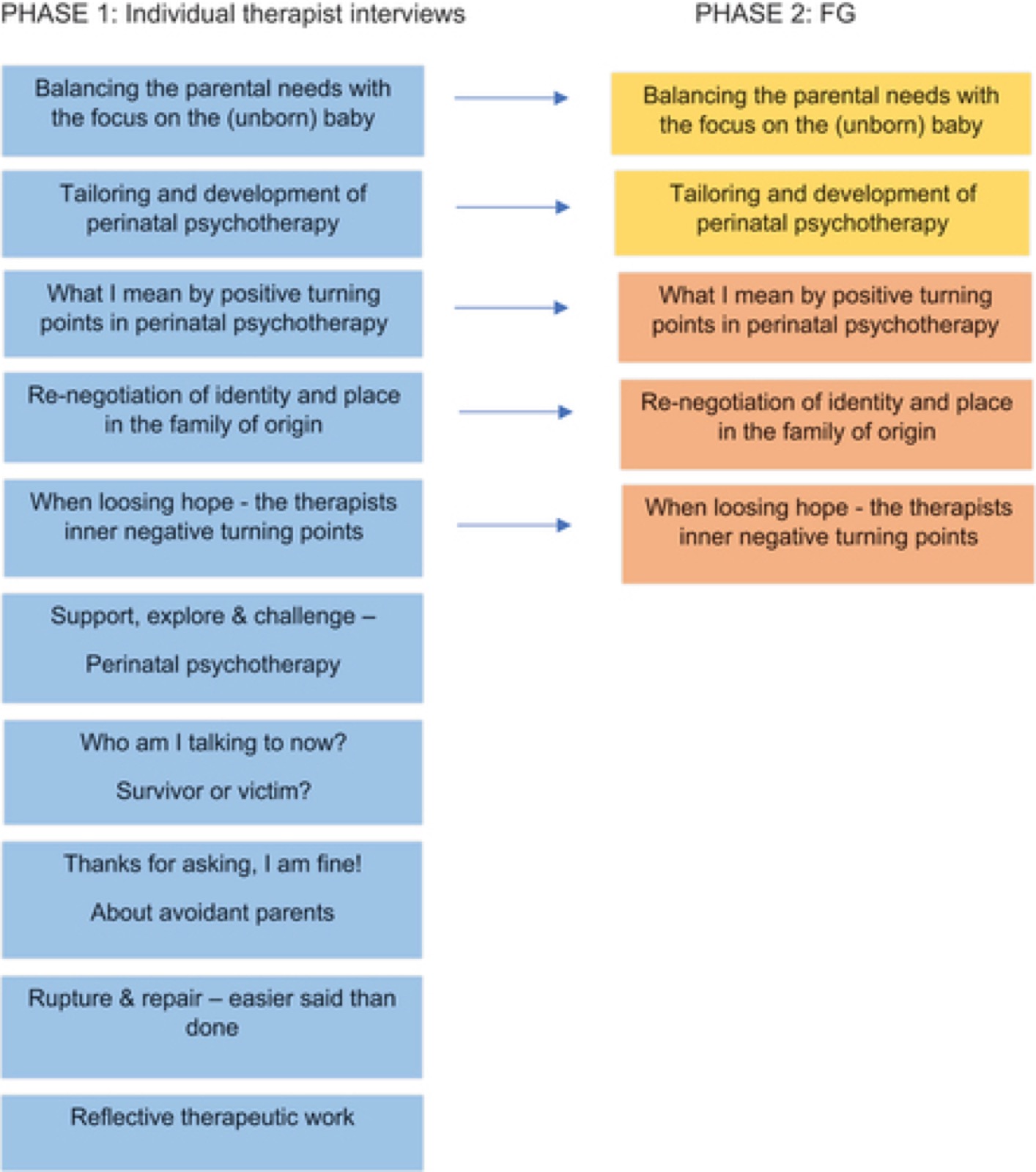
The initial coding of the individual interviews, here marked in blue, constituted phase one of data collection. The second phase of data collection, which constitute the two therapist-chosen themes marked in yellow, and three researcher-chosen themes marked in orange, further explored in the FG.
Data analysis
Transcripts of the audiotaped individual interviews and the FG constituted the data for this study. It was perceived as an aggregated data set and analyzed jointly via a reflexive thematic approach involving familiarization, coding, generating initial themes, reviewing and developing themes, refining, defining and naming themes, and writing (Braun & Clarke, 2021). In a previous article on the same data material, we explored overarching themes in perinatal psychotherapy with families with intergenerational adversities, such as ports of entry to therapy, the importance of a safe enough therapeutic alliance to experience emotional corrective relations, and therapists’ reflective functioning (Fjeldheim et al., 2024). We have narrowed the scope of the present article, focusing on the baby – mother – grandmother relationship and its impact on therapists and therapeutic processes. Owing to the theme`s perceived novelty and relevance for the generational therapeutic work with families with intergenerational adversities, the research team chose to conduct a secondary analysis of the data previously used for the abovementioned article with the following research question: What is it about the radical changes in the mother – grandmother relationship in families with intergenerational adversities that cause such strong emotional reactions and actions in the therapists? How do they understand this phenomenon?
Data extracts were organized into subthemes and shared with the research team. Quotes were chosen to illustrate each subtheme. Because reflexive thematic analysis (TA) is an organic and recursive coding process, the review and development of themes were repeated several times in search of the underlying concepts of the data (Braun & Clarke, 2021). A reflexive writing process was initiated by the first author, who wrote the first manuscript draft for feedback from the research team, followed by several feedback loops, resulting in the first author reviewing and refining the drafts until the final manuscript was submitted.
Credibility checks and reflexivity
The transparency of one’s own situated knowledge is critical when conducting reflexive TA because of the privileging of subjective processes in analytical and interpretative work (Braun & Clarke, 2019, 2021). Which themes and patterns of meaning we can discover will depend on what we are able to recognize (Malterud, 2001). The research team comprised clinicians and researchers within and outside the field of perinatal psychotherapy, enabling both closeness and a certain distance to the phenomenon studied. The first author and main interviewer is a female Norwegian specialist in infant mental health with extensive clinical experience in the field of study and prior knowledge of the therapists involved. This was perceived as helpful in the development of the interview guides as well as the elaboration of potentially vulnerable themes. Shared theoretical and clinical background with the informants was perceived as an advantage due to a common professional language and the shared experiences of the everyday life of a therapist. To address the risk of being too close to the phenomenon and the informants, the second interviewer had no prior knowledge of the therapists or the field of study. Several methodological credibility checks were included throughout the study to increase reflexivity and ensure trustworthiness, transparency and methodological integrity (Levitt et al., 2017; Stiles, 2003). To make epistemological, theoretical and private preferences and preconceptions explicit, the first author used reflexive notes registering feelings, associations and experiences after each interview (Levitt et al., 2017). To ensure transparency in the process and minimize researcher bias, the research team was actively engaged in recurring discussions concerning all phases of the study through consensus meetings and research triangulation (Flick, 2009; Levitt et al., 2017).
Results
The findings presented in this article illustrate the therapists’ experiences with the baby – mother – grandmother relational triangle during perinatal psychotherapy in families with intergenerational adversities. Two main themes with associated subthemes were derived from the data: (1) therapists’ experiences with unexpected changes toward closeness in the mother – grandmother relationship during pregnancy and postpartum and (2) therapists’ attempts to understand why some women change from perceiving their mother as an adverse caregiver to their closest support in their transition to motherhood. See Figure 2 for an overview of the themes and subthemes. Quotes are used to illustrate the themes, with informant numbers used in place of names for the individual interviews to maintain anonymity, and the abbreviation FG is used when referring to the focus group.
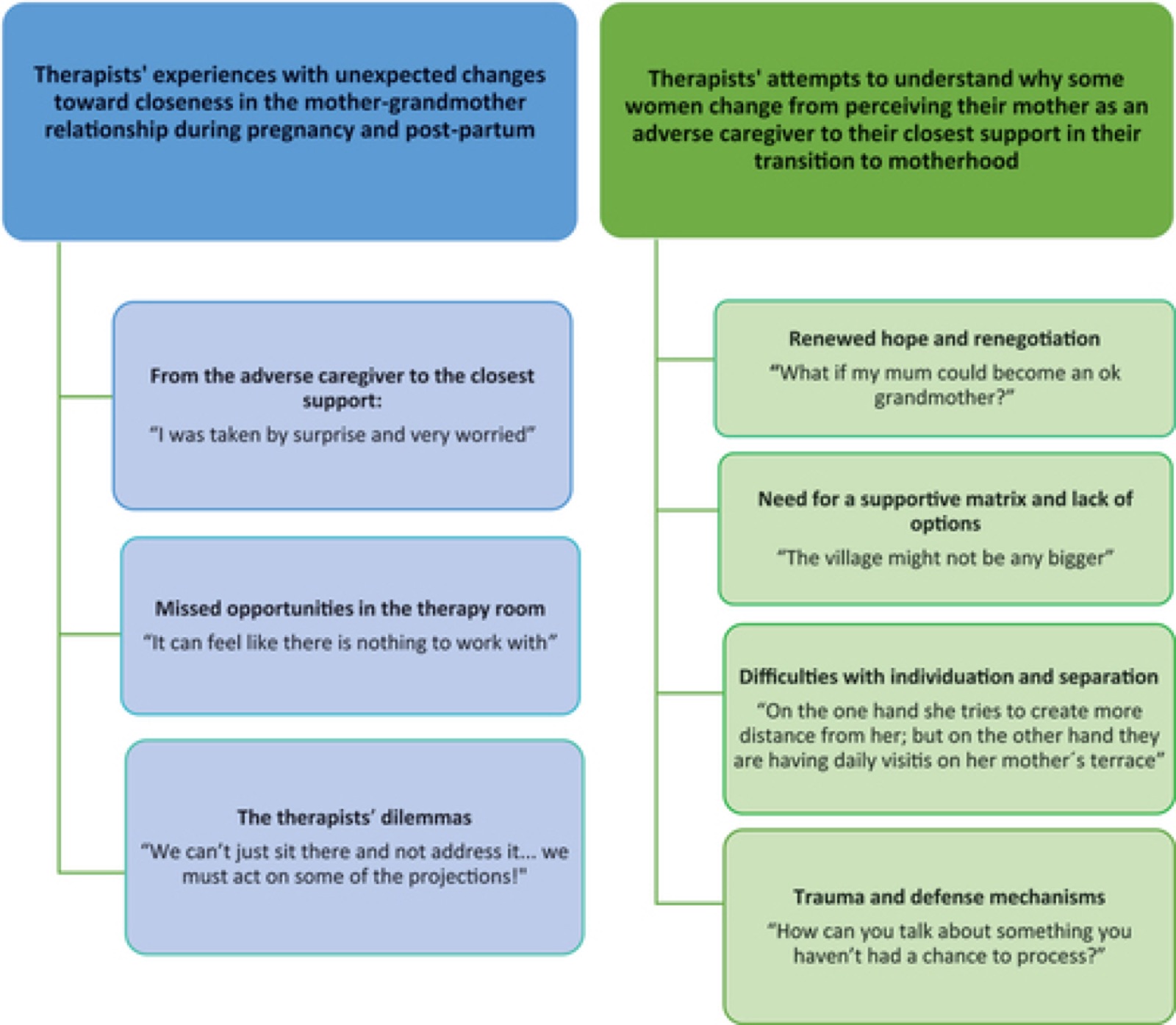
Therapists’ experiences with unexpected changes toward closeness in the mother – grandmother relationship during pregnancy and postpartum
This theme captures the therapists’ reactions to the changes in the mother – grandmother relationship during perinatal psychotherapy and their difficulties in addressing them. This includes the therapist’s initial confusion and worry when learning about the changes and, later, the urge to act upon the worry of the mother and the baby.
From the adverse caregiver to the closest support: “I was taken by surprise and very worried.”
Some of the therapists in the study shared stories of mother – grandmother relationships that changed significantly during therapy. These stories involved women with very negative and adverse childhood experiences within their families of origin. There were stories of incest, neglect, exposure to violence over the years, and living with seriously impaired mothers due to psychiatric symptoms. The predominantly negative accounts of the grandmother-to-be during the early phases of therapy and the mother’s desire to distance herself from her own mother to protect the baby and herself attracted our attention, followed by a sudden relational shift toward closeness nearing and after birth. The therapist’s initial response to this abrupt change was often one of surprise, confusion, or worry.
I worked with one who used a lot of time talking about how her own struggles were caused by her mom and her disorders and that she did not want to become like her mom, that she feared her mom really! Then, I came for a couple of home visits, and suddenly, the baby was sleeping at the grandmother’s place six weeks after birth. I was taken by surprise and very worried that she could do that, since she painted such a negative picture of her mom before birth. She talked about it as if it was completely natural. There was so little reflection, it was more like: ´I was there and checked on her (mother), that she was in good shape and did not drink or take pills` (6)
Missed opportunities in the therapy room: “it can feel like there is nothing to work with.”
In addition to the abruptness of the relational shifts, the women’s lack of reflection about the change affected the therapists. They discussed it as an action without reflection, a move from one extreme to the other in a matter-of-fact way as if there was nothing more to say about the matter.
It can become immature or idealizing like: ´Now we are best friends! Really? How did that happen?` It lacks nuances, and that is exactly what a lot of them struggle with. … It is more like: ‘It is great, nothing to worry about! Now she has learnt, she made a lot of mistakes with me, but now she is completely different. Grandchildren is something totally different than your own children! ` It is as if there is a missing link in the reasoning. (5)
After the initial surprise, the therapists invited the mothers to reflect on the relational change and the need to protect themselves and the baby and navigate the ambivalence of hope and fear they believed the women experienced. These include the hope of receiving understanding, support and validation from one’s own mother and the fear of being rejected once again. However, a shared experience among the therapists was that it was challenging to work reflectively with the theme.
It can feel like there is nothing to work with, that there is nothing more to say. You can try something like: ´Oh you are going over there (to the grandmother)?` And then they respond with: ´Yes, but that`s no problem whatsoever! Because now she is grandmother and that is something totally different. I trust her 100 percent!` And then you think that this is something to talk more about, explore further, but then there is nothing more. They don`t want to talk about it. It is more like, what`s next? … You are left with and become a carrier of quite a few nuances, or reflections or choices that they cannot own, and then the alliance becomes very demanding. (5)
The therapists’ dilemmas: “we can’t just sit there and not address it … we must act on some of the projections!”
Some of the therapists talked about the initial phase of therapy as a time of listening to and empathizing with painful childhood memories and the often ongoing relational struggles that the pregnant women had with their mothers. When some of the women, matter-of-factly, communicated later that they were back on track with their mothers, had moved in with them, or left the baby there overnight, it had an impact on the therapists. They were left with the projections of the women’s feelings, as well as their own worries concerning the safety and well-being of the babies and mothers.
If the mother or the father denies a lot, you must take over the problem as a therapist, because I think it is a problem, and then suddenly you are the owner of the problem and not the other person. It can create strong emotions in you as a therapist, that you become angry and have all sorts of feelings that the other refuses to feel. (FG)
Two of the challenges encountered by the therapists when experiencing abrupt relational changes in the women’s closest relationships were an urge to avoid addressing the theme further and a pull for action.
It is often a little difficult, because a lot of them are vulnerable and self-critical, so raising the issues, wanting to explore what they think about it … ´Now you have said this and then you send the child away to the one you fear the most!`. I find it difficult to really take in and address properly. At times I find myself thinking, this is not good, but she answers so avoidantly, and I feel that I need to keep the alliance and address it later. Scared of hurting and scared of them feeling like bad parents. (6)
We can´t just sit there and listen to it and not address it, but then again there is the question of what to do with it? Sometimes we might act. There is something about reflecting upon how it affects us (therapists). That is the dilemma here that we are not in an individual dynamic therapy where you can lean back and not act on the projections, we must act on some of the projections! But there is something about being conscious about when I act because I believe I must, and when I am acting out of worry or provocation. (FG)
Therapists’ attempts to understand why some women change from perceiving their mother as an adverse caregiver to their closest support in their transition to motherhood
The therapists made a significant effort to make sense of the sudden shifts in the mother – grandmother relationships and their own emotional reactions. They reflected upon different explanations of the phenomena both within the individual interviews and in the follow-up FG, including ideas about normal and expected developmental processes as well as more pathological ones.
Renewed hope and renegotiation: “what if my mum could become an ok grandmother?”
The therapists talked about renegotiating the mother – grandmother relationship as an expected and desired developmental task during pregnancy. This included looking at one’s upbringing more closely and reflecting on what it was like to be parented, the present relationship, and the hope for change.
Sometimes it is important to consider what phase of life they are in, when it comes to resuming relations that we struggle to understand how was repaired. There hasn’t necessarily been a repair either, but they are in a phase of life where there is awakened a lot of hope, that broken relations or betrayals or rejection can become something else. I have quite a few, but they manage to put it into words. They can say that: ´I know that it is very unlikely and now I have been in therapy and have decided that it is not healthy for me, but what if … you know. What if my mom could become a decent grandmother? What if we could have some contact?` There is a lot of hope in such a relation, and a lot happens with it in this phase. (FG)
Need for a supportive matrix and lack of options: “the village might not be any bigger.”
A lack of alternative sources of support due to being a single parent or having a scarce network was believed to contribute to some of the women turning to their own parents despite the costs involved. The need for a supporting matrix when facing changes in pregnancy and childbirth, as well as in the practicalities of life with a newborn, was perceived as a probable explanation by the therapists.
It is a phase where you become very dependent on having someone around. (FG)
The village might not be any bigger, so you will have to use what’s in it. (FG)
Difficulties with individuation and separation: “on the one hand, she tries to create more distance from her; but on the other hand, they are having daily visits on her mother’s terrace.”
Some therapists understood the sudden shift as a consequence of ongoing difficulties with individuation and separation processes with one’s own mother. Renegotiating autonomy and togetherness in an already challenging relationship was believed to be much more difficult than the struggles faced by other women trying to find their place as mothers among mothers. A range of psychological and relational themes are believed to be more challenging for women with high ACEs because of earlier and ongoing experiences of enmeshment and a lack of emotional independence and emotional reactivity in relation to their own mothers. Themes such as self-protection and struggles for independence were believed to play out during pregnancy and postpartum. One of the therapists said:
She described her (mother) as narcissistic, very selfish, and not perceiving other’s needs. She felt that she had never been taken seriously. Never been seen, never heard. She had a lot of examples both past and ongoing. … She tries to create some distance to her mom, that she says she depends upon, but then I receive rather contradictory information, because on the one hand she tries to create more distance from her, but on the other hand they are having daily visits on her mother’s terrace … I think that she tries not to be there so often, at the same time she is ambivalent to it, because that is her mom and what she is used to. (4)
Trauma and defense mechanisms: “how can you talk about something you haven’t had a chance to process?”
One therapist introduced traumatic childhood experiences and the lack of later integration of those memories as a plausible explanation for the unelaborated shifts.
I think that sometimes those with intergenerational difficulties struggle to relate to the normal psychological developmental process, either because it is not processed or if you take on a trauma perspective, that what happened in relation to her own parents is not fully integrated into her identity. Or, that it is kept at a distance, pushed away more or less consciously, because it is too overwhelming to go into. I think it is very worrying, when that process cannot take place, or when there is a lack of thoughts, feelings, and words. How can you talk about something you haven’t had a chance to process? (5)
Another theme that was introduced, but left largely unexplored, was the possibility of different defense mechanisms at play in abrupt relational shifts, such as projection, idealization, denial and splitting.
I think some might be a bit in touch with it, but project it more in a form of shame or cannot bear to explore it, while others might have experiences that it has never been processed or put into words. So they just don’t really get why we wonder about it. Like the following example: ´Now I suddenly have a very good relationship with my parents, and they are grandparents´, and you go: ´What? What happened?` And then they respond: ´Why do you ask about that?` And you understand that it does not resonate in them. (FG)
Maybe that is what`s so concerning, if the patient also becomes very black and white. ´Now, she (grandmother) is completely horrible, or now it is suddenly all good or all bad, because then it isn`t coherent.`(FG)
Discussion
The present study focused on therapists’ experiences working with the baby – mother – grandmother triangle with perinatal women with ACEs. In particular, we explored what may challenge the therapists’ ability to maintain an empathic and reflective capacity. To the best of our knowledge, few qualitative studies have examined these themes. However, there is a rich body of case studies portraying the complexity of perinatal psychotherapy (Baradon & Broughton, 2016; Biseo, 2016; Busch & Lieberman, 2010; Dugmore, 2013; Fraiberg et al., 1975; Jones, 2006, 2009; Joyce, 2009; Matheson, 2011; Slade et al., 2023; Woodhead, 2004).
Some therapists spoke about sudden changes in the mother – grandmother relationship. They shared their emotional reactions to the shifts, reflections regarding possible causes, and their own struggles in therapeutic work. Taken together, these findings provide rich material for further exploration of the processes involved in addressing intergenerational adversities during pregnancy and the postpartum period. The main findings regarding therapists’ experiences with unexpected changes in the mother – grandmother relationship and their attempts to understand these changes are discussed below.
Therapists’ experiences with unexpected changes toward closeness in the mother – grandmother relationship during pregnancy and postpartum
The therapists in the study reported initial surprise and confusion when the women announced their “return to” their mothers nearing and after birth. We are unaware of similar findings in the wider literature that support our findings of the therapists’ reactions. When discussing our findings, a pertinent question is why the therapists in the study were surprised.
To lean into hope more than ambivalence
One line of thought may be that some of the therapists had prioritized and leaned too much into hope for change, instead of attending to a possible “hidden” ambivalence in the women toward their mothers. Siding with hope may have left the therapists vulnerable to the latter blow when the women suddenly reunited with their mothers nearing and after birth. This interpretation stems from some of the therapists` accounts of the early phases of therapy, when some of the women shared their painful childhood memories of their parents and their intentions to protect themselves and their babies from further pain. The capacity to reflect upon one’s own childhood experiences and emotionally identify with oneself as a child is considered key to the breaking of intergenerational adversities and, as such, can be perceived by therapists as hopeful signs of emerging generational change (Fraiberg et al., 1975; Lieberman et al., 2020; Narayan et al., 2020). The pressing need for breaking the generational legacy can make it hard for therapists and women to explore the ambivalence of longing and hoping for support and care, on the one hand, and the need to protect against their own mothers, on the other hand.
What could a different approach to ambivalence look like? A clinical case by Busch and Lieberman (2010) portraying the work with a young woman’s ambivalence in relation to her drug-using mother when becoming a mother herself might offer an alternative approach. The mother-to-be expressed a strong desire to distance herself from the ongoing emotional abuse and neglect from her mother while simultaneously turning to her and maintaining hope of change (Busch & Lieberman, 2010). The therapist responded by addressing her mixed feelings of wanting and needing her mother as a role model while continually being disappointed that nothing has changed. In doing so, the therapist affirmed the duality of the mother’s mental insight and her longing for support and hope of relational change.
The struggle to address abrupt changes therapeutically
After the initial surprise, the therapists in our study wished to help the women reflect upon the mixed emotions of individuation and separation and renegotiate their relationship with their mothers. However, this proved to be challenging for some women, which in turn heightened the therapists’ concern for potential danger for the women and their babies. The therapists especially highlighted the difficulty of engaging the women in reflecting on the abrupt relational changes. Challenges in engaging families with high ACEs in reflective therapeutic work have been described by other authors (Dalley, 2009; Jones, 2009; Slade et al., 2016; Tomas-Merrills & Chakraborty, 2009), which resonate with the findings of this study and may be part of the explanation for the challenge. We have wondered, however, if the lack of some of the therapists addressing the ambivalence at an early stage of therapy could also have contributed to prematurely closing the theme by signaling that it is too painful or difficult to understand why someone can long and hope for something that has been perceived as threatening or damaging. Would they have had a different experience if they had embraced the ambivalence from the beginning? And if so, why didn’t they?
Good grandmother transference and countertransference
When Daniel Stern introduced a framework for therapeutic work with pregnant women, he argued that the work required a caring, sensitive, warm, and engaged therapist as opposed to a more traditional therapeutic role (Stern, 1995). This opened the doors for a more active therapeutic approach offering home visits, giving advice, showing affection, and focusing on capacities and strengths rather than conflicts and pathology (Hoffman, 2004; Imber, 2010; Stern, 1995). Stern argued that the therapist representing the “good grandmother transference” was more fitting to the expecting mothers’ need to feel valued, supported and aided by an older maternal figure (Stern, 1995). The therapists in our study adhered to Stern’s ideas of active and emotionally invested therapists. They offer home visits, give advice on self-care and the baby’s needs, help them contact other services that can address their socioeconomic needs, and offer perinatal psychological treatment.
Authors such as Hoffman (2004), Imber (2010) and Dugmore (2013) argued that there might be a risk in identifying too closely with the “good grandmother transference.” While the “good grandmother transference” was meant to provide mothers with alternative role models contrasting ACEs as well as buffering the fear of being inadequate (Stern, 1995), it can also “mask negative feelings and fantasies to which we must stay alert” (Imber, 2010, p. 489) or undermine important aspects of the work of helping mothers accept ambivalence about themselves, their mothers, and their children (Hoffman, 2004). Containing ambivalent and painful relationships can be challenging for both mothers and therapists; however, as Dugmore eloquently reminds us, “The new mother needs to identify with her own mother and remain in touch with herself-as-child in order to be an understanding and loving mother to her infant” (Dugmore, 2013, p. 61). Most therapists in the study were experienced in the perinatal field, yet they reported experiencing emotional reactions to abrupt changes in the mother – grandmother relationship. One way of understanding this is that the “good grandmother transference” was at play, emphasizing too heavily the protecting and caring aspects of the therapist’s role and, in doing so, risking a limited focus on ambivalence. Another aspect of “the good grandmother transference” is the relation to the real grandmother in the woman’s life. This was not a theme that was explored by the therapists. However, their emotional reactions when the “grandmother – therapist” was “replaced” by the real grandmother as the one to support and care for the mother despite the history of neglect, abuse, and trauma are relevant to explore in further research, not least within a frame of countertransference (Hayes et al., 2018). One can hypothesize that the maternal grandmother’s return can challenge the therapist’s role as caring, protective, and nurturing and possibly activate a range of countertransference reactions in which the therapist’s own relational themes and vulnerabilities may surface (Hayes et al., 2018). As human beings, they all have personal histories with met and unmet needs as dependent infants and daughters to their mothers. In the current study, all the therapists were also mothers, having experienced and negotiated their own transition to motherhood with its inherent complexities in relation to themselves and the grandmothers. Both sections above regarding “leaning into hope more than ambivalence” and “struggles to address the abrupt changes therapeutically” touch upon the possibility that countertransference reactions might have been at play for the therapist, for instance, a primary fear of failing to protect a dependent and vulnerable child – be it the real newborn child, the child within the mother or hidden memories of the therapist herself as a child. There are many possible focuses and layers that may be triggered in therapists working with perinatal therapy because of its emotionally and relationally powerful themes. In various ways, the therapists’ developmental dynamics and current lives can link to and potentially affect their reactions and reflections in their therapeutic work, calling for awareness and management when they act out in countertransference (Hayes et al., 2018). What are their identifications and overidentifications? What are their unresolved conflicts and blind spots? Since the countertransference phenomenon was not described by the therapists in the current study, we do not have data on the specific ways it might have been at play in relation to their experiences of abrupt changes in the mother – grandmother relationship. However, its presence is inevitable (Masterson, 1988) and needs further research in perinatal psychotherapy.
Continuum of risk and threshold for action
Another important aspect in understanding the therapist’s concerns is the fear of real danger to the mother and baby because of their approximation to the grandmother. Examples such as the mother who left the newborn with the grandmother despite fearing for her herself or the risk of ongoing drug abuse by the grandmother while taking care of the baby are examples of real worry. Across perinatal treatment methods, the therapist’s urge to act and the challenges involved in maintaining a reflective stance when working with vulnerable families are widely acknowledged (Dalley, 2009; Lieberman et al., 2020; Slade et al., 2016, 2023; Tomas-Merrills & Chakraborty, 2009).
The therapists in the study had different reactions to the fear of safety. Some avoided addressing the abrupt changes directly, hoping this would deescalate the situation and not cause an alliance rupture, whereas others described an urge and a duty to act upon the worries due to the potential danger involved. Finding a balance between containing, reflecting, waiting, and acting can be extremely difficult. The terms “continuum of risk” and “threshold for action” provide ways of referring to the complexity of these risk assessments (Baradon & Broughton, 2016). There are several times when the urge to act is a valid call for action. Matheson (2011) draws our attention to the interplay between the inner life of the patient and the outside world with its possible risks, with the following words: “Although the focus of psychodynamic psychotherapy is on the internal, psychic world, a therapist working with pregnant women and new mothers may also need to deal with serious problems in the external physical world” (Matheson, 2011, p. 272). By using the example of a young woman smacking her 10-month-old baby while also struggling with rage at her own mother’s abandonment, Matheson addresses the need for risk assessment and handling in perinatal psychotherapeutic work. This is in line with the accounts of other authors in the field, emphasizing the urge to intervene on behalf of the mother and the child to secure their safety and well-being (Baradon, 2009a; Baradon & Broughton, 2016; Slade et al., 2016), resonating with the therapists in the present study.
Therapists’ attempts to understand why some women change from perceiving their mother as an adverse caregiver to their closest support in their transition to motherhood
When the therapists tried to make sense of the sudden approximation of the women toward their mothers during late pregnancy and postpartum, they discussed a range of hypotheses, including expected developmental processes during pregnancy, the need for a supporting matrix and more pathological processes such as unresolved separation – individuation processes, traumas, and defense mechanisms such as idealization, denial, and projection.
Broadening the perspective of normal developmental processes
Pregnant women’s perception of and relationship with their own mother undergoes both reactivation and reorganization in the developmental process and transition to own motherhood (Ammaniti et al., 2013; Dugmore, 2013; Hoffman, 2004; Schechter, 2017; Stern, 1995). The approximation process between the mother-to-be and the grandmother-to-be is part of the renegotiation, as searching for possible models in one’s own life is key to forming a new identity as a mother (Stern, 1995). The therapists’ experience was that these expected relational changes also occurred in some of the mothers with ACEs; however, these changes were more abrupt and less reflected on for some mothers. Some of the women with ACEs also hoped for approximation, acknowledgment, and support from their mothers. They turned to them for help and support when giving birth and taking care of a newborn baby, despite their previous experiences. These processes were more difficult to share and reflect upon, and the relational changes were more extreme and sudden.
Despite their potential importance to intergenerational therapeutic work, these relational struggles have received scarce attention in the perinatal psychotherapy literature. Notable exceptions are Dugmore and Schechter, who eloquently portrayed the complex renegotiation of the mother – grandmother relationship in families with great adversity, and the aforementioned clinical case study of Busch and Lieberman (Busch & Lieberman, 2010; Dugmore, 2013; Schechter, 2017). Their accounts of the alternation between hope and disappointment, reaching out and pulling back from one’s own mother, resonate with the findings of our study.
Supporting matrix
Taking care of a child requires many resources, knowledge, and skills, hence the famous saying, “It takes a village to raise a child.” However, what if you do not have “a village” at your disposal? What if you are a single mother or have a partner suffering from difficulties or a limited network of social support? There is a need to establish a supporting matrix, or village, to meet the increased needs of practical aid, advice, and support accompanying pregnancy and the birth of a baby (Dugmore, 2013; Hoffman, 2004). The main function of the supporting matrix is to protect the mother, provide for her needs, buffer external demands, and provide psychological and educational support (Stern, 1995). The therapists discussed the hypothesis that some women reunite with their mothers out of pure necessity, even though doing so might cost them dearly. This resonates with other authors claiming that the help from the supporting matrix can come at too high a price in terms of the mother-to-be’s self-esteem, autonomy, and dignity (Schechter, 2017; Stern, 1995). The need for support can bring the mother’s own mother back into the life of the mother, even after a long absence.
Generational patterns of separation and individuation
With pregnancy, a new form of separation and individuation takes place to differentiate one from one’s own mother and establish one’s own motherhood (Ilicali & Fisek, 2004; Schechter, 2017; Vizziello et al., 1993). According to Fava Vizziello and colleagues, “the creation of a space for the child and the self-as-mother is linked to the woman’s ability to go one stage further in the separation-individuation process with respect to her own mother” (Vizziello et al., 1993, p. 14). Aspects such as navigating enmeshment and threats of rejection from one’s own mother while striving for autonomy as a new mother (Stern, 1995) are central to intergenerational therapeutic work (Brodén, 2004; Slade & Cohen, 1996; Stern et al., 1998). This is in line with the findings of the present study. Some of the therapists discussed additional difficulties that women with previous or ongoing relational struggles and traumas could face when going from being someone’s daughter to becoming someone’s mother. They specifically addressed the challenges related to separation and individuation in the aftermath of trauma and adversity. The therapists elaborated on what these processes can look like in families with intergenerational adversities. They spoke of some of the women’s expressed desire and attempts to protect themselves and their babies through distancing themselves from their own mother but at the same time reaching out for her or allowing her to draw close. The therapists described these processes as ambivalent, contradictory, and confusing. The dynamic they described resonates with Dugmore’s accounts of challenging and disorganized mother – grandmother relationships due to enmeshment, unavailability, conflict, or bereavement (Dugmore, 2013).
How can patterns of separation and individuation be passed on from one generation to the next? Charles et al. (2001) examined the intersubjective processes within two generations of women and reported that many of the mothers in their study reenacted their own mothers’ negative separation attitudes. Two patterns emerged in their study. The mothers who were unable to access past experiences did not realize how they ignored or infantilized their daughters’ attempts at autonomy, whereas those who were conscious of their own negative separation memories were blind to its repetition in the present (Charles et al., 2001). Applying this knowledge to the therapists’ experiences, we can hypothesize that generational patterns of individuation and separation may contribute to the challenges encountered by some of the mothers referred to in the study. Renegotiation of a relationship is an intersubjective process of growing into new roles and being given permission and space to do so. To witness a daughter become a mother and a mother become a grandmother for the first time is a new experience for both parties involved. The experiences can feed on one another, as both gradually come to acknowledge and accept the changing roles of one another and, as such, provide room for mutual adaptation into new complementary roles. Whether the renegotiation of new roles takes the form of a warm and respectful second individuation or intense battles for independence with themes such as submission, abandonment, criticism, and devaluation at play has consequences for the conceptual shift from daughter to mother and mother to grandmother.
Unintegrated childhood traumas or defense mechanisms at play?
In an attempt to understand the abrupt changes, one of the therapists briefly reflected upon the possible impact of the patients’ unintegrated childhood traumas. This was not a hypothesis that was explored by the other therapists. Nevertheless, it provided an additional way to understand abrupt relational changes. The therapist shared moments in therapy when the women announced that they had done the opposite of the last session’s decisions, leaving the therapist wondering what had happened and realizing that the shared understanding and decision previously communicated was everything other than shared. She spoke of the attempts to elaborate further on what had happened for the mother to completely change her mind and the experience of not getting anywhere because of a lack of access to, or integration of, earlier traumatic parental memories. Denial, idealization, and projection were also perceived as possible explanations for the abrupt relational shifts by some of the therapists, either mentioned in combination with unintegrated trauma or as defensive mechanisms at play. This resonates with the broader literature on the complex work of psychological defenses (Busch & Lieberman, 2010; Fraiberg et al., 1975; Jones, 2006, 2009; Schechter, 2017; Slade et al., 2016; Tomas-Merrills & Chakraborty, 2009). The capacity to reflect upon and reconstruct the story of the maternal relationship as it was and is, with its good and bad parts, is believed to be crucial to challenging the generational legacy of adversities, whereas ongoing evidence of bereavement and lack of resolution of trauma and loss can indicate continued risk (Steele et al., 2009). A way of understanding abrupt changes could be to consider the possible impact of unresolved trauma on the capacity to reflect upon the complex mother – grandmother relationship.
Strengths and limitations
The foremost strength of this study is that it provides rich clinical descriptions of perinatal therapeutic work with families with ACEs. The qualitative design allowed for an in-depth exploration of complex therapeutic themes through individual interviews and an FG interview. There are, however, limitations to note. The choice of a single FG interview, as opposed to several, is a limitation worth mentioning. However, the fact that the data analyzed were explored individually and in the FG strengthens the quality of the collected data.
Another limitation is the sample of informants, which was limited in more than one sense. The sample size was relatively small, and the participants were recruited from the same clinic. They had diverse professional training and therapeutic experience. However, there was little gender, ethnic, or cultural diversity. Although unintentional by the researchers, all the therapists included were mothers and shared the experience of transitioning to motherhood with their patients. A greater diversity among the therapists, including cultural, ethnic and gender diversity, as well as therapists without parenting experience and therapists with experience as grandparents, might have added to the richness of the data and possibly altered the findings.
A third limitation is the limited focus on what the therapists bring to their work, which might impact how they experience their patients’ relational shifts. An explicit exploration of the therapists’ experiences of becoming mothers themselves, their negotiations of the motherhood constellation and their thoughts on their own mothering selves might have provided valuable clinical and research knowledge. An emphasis on the therapists’ potential triggering themes and how they play out in relation to the patients’ struggles with their mothers could also have led to hypotheses other than those explored in this study.
Finally, the lack of focus on the impact of the partner and/or grandfather in understanding the mother – grandmother relational changes is worth noting. It is plausible that relationships with the partner and grandfather, and their level of support offered, can impact the mother – grandmother relationship and the negotiation of the “motherhood constellation.” This was, however, not explicitly explored by the therapists in this study and, as such, represents a limitation to understanding the complex processes involved in negotiating the mother – grandmother relationship.
The findings from the study should be complemented in future studies by the perspectives of therapists with diverse experiences of motherhood and negotiations of the mother – grandmother relationship than the therapists included in this study. It is also highly important to complement and contrast the findings with in-depth studies exploring possible transference and countertransference processes at play during abrupt relational shifts in the mother – grandmother relationship.
Conclusions and clinical implications
The findings from this study suggest that therapists’ empathic and reflective capacity was challenged by abrupt relational changes in the mother – grandmother relationship in families with ACEs during pregnancy and postpartum. Their attempts to make sense of these sudden approximations ranged from expected developmental processes and the need for support to pathological processes involving complicated separation – individuation processes, unresolved traumas, and defense mechanisms such as idealization, denial, and projection. The findings suggest that women with ACEs also renegotiate their relationship with their mothers during pregnancy; for some, however, this renegotiation takes place more abruptly and with less reflection. The hope and need for support, understanding, and acknowledgment from a supportive matrix resemble those of other women transitioning to motherhood but can come at a higher price owing to the challenges related to separation and individuation in the aftermath of traumas and adversities. While not surprising, this can have implications for therapeutic work during pregnancy and the postpartum period. Therapists direct our attention to the challenge of finding a balance between containing, reflecting upon, and acting on the emotions caused by the abrupt relational changes in the mother – grandmother relationship owing to concern about the safety of the mother and the baby. This paper suggests that it can be tempting to lean into the hope of generational change more than ambivalence in the early phases of therapy, risking undermining the work of containing ambivalent and painful relationships. The study underscores the importance of having access to a range of possible explanations for abrupt relational changes in therapeutic work with perinatal women with ACEs requiring knowledge from multiple fields. In terms of training recommendations, this study highlights the importance of broad knowledge of generational trauma, the impact of early adversity on parenting, relational patterns of individuation and attachment across generations, and how these patterns resurface during the perinatal phase. It also focuses on the need for continuous therapeutic development and reflective supervision, in line with other studies (Dalley, 2009; Fjeldheim et al., 2024; Slade et al., 2023; Tomas-Merrills & Chakraborty, 2009; Weatherston et al., 2010), to find the balance between containing, reflecting and acting during critical moments in therapy (Baradon & Broughton, 2016), such as abrupt relational changes in the mother – grandmother relationship.
Patient anonymization statement
Potentially personally identifying information presented in this article that relates directly or indirectly to an individual, or individuals, has been changed to disguise and safeguard the confidentiality, privacy and data protection rights of those concerned, in accordance with the journal’s anonymization policy.
Complexe Systémique: key points
The study finely describes a moment many clinical teams know: the patient who “returns” to the mother she feared, without being able to talk about it. Its systemic strength is to shift the gaze from the patient to the baby–mother–grandmother triangle and to the therapist herself, caught in a “good grandmother transference” that pushes her to protect, to hope, then to act. The key idea, welcoming ambivalence from the outset rather than betting on a break with the family line, is valuable in perinatal work as in family therapy. One can also retain the reminder about the supporting matrix: when the village is small, turning back to one’s mother may be a necessity more than a symptom. The limits are clear: seven therapists from a single team, all mothers, no patients’ voices, and neither partners nor grandfathers in the picture. Read alongside the study of grandmothers in postpartum care, and the article on the transmission of birth trauma from grandmother to granddaughter.
Notes from the original
Ethical considerations/ethics committee approval. The study was approved by the Regional Committee for Medical and Health Research Ethics as part of a more extensive study (97191). As this part is a study of experienced professionals` recollections and reflections about perinatal psychotherapeutic work, there is no contact with patients in the present study. Issues of confidentiality were highlighted, and written informed consent was obtained from the participants before data collection. The participants were informed that their participation was voluntary, that the data collected would be kept confidential and that they could withdraw from the study at any time and without any consequences. The interviews were transcribed accordingly.
Clinical trial registration. NCT 04528589
Acknowledgments. We would like to thank the therapists who participated in the study and the leadership of the CAMHS involved in facilitating and supporting the study.
Disclosure statement. No potential conflict of interest was reported by the author(s).
References
Ammaniti, M., Tambelli, R., & Odorisio, F. (2013). Exploring maternal representations during pregnancy in normal and At-risk samples: The use of the interview of maternal representations during pregnancy. Infant Mental Health Journal, 34(1), 1–10. https://doi.org/10.1002/imhj.21357
Baradon, T. (2009a). Epilogue: ‘ghosts and angels in the nursery’ –windows of opportunity and remaining vulnerability. In T. Baradon (Ed.), Relational trauma in infancy: Psychoanalytic, attachment and neuropsychological contributions to parent-infant psychotherapy (pp. 229–239). Routledge.
Baradon, T. (Ed.). (2009b). Relational trauma in infancy: Psychoanalytic, attachment and neuropsychological contributions to parent-infant psychotherapy. Routledge. https://doi.org/10.4324/9780203856673
Baradon, T., Biseo, M., Broughton, C., James, J., & Joyce, A. (Eds.). (2016). The practice of psychoanalytic parent-infant psychotherapy: Claiming the baby (2nd ed.). Routledge/Taylor & Francis Group.
Baradon, T., & Broughton, C. (2016). Consideration of risk in the parent–infant relationship. In T. Baradon, M. Biseo, C. Broughton, J. James, & A. Joyce (Eds.), The practice of psychoanalytic parent–infant psychotherapy (pp. 115–121). Routledge.
Barnett, M. A., Mills‐Koonce, W. R., Gustafsson, H., Cox, M., & Investigators, F. L. P. K. (2012). Mother‐grandmother conflict, negative parenting, and young children’s social development in multigenerational families. Family Relations: An Interdisciplinary Journal of Applied Family Studies, 61(5), 864–877. https://doi.org/10.1111/j.1741-3729.2012.00731.x
Biseo, M. (2016). Knowing and being known. Parent infant psychotherapy in the face of severe maternal psychopathology. In T. Baradon, M. Biseo, C. Broughton, J. James, & A. Joyce (Eds.), The practice of psychoanalytic parent–infant psychotherapy (pp. 177–186). Routledge.
Braun, V., & Clarke, V. (2019). Reflecting on reflexive thematic analysis. Qualitative Research in Sport, Exercise & Health, 11(4), 589–597. https://doi.org/10.1080/2159676X.2019.1628806
Braun, V., & Clarke, V. (2021). Can I use TA? Should I use TA? Should I not use TA? Comparing reflexive thematic analysis and other pattern-based qualitative analytic approaches. Counselling and Psychotherapy Research, 21(1), 37–47. https://doi.org/10.1002/capr.12360
Brodén, M. (2004). Graviditetens muligheder : en tid hvor relationer skabes og udvikles. Akademisk Forlag.
Busch, A. L., & Lieberman, A. F. (2010). Clinical case study: Good expectations – a case study of perinatal child-parent psychotherapy to prevent the intergenerational transmission of trauma. In C. M. Worthman, P. M. Plotsky, D. S. Schechter, & C. A. Cummings (Eds.), Formative experiences: The interaction of caregiving, culture, and developmental psychobiology (pp. 197–209). Cambridge University Press. https://doi.org/10.1017/CBO9780511711879.015
Charles, M., Frank, S. J., Jacobson, S., & Grossman, G. (2001). Repetition of the remembered past: Patterns of separation–individuation in two generations of mothers and daughters. Psychoanalytic Psychology, 18(4), 705. https://doi.org/10.1037/0736-9735.18.4.705
Dalley, T. (2009). Containment of trauma: Working in the community. In T. Baradon (Ed.), Relational trauma in infancy (pp. 116–129). Routledge.
Dugmore, N. (2013). The grandmaternal transference in parent–infant/child psychotherapy. Journal of Child Psychotherapy, 39(1), 59–75. https://doi.org/10.1080/0075417X.2012.761423
Emanuel, L. (2002). Deprivation x 3: The contribution of organizational dynamics to the ´triple deprivation` of looked-after children. Journal of Child Psychotherapy, 28(2), 163–179. https://doi.org/10.1080/00754170210143771
Fjeldheim, H., Werner, A., Anke, T., Moe, V., Norheim, H. S., & Aalberg, M. (2024). Parenting the parent without losing sight of the child. A qualitative study of therapists’ experiences with intergenerational adversities in perinatal psychotherapy. Infant Mental Health Journal, 45(2), 1–16. https://doi.org/10.1002/imhj.22100
Flick, U. (2009). An introduction to qualitative research (4th ed.). Sage Publications Ltd.
Fraiberg, S., Adelson, E., & Shapiro, V. (1975). Ghosts in the nursery. A psychoanalytic approach to the problems of impaired infant-mother relationships. Journal of the American Academy of Child Psychiatry, 14(3), 387–421. https://doi.org/10.1016/s0002-7138(09)61442-4
Hayes, J. A., Gelso, C. J., Goldberg, S., & Kivlighan, D. M. (2018). Countertransference management and effective psychotherapy: Meta-analytic findings. Psychotherapy (Chic), 55(4), 496–507. https://doi.org/10.1037/pst0000189
Hoffman, L. (2004). When Daughter Becomes Mother: Inferences from multiple dyadic parent–child groups. Psychoanalytic Inquiry, 24(5), 629–656. https://doi.org/10.1080/07351692409349107
Ilicali, E. T., & Fisek, G. O. (2004). Maternal representations during pregnancy and early motherhood. Infant Mental Health Journal: Official Publication of the World Association for Infant Mental Health, 25(1), 16–27. https://doi.org/10.1002/imhj.10082
Imber, R. R. (2010). Treating patients who are parents: The good grandparent transference and countertransference. Journal of the American Psychoanalytic Association, 58(3), 489–511. https://doi.org/10.1177/0003065110375275
Jones, A. (2006). How video can bring to view pathological defensive processes and facilitate the creation of triangular space in perinatal parent–infant psychotherapy. Infant Observation, 9(2), 109–123. https://doi.org/10.1080/13698030600818923
Jones, A. (2009). The traumatic sequelae of pathological defensive processes in parent–infant relationships. In T. Baradon (Ed.), Relational trauma in infancy: Psychoanalytic, attachment and neuropsychological contributions to parent-infant psychotherapy (pp. 75–87). Routledge.
Joyce, A. (2009). Infantile psychosomatic integrity and maternal trauma. In T. Baradon (Ed.), Relational trauma in infancy: Psychoanalytic, attachment and neuropsychological contributions to parent-infant psychotherapy (pp. 82–94). Routledge.
Knorr, D. A., & Fox, M. (2023). An evolutionary perspective on the association between grandmother-mother relationships and maternal mental health among a cohort of pregnant latina women. Evolution and Human Behavior, 44(1), 30–38. https://doi.org/10.1016/j.evolhumbehav.2022.10.005
Levitt, H. M., Bamberg, M., Creswell, J. W., Frost, D. M., Josselson, R., & Suárez-Orozco, C. (2018). Journal article reporting standards for qualitative primary, qualitative meta-analytic, and mixed methods research in psychology: The APA publications and communications board task force report. The American Psychologist, 73(1), 26–46. https://doi.org/10.1037/amp0000151
Levitt, H. M., Motulsky, S. L., Wertz, F. J., Morrow, S. L., & Ponterotto, J. G. (2017). Recommendations for designing and reviewing qualitative research in psychology: Promoting methodological integrity. Qualitative Psychology, 4(1), 2–22. https://doi.org/10.1037/qup0000082
Lieberman, A. F., Diaz, M. A., Castro, G., & Bucio, G. O. (2020). Make room for baby: Perinatal child-parent psychotherapy to repair trauma and promote attachment. Guilford Publications.
Malterud, K. (2001). Qualitative research: Standards, challenges, and guidelines. Lancet, 358(9280), 483–488. https://doi.org/10.1016/s0140-6736(01)05627-6
Malterud, K. (2017). Kvalitative forskningsmetoder for medisin og helsefag (4. utg. ed.). Universitetsforlaget.
Masterson, J. F. (1988). The search for the real self: Unmasking the personality disorders of our age. Free Press.
Matheson, C. (2011). What do women need? Integrating psychodynamic psychotherapy with cognitive techniques in working with pregnant women and new mothers. British Journal of Psychotherapy, 27(3), 272–291. https://doi.org/10.1111/j.1752-0118.2011.01242.x
Narayan, A. J., Atzl, V. M., Merrick, J. S., Harris, W. W., & Lieberman, A. F. (2020). Developmental origins of ghosts and angels in the nursery: Adverse and benevolent childhood experiences. Adversity and Resilience Science, 1(2), 121–134. https://doi.org/10.1007/s42844-020-00008-4
Narayan, A. J., Rivera, L. M., Bernstein, R. E., Harris, W. W., & Lieberman, A. F. (2018). Positive childhood experiences predict less psychopathology and stress in pregnant women with childhood adversity: A pilot study of the benevolent childhood experiences (BCEs) scale. Child Abuse and Neglect, 78, 19–30. https://doi.org/10.1016/j.chiabu.2017.09.022
Sadler, L. S., Slade, A., Close, N., Webb, D. L., Simpson, T., Fennie, K., & Mayes, L. C. (2013). Minding the baby: Enhancing reflectiveness to improve early health and relationship outcomes in an interdisciplinary home visiting program. Infant Mental Health Journal, 34(5), 391–405. https://www.ncbi.nlm.nih.gov/pubmed/24049219
Schechter, D. S. (2017). Witch-mother is which? The potential role of the analyst in facilitating authentic motherhood. International Forum of Psychoanalysis, 26(1), 10–21. https://doi.org/10.1080/0803706X.2016.1195511
Slade, A., & Cohen, L. J. (1996). The process of parenting and the remembrance of things past. Infant Mental Health Journal, 17(3), 217–238. https://doi.org/10.1002/(SICI)1097-0355(199623)17:3<217::AID-IMHJ3>3.0.CO;2-L
Slade, A., & Sadler, L. S. (2019). Pregnancy and infant mental health. In C. H. Zeanah (Ed.), Handbook of infant mental health (pp. 25–40). Guilford Publications.
Slade, A., Sadler, L. S., Close, N., & Fitzpatrick, S. E. (2016). Minding the Baby®: The impact of threat on the mother-baby and mother-clinician relationship. In S. Gojman de Millan, C. Herreman, & A. L. Sroufe (Eds.), Attachment across clinical and cultural perspectives (pp. 182–204). Routledge.
Slade, A., Sadler, L. S., Eaves, T., & Webb, D. L. (2023). Enhancing attachment and reflective parenting in clinical practice. Guilford Publications. https://books.google.no/books?id=DUmczwEACAAJ
Steele, M., Steele, H., & Murphy, A. (2009). The adult attachment interview and relational trauma: Implications for parent-infant psychotherapy. In T. Baradon (Ed.), Relational trauma in infancy: Psychoanalytic, attachment and neuropsychological contributions to parent–infant psychotherapy (pp. 180–194). Routledge.
Stern, D. N. (1995). The motherhood constellation: A unified view of parent–infant psychotherapy. Basic Books.
Stern, D. N., Bruschweiler-Stern, N., & Freeland, A. (1998). The birth of a mother: How the motherhood experience changes you forever. Basic Books. https://books.google.no/books?id=S8bSXKuAHnUC
Stiles, W. B. (2003). Qualitative research: Evaluating the process and the product. In S. Llewelyn & P. Kennedy (Eds.), Handbook of clinical health psychology (pp. 477–499). https://doi.org/10.1002/0470013389.ch24
Tomas-Merrills, J., & Chakraborty, A. (2009). Babies behind bars: Working with relational trauma with mothers and babies in prison. In T. Baradon (Ed.), Relational trauma in infancy: Psychoanalytic, attachment and neuropsychological contributions to parent-infant psychotherapy (pp. 103–115). Routledge.
Vizziello, G. F., Antonioli, M. E., Cocci, V., & Invernizzi, R. (1993). From pregnancy to motherhood: The structure of representative and narrative change. Infant Mental Health Journal, 14(1), 4–16. https://doi.org/10.1002/1097-0355(199321)14:1<1::AID-IMHJ2280140102>3.0.CO;2-S
Weatherston, D. J., Weigand, R. F., & Weigand, B. (2010). Reflective supervision: Supporting reflection as a cornerstone for competency. Zero to Three, 31(2), 22–30.
Woodhead, J. (2004). ‘Dialectical process’ and ‘constructive method’: Micro-analysis of relational process in an example from parent–infant psychotherapy. The Journal of Analytical Psychology, 49(2), 143–160. https://doi.org/10.1111/j.1465-5922.2004.00450.x
Reformatted republication of “As a Grandmother, I Trust Her 100%!” A Qualitative Study of Therapists’ Experiences with Unexpected Changes in the Mother–Grandmother Relationship Among Perinatal Women with Adverse Childhood Experiences, by Heidi Fjeldheim, Teija M. S. Anke, Helen Suizu Norheim, Anne Werner, Marianne Aalberg and Vibeke Moe, Journal of Infant, Child, and Adolescent Psychotherapy, vol. 23, no 4, p. 301-319 (2024), doi: 10.1080/15289168.2024.2409610, under a CC BY 4.0 licence. Edition and layout: Complexe Systémique, September 2026 — the work has been modified under the terms of the licence. Neither the authors nor the publisher are responsible for this edition; the original version prevails.
This is the original article ““As a Grandmother, I Trust Her 100%!” A Qualitative Study of Therapists’ Experiences with Unexpected Changes in the Mother–Grandmother Relationship Among Perinatal Women with Adverse Childhood Experiences”, published in Journal of Infant, Child, and Adolescent Psychotherapy (2024) under a CC BY 4.0 licence. Republished by Complexe Systémique: the author’s text is unchanged; only the presentation has been adapted for reading online, as set out at the head of this page.
Read the original articleHow to cite this article
Fjeldheim, H., Anke, T. M. S., Norheim, H. S., Werner, A., Aalberg, M., et Moe, V. (2024). “As a Grandmother, I Trust Her 100%!” A Qualitative Study of Therapists’ Experiences with Unexpected Changes in the Mother–Grandmother Relationship Among Perinatal Women with Adverse Childhood Experiences. Complexe Systémique. https://app.complexe-systemique.com/en_GB/articles/as-a-grandmother-i-trust-her-100-a-qualitative-study-of-therapists-experiences (Original work published in 2024 in Journal of Infant, Child, and Adolescent Psychotherapy, 23(4), 301-319 (2024); republished in 2024 by Journal of Infant, Child, and Adolescent Psychotherapy, https://www.tandfonline.com/doi/full/10.1080/15289168.2024.2409610)
To go further
- Des aidantes en marge : une étude qualitative des grands-mères dans les soins post-partum et les soins au nourrissonGrandmothers after the birth.
- De la grand-mère à la petite-fille : une étude phénoménologique de la transmission intergénérationnelle des expériences traumatiques de l’accouchementThree generations and childbirth.
- Explorer le regard des parents et des équipes professionnelles sur une approche de psychothérapie parent-nourrisson dans le nord-est de l’AngleterreParent–infant psychotherapy.
Related training courses
 Certifying course
Training in Systemic Therapy and Interventions – Cycle 1
Certifying training cycle in systemic therapy and interventions – year 1. Courses, supervision and practice, aligned with EFTA/SFTF. In French.
 Certifying course
Training in Systemic Therapy and Interventions – Cycle 2
Certifying training cycle in systemic therapy and interventions – year 2. Clinical complexity, supervision and practice. EFTA/SFTF aligned. In French.
 Certifying course
Training in Systemic Therapy and Interventions – Cycle 3
Certifying training cycle in systemic therapy and interventions – year 3. In-depth intervention, supervision and practice. EFTA/SFTF aligned. In French.
 Certifying course
Training in Systemic Therapy and Interventions – Cycle 4
Certifying training cycle in systemic therapy and interventions – year 4. Clinical integration, supervision and certification. EFTA/SFTF. In French.
Related articles
 Article
 “One Can Have All Sorts of Good Intentions but Sometimes in Everyday Life, It Turns Out Differently”: Change Agreements in Couples' Everyday Lives
Six Danish couples followed after an online couple program: their change agreements become guilt-inducing contracts, shared understanding or revealers of inequality.
 Article
 How can we BeST? meet the needs of adoptive families? Relevant findings from a major Randomised Controlled Trial of infants in foster care in the UK
The BeST? trial (488 infants in care in the UK) reread for adoption: holistic, ongoing assessment of children and a move to dual registration.
 Article
 Internal Family Systems Therapy as Part of the ‘Family of Systemic Therapies’: A Critical Exploration of Systemic Practice in the Intra-Personal Domain
Does IFS belong to the family of systemic therapies? A critical exploration, grounded in a family court vignette, of systemic work with “parts”.
 Article
 The Role of Parental Expressed Emotion and Loss-Specific Parental Responses in Children’s Loss-Related Outcomes Following Traumatic Loss: A Mixed-Methods Observational Study
After a road-traffic bereavement, parental criticism goes with the child's depression, positive appraisals of the loss with better well-being.