Red Sistémica · Couple therapy
The instability of the conjugal bond
The couple, assumed to be for life, ends up breaking in almost one case out of two. Should we be alarmed by this, or see in it a normal stage of family life? What are today the legitimate expectations of the conjugal couple, and is a lasting couple still viable? Irene Loyácono sets in tension the models of love inherited from the sentimental revolution of Modernity, questions of gender, the burdens of raising children and the contributions of the neurosciences, in order to move beyond the idealisation of love without falling into relational cynicism.
“In order to feel good, it seems more effective to stay alive within the couple than to ask the other: make me happy.”
Irene Loyácono
I shall speak here of heterosexual conjugal couples from the urban middle classes, married or living together. Homosexual couples share certain characteristics with them, but they are somewhat different, and the same goes for couples from other social milieus.
Couples were better in the old days
The continual change of social practices modifies both the ideal models and the relational practices within the conjugal couple. We constantly encounter mixed, hybrid ways of living, which invite us therapists into a permanent process of reflection on and revision of our theories and our criteria. This paper would like to be a partial response to that invitation.
For some time now we have been observing a growing instability of couple bonds: the couple, assumed to be for a whole lifetime, ends up breaking in almost one case out of two.
For some, this instability is worrying: not only does conjugal rupture, experienced as a failure, bring a great deal of suffering to those who go through it, but it also disrupts the setting in which children are raised, jeopardising what are assumed to be the healthiest conditions for their growth.
For others, divorce, far from being a failure, is one of the normal stages of family life. Those who think this way maintain that fidelity and monogamy (as well as monoandry) are abstract creations of Modernity, which in certain cases could be sustained when life expectancy was around fifty years, but which are impracticable today, when one has time to live two loves “for a whole lifetime”, or more.
A few questions about the models
What are today the legitimate expectations of the conjugal couple? Is a lasting conjugal couple viable?
Clinical vignette: Ariel
Ariel is 37, a successful professional; he is married and the father of two little girls of 6 and 4. He asks for couple therapy and says, very distressed: “I don’t love Guadalupe any more, and the idea of spending the rest of my life with a woman I don’t love is unbearable to me. I have the right to look for a great love, and I want it… But I got married for a whole lifetime; the idea of having a conjugal failure is killing me.” And he adds: “My girls are very small, I can’t leave them with a broken family…”
The tension between the different models is no less harmful for being obvious. In consultation we continually encounter various states of transition between more traditional legalities and more current models, not only from one client to another, but also, as in Ariel’s case, within the internal world (the belief system) of one and the same client.
Love in order to be happy
We consider marriage for love to be a conquest of freedom. In Civilization and Its Discontents, Freud (Freud, 1968) notes that the human being “takes love as the central point and expects the greatest satisfaction from loving and being loved”. Sexual love was at that time considered the method par excellence for attaining happiness. And that idea still retains all its force today.
And yet…
We know that this romantic way of forming couples, born a little more than two hundred years ago out of what Shorter called the sentimental revolution of Modernity (Shorter, 1977), far from strengthening the conjugal relationship, has contributed to its instability by increasing and complicating the expectations with which one enters the bond. We know that, when expectations increase, it is easier to be frustrated. We have learned the hard way that “love is never enough” (Beck, 1990).
Love
But which love are we talking about? Passionate love, romantic love. That kind of delicious folie à deux. Now, how is one to hold a couple together over the long term, still less a family, with the illusory fabric of falling in love which, to be worth the trouble, has to be blind? Perhaps that is why some people, like that Pakistani political leader last year, still resort to marriages arranged by their elders. Or why, in versions that are now cybernetic, one goes looking for the wisdom of a computer.
To come back to the state of being in love, the psychologist Cindy Hazan, a specialist in the psychology of attachment at Cornell University in New York, states that “human beings are biologically programmed to remain in love for 18 to 30 months”. After interviewing and studying 5,000 people from 37 different cultures, Hazan posited that love has a “lifespan” long enough for the couple to get to know one another, mate and have a child. “In evolutionary terms,” she states, “you don’t need thrilling emotions.” (Hazan, 2006)
Yet things do not stop there. To the relief of our romantic hearts, Hazan specifies that, when passion declines, the brain starts producing another type of endorphins, linked to less burning manifestations of love: companionship, affection, trust (what she calls “mature love”).
Being in love
From 18 to 30 months according to Hazan: a lifespan just long enough for the couple to get to know one another, mate and have a child.
“Mature love”
When passion declines, other endorphins take over: companionship, affection, trust.
These findings correlate with another aspect that psychoanalysis had brought out: passion, because it is subject to the law of jouissance, is formally incompatible with happiness. In Assoun’s words: “Love is the most powerful of the techniques of happiness, but it undermines happiness with maximum efficiency” (…), since “love entails a risk correlative to its jouissance: that of the ego emptying itself for the benefit of the object”. Given that love implies a “contract” consisting in making oneself the Object of the other, the loving couple is formed not so much as an intersubjectivation as a reciprocity of “making oneself an object”. But being an object does not guarantee happiness; it rather exposes us to a great risk of suffering. “The lover has the impression, not entirely unfounded, that the other is swallowing him.” (Assoun, 2006)
Faced with these risks, an alternative and more postmodern way of approaching the couple is what Bauman (Bauman, 2005) calls liquid love: in an environment as fluid as ours, “committing oneself to the future is as impossible as it is offensive”, and the most current relational model would rest more on the “wish” than on love and desire. For in a culture that promotes “instant satisfaction”, sowing, cultivating and nourishing desire takes an unbearably long time. Whereas, when it is inspired by the wish, the relationship follows the model of consumption and requires only the skill of an average, moderately experienced consumer. Like other products, the relationship is destined for immediate consumption (it demands no additional or prolonged preparation) and for single use, that is to say, it is disposable.
I think we have all experienced the emptiness brought to us by the clients who practise this relational model.
Questions of gender
Staking everything on love no longer has a good press. But “let a love make me happy” is what everyone expects, with a binary logic: either it makes me happy, or I have failed.
This is particularly true for women. That is what the bolero used to say: a woman who does not give herself to love does not deserve to be called a woman. We cannot deny that gender practices have changed a great deal today. Nor that the definitions of the feminine and the masculine have mutated. And we could say with the same justification, even if it does not rhyme: “a man who does not give himself to love does not deserve to be called a man… he is an affective impotent (an alexithymic)”.
Generally speaking, what we meet today are women who stand upright, more or less sure of themselves, fighting for their full citizenship, and men who are “more or less disoriented and unsure of themselves, in search of the lost identity and of a strong identificatory referent, but one that is founded neither on inequality nor on violence” (Ibarra Casals, 2006).
In any case, let us agree that, with honourable exceptions, the well-being of the family still rests far more on women’s shoulders than on men’s. Children, the elderly and the sick remain, with overwhelming frequency, women’s business. Although gender equity is no longer disputed as a social value, we cannot say that this equity has been fully achieved.
Yet it is increasingly evident that women are no longer so willing to set themselves aside, which, incidentally, does contribute to their own mental health and to that of their family. But it is not so simple. Precisely because of this transition, we continue to find deeply inscribed in older women, but also in young ones, those ideals of maternal love (unconditional, altruistic, sacrificial) not only towards their children, but also towards their spouse. I don’t know whether it is worth pointing out that this type of maternal love gradually ceases to be necessary and useful as the children leave childhood and go through adolescence.
Moreover, our erotic model, and Jessica Benjamin analyses this very finely (Benjamin, 1996), continues to interweave love and domination. A domination (preferably in the man’s favour) which is very visible in the possessive control of situations of conjugal violence, but which also shows through in exchanges as everyday as this loving question: “whose is this little mouth?” This time, the question can also be asked by women. The expected answer being that the person addressed should say: “it’s yours”.
Conjugal love and raising children
I mentioned that the concern about the fragility of the bond also involves the family that raises children. Given that human reproduction still takes place in family contexts, the fragility of the conjugal couple also confronts us with the social problem of raising children.
Children still need, in order to develop, an enormous flow of affection and assistance, which translates into time, energy and also money. The first two contributions (time and energy) have traditionally been taken on by women. Today a woman is expected to have a professional career and bring in money as well, and a man to be a loving and giving father without ceasing to provide. Children still need a calm and stable environment, but the configurations of the labour market remain incompatible with family life and with an equitable distribution of domestic work and of raising children. The result, almost inevitably, is the female double day and the growing malaise, as well as the anger, of women who, as we have said, are no longer so willing to set themselves aside.
But when women no longer choose to set themselves aside, who will do it? There is a very great social debt here towards women. Those who help raise the children are generally other women (grandmothers, domestic employees who in turn leave their own children in the care of other women, and so on).
The gender factor is at work in many of the misunderstandings of family life. I shall not dwell on it here, since it is not the theme of this article, but I want to stress that I consider indispensable both the therapist’s training in gender issues and personal work on his or her own gender ideology, so as to be able to detect the prejudices and blind spots that perpetuate conflicts and/or legitimise sexist attitudes and conduct within the family.
Raising children and adolescents demands an enormous amount of work and many overwhelming decisions; it is easier, or at least one is better accompanied, to raise them as a couple. We know that divorce in itself does not necessarily destroy children, but we also know that the dynamics of a binuclear or stepfamily are much more complex, without being necessarily more pathological, than those of the nuclear family. Hence the legitimacy of trying to preserve the existing couple as long as it remains viable.
A look from the side of the neurosciences
What are we, as human beings, looking for? The neurosciences bring a view that sheds light on certain aspects. We know that neurobiology phylogenetically distinguishes three brains, and that it designates the limbic brain, the mammalian brain, as the regulating centre of our being-in-the-world.
As Maturana has very rightly stressed, humans, as mammals, are beings of attachment: we need to be in attunement with another human being (or at least with another sentient being; for some people it is more accessible to be in attunement with their pet than with another human). To obtain attunement and regulation from our relationships, the neurobiologists tell us, are necessary elements of our well-being.
Indeed, loneliness, the absence of significant relationships, impoverishes and destabilises us; and when the deprivation is extreme, it can go so far as to drive us mad and to kill us.
New contributions are proving very interesting. The discovery, for example, of a “heart brain” (Armour, J. and Ardell, J., 2006), a neurological centre located in the heart and endowed with a magnetic field 5,000 times greater than that of the brain, or the discovery of the electrotonicity of brain waves, whereby the brain frequencies of partners synchronise, shed light on the microphysics of this relational regulation. They also give a biological correlate to old knowledge of psychotherapists: the value of personal encounter, what we used to call the corrective emotional experience, or the non-specific factor that makes different psychotherapies produce similar results; and even the reason for the ineffectiveness of merely reading self-help books in order to resolve psychological problems. They would also call into question the effectiveness of online therapies.
Finally, the neurosciences teach us that humans have the capacity to restructure one another’s limbic brain. We are regulated from the outside: in order to live in good health and to heal when we fall ill, we need a source of external stabilisation, the presence of other significant beings and interaction with them.
The malaise
I think we can agree that the malaise in culture is today writ large. Partly because we live in a fluid world (Corea, C. and Lewcowicz, I., 1999), centred on the signifier money, which takes no account of our personal needs and which flows at a speed that conspires against our biological rhythms, given that relationships are not fast food. This is a cause of the malaise that we might call “objective”.
But, as our theories and our practices show us, malaise is also intrinsic to human relations. Far from being a pathology, a relative disagreement, a relative malaise, is the very form that real bonds take.
In a very fine paper, Seiguer and Moguillanski write: “There is a violence intrinsic to every bond of love, which is born of the tension between the tendency to merge into one and the existence of inextinguishable differences of otherness (…), the violence of failing to recognise the different existence of the other and of feeling that the other fails to recognise one’s own.” The health of the bond will depend on the possibility of accepting difference as diversity (Seiguer and Moguillanski, 2005).
The trap of “make me happy”
We were saying that we have long known that love is not enough. But that humans go on trying to build stable couples founded on love.
How can we move beyond the idealisation of love without falling into relational cynicism?
Spinoza taught us that no one knows what a body can do (Spinoza, 1980). If there is a passion for living together (Maturana, 1980), relationships can be recreated. Human beings are of an unimaginable complexity. We have an infinity of facets that can be activated at different moments, bringing that touch of novelty capable of awakening desire.
In order to feel good, it seems more effective to stay alive within the couple than to ask the other to “make me happy”. Staying alive means not switching off when you come home. Keeping a certain humour, a certain capacity for play, a certain acceptance of the other (and not merely tolerance), and a good dose of curiosity. Staying alive would mean not expecting everything from the other and having interests of one’s own, in areas capable of being sources of extra-amorous gratification. And not forgetting a little mystery: Rosa, a mature woman, would answer certain questions from her husband with the formula “that’s a thousand-year-old secret”, and this had turned into a game that stimulated the fantasy of them both.
In order to preserve the couple’s vitality, a periodic “overhaul” or tune-up also seems to help: in the form of readings, psychological guidance, reflection groups, workshops, experiences or laboratories that put one in contact with the creative and constructive facets of one’s own personality. Just as people devote time to their professional development, by attending a congress for instance, they should also schedule stimulating activities for this relationship that “has to make me happy”.
I like the metaphor of love as a collaborative work of art. Human beings arrive in the world unfinished and must go on cultivating and creating themselves, finishing themselves by hand, in a process that stops only with death. The same is true of the couple.
Key takeaway
A relative malaise is not a pathology of the bond: it is the very form that real bonds take, and the health of the bond lies in the possibility of accepting difference as diversity. Hence the shift proposed: to stop expecting the other to make us happy, and to stay alive within the couple – humour, play, acceptance, curiosity, interests of one’s own, a little mystery – treating love as a collaborative work of art, never finished.
Note from the original
Article originally created for the 7th Congress of the Buenos Aires Association of Systemic Psychotherapy 2006, 5th Pan-American Congress of Systemic Therapy. Round table: Current concerns in couple therapy.
Who is Irene Loyácono
Irene Loyácono is a psychologist. Therapist, and trainer of couple and family therapists. Director of CeTEF (www.cetef.org.ar).
References
Armour, J. and Ardell, J. (2006) – Neurocardiology. Oxford University Press, New York, 1994, cited by David Grand in the “Brainspotting” seminar, Buenos Aires, July 2006.
Assoun, Paul Laurent (2006) – La pareja Inconciente. Amor freudiano y pasión poscortés. Buenos Aires, Nueva Visión.
Bauman, Zygmunt (2005) – El amor líquido. Buenos Aires, Fondo de Cultura Económica.
Beck, Aaron (1990) – Con el amor no basta. Barcelona, Paidós.
Beck, Ulrich and Beck-Gernsheim (2001) – El normal caos del amor. Barcelona, Paidós.
Benjamin, Jessica (1996) – Los lazos de amor. Psicoanálisis, feminismo y el problema de la dominación. Buenos Aires, Paidós.
Burin, M. and Meler, I. (1998) – Género y familia. Buenos Aires, Paidós.
Corea, C. and Lewcowicz, I. (1999) – ¿Se acabó la infancia? Buenos Aires, Lumen.
Coria, Clara (1989) – El dinero en la pareja. Buenos Aires, Grupo Editor de América Latina.
Freud, Sigmund (1968) – El malestar en la cultura. Obras Completas, vol. III, Buenos Aires, Biblioteca Nueva.
Hazan, Cindy (2006) – http://www.zoominfo.com/search/PersonDetail.aspx?PersonID=18971608
Ibarra Casals, Darío (2006) – En la búsqueda de una identidad. Subjetividad masculina en psicoterapia. 8th Conference on Psychoanalysis and Gender of the APBA, 2006.
Kuriyama, Shigehisa (2005) – La expresividad del cuerpo. Madrid, Ediciones Siruela.
Lewis, Th., Amini, F. and Lannon, R. (2001) – Una Teoría general del Amor. Barcelona, RBA Libros.
Loyácono, Irene – Contexto, Familias, Teorías y Terapeutas. Actualidad Psicológica journal, year XXIV, no. 279, Buenos Aires.
Loyácono, Irene (1990) – Las cosas del decir y la pareja. www.cetef.org.ar
Loyácono, Irene (1996) – La pareja y la ira femenina. Paper given at the 2nd Conference of the APBA Forum on Psychoanalysis and Gender, Buenos Aires. www.cetef.org.ar
Loyácono, Irene (2001) – Round table: Familias siglo XXI. Fortalezas y debilidades. SIP Congress, Santiago de Chile, July-August.
Loyácono, Irene (2003) – Terapia constructivista con enfoque familiar, un modelo articulador. 11th Argentine Congress of Psychology, San Juan.
Loyácono, Irene (2005) – Familias Ensambladas. Symposium: Family therapy in the middle classes in Buenos Aires, 4th World Congress of Psychotherapy, Buenos Aires, August 2005.
Maturana, Humberto, Mendez and Caddou (1980) – Cómo se engendra la patología. SATF paper, 1998.
Roudinesco, Élisabeth (2003) – La Familia en desorden. Buenos Aires, Fondo de Cultura Económica.
Seiguer, G. and Moguillanski, R. (2005) – La Violencia en los Vínculos Familiares. Symposium: Family therapy in the middle classes, APRA Congress 2005, Buenos Aires.
Shorter, E. (1977) – El nacimiento de la familia moderna. Buenos Aires, Crea.
Spinoza, Baruch (1980) – Ética. Madrid, Editorial Hyspamérica.
Torrado, Susana (2003) – Historia de la familia en la Argentina moderna (1870-2000). Buenos Aires, Ediciones de la Flor.
Wainerman, Catalina (2003) – Conyugalidad y paternidad. ¿Una revolución estancada? International seminar, Universidad de la República (Uruguay) and CLACSO.
Wallerstein, J. (2001) – El sorprendente legado del divorcio: un estudio de seguimiento a 25 años. Buenos Aires, Editorial Atlántida.
This article is an English translation of “Inestabilidad del vínculo conyugal”, published by Red Sistémica (first published in VIIe Congrès de l’Association de psychothérapie systémique de Buenos Aires – Ve Congrès panaméricain de thérapie systémique, table ronde « Préoccupations actuelles en thérapie de couple », 2006). Translated and republished with the journal’s permission.
Read the original articleHow to cite this article
Loyácono, I. (2022). The instability of the conjugal bond (Complexe Systémique, Trans.). Complexe Systémique. https://app.complexe-systemique.com/en_GB/articles/the-instability-of-the-conjugal-bond (Original work published in 2006 in VIIe Congrès de l’Association de psychothérapie systémique de Buenos Aires – Ve Congrès panaméricain de thérapie systémique, table ronde « Préoccupations actuelles en thérapie de couple », 2006; republished in 2022 by Red Sistémica, https://redsistemica.ar/2022/08/08/inestabilidad-del-vinculo-conyugal/)
To go further
- What you need to know about couple therapy: reflections for couples and professionalsWhat one can legitimately expect from couple therapy, extending the questions raised here about conjugal models.
- The couple's life cycle: a clinical compass for navigating marital crisesConjugal crises read as stages of the life cycle rather than as failures.
- Separating without destroying each other: what no one tells you about couple separationWhen the couple is no longer viable: supporting the break-up without reducing it to a failure.
Related training courses
 Webinar
Extramarital affairs: what does the therapist do when the couple explodes?
Free webinar: how to position yourself as a systemic therapist in the crisis of the extramarital affair. Revelation, secrecy, multipartiality.
 Webinar
The three loves
Free live webinar with Dr Robert Neuburger, 1 October 2026, 6 pm (Paris): the three loves, attachment and ways of loving. Held in French.
 Certifying course
Training in Systemic Therapy and Interventions – Cycle 1
Certifying training cycle in systemic therapy and interventions – year 1. Courses, supervision and practice, aligned with EFTA/SFTF. In French.
 Certifying course
Training in Systemic Therapy and Interventions – Cycle 2
Certifying training cycle in systemic therapy and interventions – year 2. Clinical complexity, supervision and practice. EFTA/SFTF aligned. In French.
Related articles
 Article
 The AFFIRM Model for Navigating Challenges in Continuously-Interfaith and Divergent-Interfaith Marriages
Thirty happy interfaith couples describe how they navigate their religious differences: five processes, from respecting each other’s choices to religious intimacy, gathered in the AFFIRM model.
 Article
 Toxic, narcissistic, borderline: what therapy speak does to your relationships
Narcissistic, borderline, toxic: therapy speak has left the consulting room. Julien Besse shows how these labels close the debate and relieve us of our own part.
 Article
 Rebuilding trust after infidelity: the 5 behaviours that repair
Infidelity does not doom a couple, but surviving it owes nothing to chance. Five behaviours that restore trust after a betrayal, from a couple therapist’s practice.
 Article
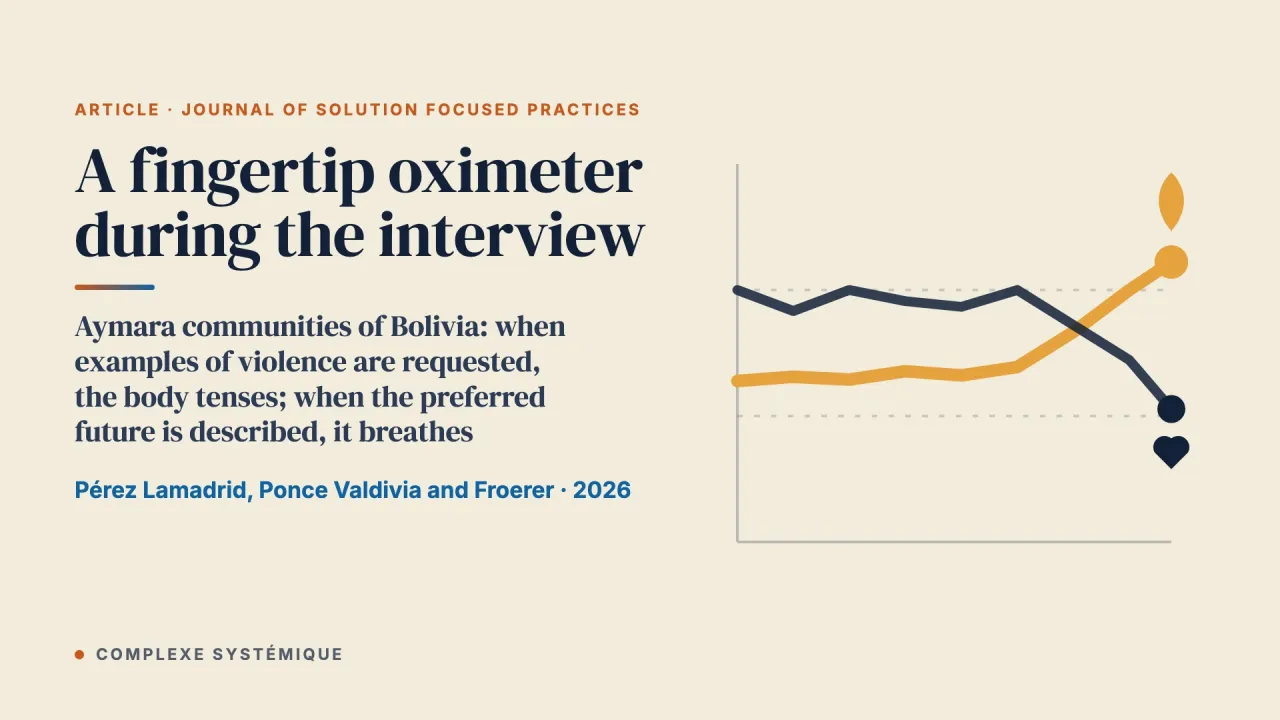
 Oxygenation and Heart Rate in Solution-Focused and Problem-Focused Interviews With Rural and Indigenous Aymara Communities (Viacha and Laja) Regarding Intersectional Violence
A fingertip oximeter on 19 Aymara people of the Altiplano: the problem-focused interview tenses when examples of violence are requested; the solution-focused one oxygenates and slows the heart.
Comments 0
Log in to join the discussion. Log in